
Chimney Sweep & Fireplace Service in Denison, TX
From 1890s railroad-town Victorians a few blocks off Main Street to newer builds out toward the lake, Denison chimneys are older and more varied than most of North Texas. We photograph everything we find.
LOCALLY BASED IN DFW
We drive to you, no national call center
WRITTEN PHOTO REPORT
Every finding shown before it is quoted
SAME-WEEK SCHEDULING
Booked in days, not weeks
OWNER-ANSWERED PHONE
The person who answers is the person who comes
A crack running through hundred-year-old brick. A musty smell from a fireplace nobody has lit in decades. A flue that may never have had a liner in the first place. Denison houses raise chimney questions that newer suburbs never have to ask.
Local Chimney Experts is new to the trade in Denison, and we will not pretend otherwise. What we offer instead is careful work and photos of everything we find, before and after, so nothing rests on our word alone. If nothing is wrong, that is the report you get.
This page is about Denison homes specifically: what a railroad town’s housing stock means for its chimneys, what North Texas weather does to old masonry, and what to watch for in yours.
YOU SEE WHAT WE SEE
You cannot see your own chimney. That is the whole problem with this trade, and it is why people feel talked into things.
Every visit ends with photographs of what we found, walked through with you before anything is quoted. If the pictures show nothing wrong, that is the report you get.
- Camera up the flue, not a guess from the hearth
- Every finding photographed before it is quoted
- The same spots photographed again after the work
- Written report in your inbox the same day
A Town Laid Out in 1872, With the Chimneys to Match
Denison exists because of the railroad. The Katy, the Missouri-Kansas-Texas line, platted the townsite in 1872 where its tracks would cross the Red River into Texas, and the first train rolled in that Christmas Eve. The town that grew up around the depot built fast, in brick and wood.
That history is still standing. A few blocks off downtown, streets like West Sears and West Morton carry wood-frame Victorians from the 1890s. The Eisenhower Birthplace State Historic Site preserves one of the plainer houses from that same decade on the east side, near the tracks, in what was then a working-class railroad neighborhood.
Houses that age come with true masonry chimneys: soft brick, lime-based mortar, and often no liner at all if the flue was never updated. None of that means the chimney is unsafe. It means nobody should light a fire in it without knowing its actual condition first.
What Old Brick Needs, and What Hurts It
Brick fired in the 1890s is softer than modern brick, and the lime mortar between it is softer still. That is not a defect. The wall was built to flex and breathe, and it has been doing both for 130 years.
The damage usually comes from well-meant repairs. Hard modern mortar smeared into old joints traps moisture and pops the faces off soft brick. A coat of paint or the wrong sealer does the same thing from the outside. On houses this age we would rather show you photos of exactly which joints are failing than grind out everything in reach.
Inside the flue, the question is simpler: is there a continuous, sealed path for smoke from the firebox to the sky, or are there open joints and gaps hiding behind the wall. A camera answers that in one visit, with pictures you keep.
We Cover Denison.
Tell us what you are seeing and we will tell you which visit it needs.
Clay Soil, Freeze-Thaw, and Hail: The Denison Weather Bill
North Texas clay swells when it rains, shrinks in the summer heat, and moves foundations as it goes. A masonry chimney is the heaviest, most rigid thing on the house. On a Denison Victorian that has been riding that soil since the 1890s, the lean is sometimes visible from the street. A gap opening between chimney and wall started in the ground, not in the brick.
Winter does its part. Denison sits at the top of US-75, the last Texas town before the highway crosses the Red River into Oklahoma, and northers moving down the plains reach the Red River before they reach Dallas. Each hard freeze pushes water a little deeper into cracked crowns and open mortar joints, where it expands and pries.
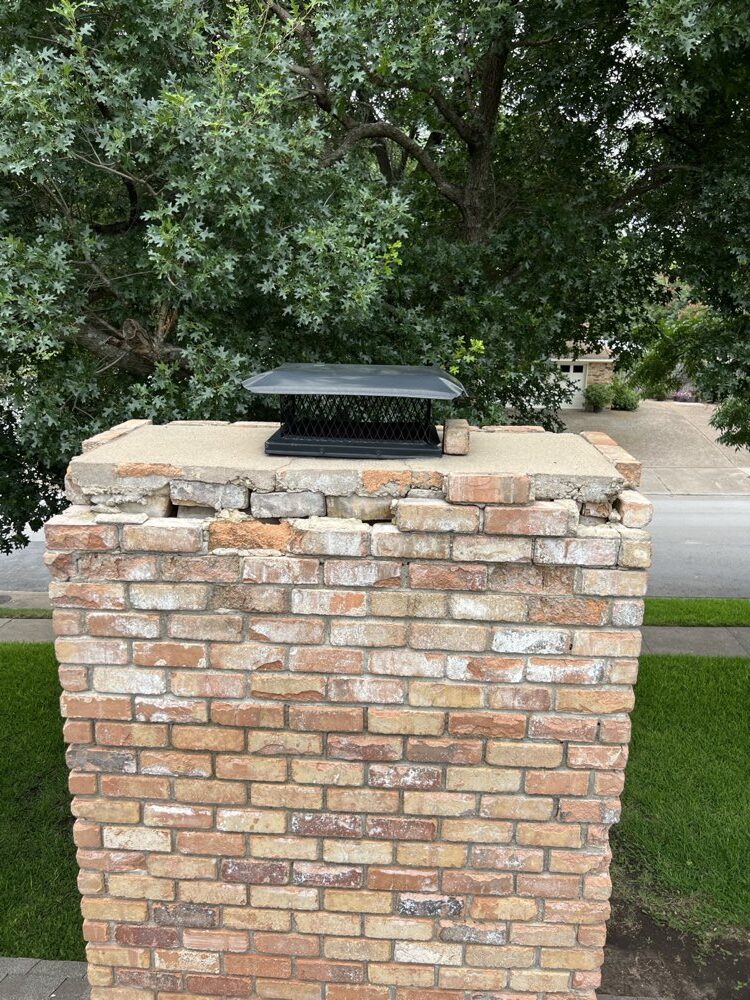
Spring hail rounds it out. The chimney is the highest point on the roof and takes the hit first: dented caps, cracked crowns, punctured metal covers on newer homes. After a storm the roof gets an adjuster’s attention and the chimney usually gets none.
- White crusty staining on brick, a sign water is moving through it
- A chimney visibly leaning or pulling away from the wall
- Mortar joints soft enough to rake out with a house key
- Pieces of crown or brick in the gutters after a freeze
Newer Homes Have the Opposite Problem
Denison is not only old houses. Denison Dam went up on the Red River in the 1940s, at the time the largest rolled-earth dam in the world, and Lake Texoma sits just past it. In recent decades new subdivisions have been filling in the edges of town, and almost everything built from the 1980s on uses a factory-built fireplace: a metal firebox and flue pipe inside a wood-framed chase, wrapped in brick veneer or siding, with a sheet metal cover on top.
Those systems fail at the top. The chase cover rusts through, rain gets into the wood framing, and by the time a stain shows on the ceiling the damage has been working for months. On a house that sits empty part of the year, it can go longer without anyone noticing.
If your Denison home is newer, the chase cover, the cap, and the flashing are the three things worth photographing every few years. All three are small jobs caught early and big ones ignored.
Downtown's Second Act, and the Flue Nobody Has Opened in Decades
Downtown Denison reinvented itself after the railroad jobs faded in the late 1980s. The city joined the Texas Main Street Program in 1989, and the old commercial blocks along Main Street came back to life. The neighborhoods around them are full of houses from the same era, and a lot of those houses have a fireplace that has not burned anything since before the current owner moved in.
A long-idle flue is not automatically fine. Open at the top, it collects rain, leaves, and animals. Sealed badly, it traps moisture and sends musty or smoky smells into the house on humid days. We get called about the smell more often than the fire.
The fix starts with looking: a camera up the flue, photos of what is actually in there, then a decision. Cap it properly, bring it back into service, or leave it alone, with evidence that leaving it alone is fine.
New Company, Documented Work
We are new in Denison and we do not dress that up. The business is built around something you can check yourself: photos. The inside of your flue before we touch it. The crack we found in your crown. The same spots after the work. We call it Photos Not Promises, and it means you judge the work with your own eyes instead of our adjectives. When you call, you talk to the technician, and the technician is who shows up.
If you are not sure where to start: a chimney inspection fits a house with an unknown history, which in Denison covers most houses more than a few decades old. A chimney sweep fits a fireplace that burns regularly. Chimney repair fits a problem you can already see.
Talk To Someone Who Works In Denison
Tell us what you are seeing or hearing and we will tell you whether it needs a sweep, an inspection, or a repair. If it is nothing, we will say that too.
WHAT HAPPENS WHEN YOU CALL
You call or send the form
We ask what you are seeing or hearing. A person, not a queue.
We arrive and cover everything
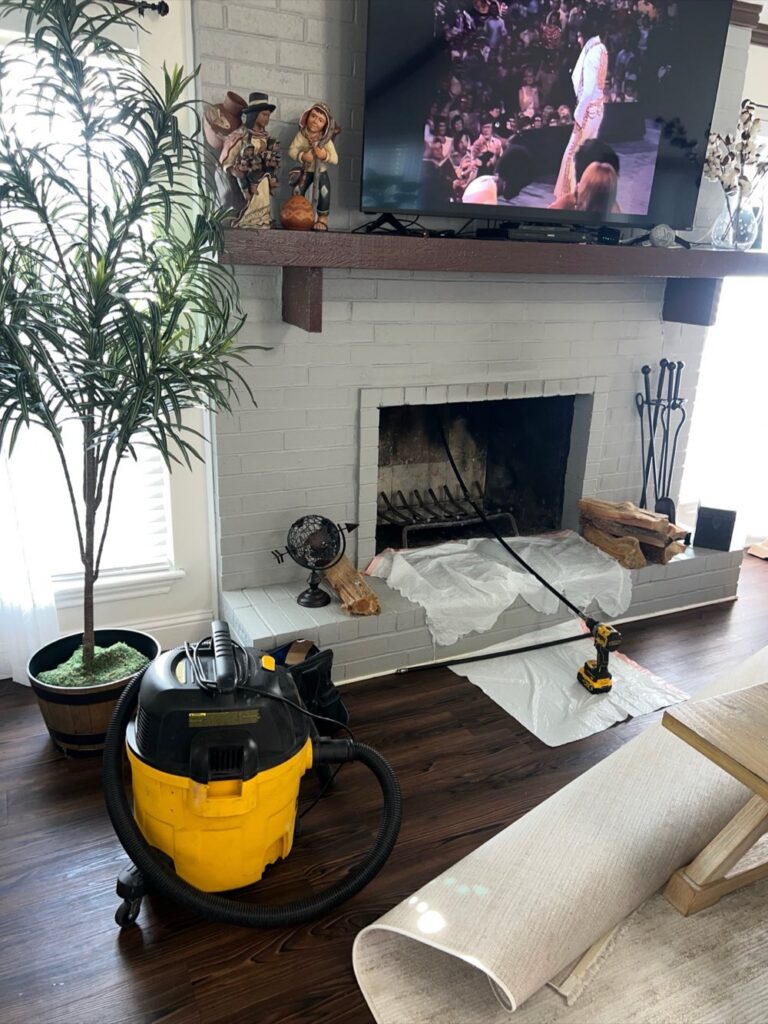
Tarps down and the vacuum ready before a tool comes out.
Camera, brushes, eyes on all of it
Firebox, damper, flue and the top of the chimney, photographed.
Photo report the same day
You see what we saw and decide what happens next.
COMMON QUESTIONS
Yes, and they get treated differently from modern construction. Brick from the 1890s is softer, the mortar is lime-based, and the flue may be unlined. We photograph the masonry and the inside of the flue before recommending anything, so you see the actual condition before any work is discussed.
Not until someone has actually looked. An unlined flue can be sound, or it can have open joints hiding behind a wall. A camera inspection settles it with pictures instead of opinions. If a liner is needed, that is a solvable job. If the flue checks out, you get the photos that say so.
Leaving it alone is a fine choice, but make it with information. A badly sealed flue traps moisture inside the chimney, and an open one collects rain and animals. One look tells you whether your sealed fireplace is resting quietly or rotting quietly.
We work on the chimney side only: the masonry, the flue, the crown, the cap, the venting. Gas lines, valves, and pilots belong to a gas fitter, and we will tell you plainly when a problem crosses into their territory instead of pretending it is ours.
It means water is getting somewhere it should not be. Rain moving through a chimney picks up old soot and carries the smell into the house. Sometimes the fix is a cap, sometimes flashing, sometimes the crown. We trace where the water enters and photograph it, because guessing at leaks wastes your money.
It depends on burning, not the calendar. The burn season here runs roughly November through February. Burn most weekends of it and a yearly check before the first fire makes sense. Burn twice a winter and an inspection will tell you whether a sweep is even needed.
All of Denison, from the historic streets near downtown to the newer additions on the edges of town, plus the surrounding Grayson County communities. We are a mobile company, so we come to you.
REQUEST A CALL BACK
A person calls you back about your chimney, not a dispatcher.
Is Your 1890s Flue Even Lined?
One camera visit answers it with photos of the brick and the flue, whether your Denison house dates to the railroad or the lake subdivisions.