
Chimney Answers for Dallas-Fort Worth Homeowners
Plain answers to the questions people actually call us about, written so they are useful whether or not you ever hire anyone.
CAMERA INSPECTION
We look before we quote, every time
PHOTOS OF EVERY FINDING
No photo, no claim
MASONRY AND VENTING ONLY
Gas lines go to a gas fitter and we say so
SAME-DAY REPORT
In your inbox before we finish the day
Most chimney questions come from the same place: you cannot see the thing you are asking about. It sits above the roofline, it is hollow, and the only people who have looked inside it are the ones asking you for money.
So these guides are written the other way around. Each one explains what is actually happening up there, what you can check yourself from the ground or the hearth, and what each observation rules in or out. If a guide saves you a call, it did its job.
YOU SEE WHAT WE SEE
You cannot see your own chimney. That is the whole problem with this trade, and it is why people feel talked into things.
Every visit ends with photographs of what we found, walked through with you before anything is quoted. If the pictures show nothing wrong, that is the report you get.
- Camera up the flue, not a guess from the hearth
- Every finding photographed before it is quoted
- The same spots photographed again after the work
- Written report in your inbox the same day
Start Here If Something Changed
A chimney rarely fails all at once. It announces itself: a smell that was not there in July, a stain that showed up after one storm, a sound in June that stops in September. These three cover the changes people notice first.
- A campfire smell in warm weather usually means humid air pulling odor off creosote in the flue
- A stain near the chimney after heavy rain points at the crown, the cap, or the flashing, in that order
- Chattering or scratching between May and August in North Texas is almost always chimney swifts
How Often, and Why the Calendar Is the Wrong Question
The most common question we get has the least useful common answer. Once a year is a starting point for a look, not a rule for a sweep. What you burn, how often, how dry the wood is, and whether the appliance is an open fireplace or an insert change the real interval more than the date does.
The guide on sweeping frequency works through the actual variables, so you can decide from your own burning habits instead of a generic number.
The Parts People Mix Up
Half the confusion in this trade is vocabulary. A crown is not a cap. A chase cover is not a crown. A liner is not the chimney. Knowing which part someone is quoting on is the difference between a fair price and a story.
The crown versus cap guide sorts out the two that get confused most, with what each failure looks like from the ground so you can check before anyone climbs up.
Creosote, in Plain Terms
Creosote is the fuel for a chimney fire, and it forms in three progressively worse stages. Stage one brushes off. Stage three is a glassy layer that has to be removed with specific tools and, in the wrong conditions, cannot be removed at all without relining.
The creosote guide explains what speeds it up, what each stage looks like, and which warning signs homeowners in Dallas-Fort Worth tend to miss because they only look at the firebox.
Before the First Cold Night
North Texas gives you a short burning season and a rush that starts the week of the first hard freeze. Everything is easier to schedule in September than in December, and most of what goes wrong in December was visible in September.
The winter checklist walks the whole system from the firebox to the cap, marks what is safe to check yourself, and says plainly which items need someone on the roof.
How We Use These Guides
If you call us, the guide is where the conversation starts, not a sales page we point at. We will tell you on the phone what a symptom usually means, and if it sounds like something you can watch rather than fix, we will say that too.
When a visit does make sense, the promise is the same one on every page of this site: we photograph what we find, walk you through the pictures, and quote after that. If nothing is wrong, the report says nothing is wrong.
WHAT HAPPENS WHEN YOU CALL
You call or send the form
We ask what you are seeing or hearing. A person, not a queue.
We arrive and cover everything
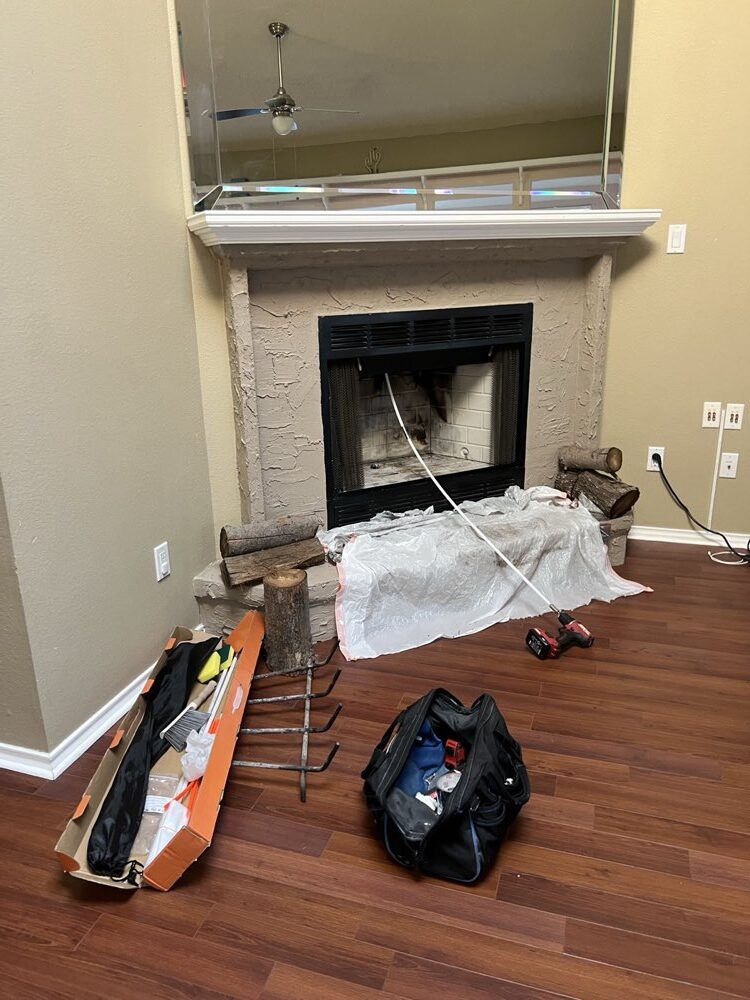
Tarps down and the vacuum ready before a tool comes out.
Camera, brushes, eyes on all of it
Firebox, damper, flue and the top of the chimney, photographed.
Photo report the same day
You see what we saw and decide what happens next.
COMMON QUESTIONS
Yes. The burning season here is short, the freeze count is low but sharp, hail season is real, and most housing splits between older masonry near the city centers and factory-built fireplaces in the newer suburbs. All of that changes what fails and when, so the guides are written against those conditions rather than a national average.
No. Every guide includes what you can observe yourself and what each observation means. Plenty of readers will find out their situation is normal, which is a perfectly good outcome.
Because a number without a look is a guess, and chimney work varies enormously by what is actually there. The same repair name covers a small job and a large one. You get a number after someone has seen your chimney and you have seen the photographs.
As the questions come in. The list grows from real calls rather than a keyword plan, which is why the ones here cover smells, birds, creosote, parts confusion and seasonal timing before anything else.
REQUEST A CALL BACK
A person calls you back about your chimney, not a dispatcher.
Question Not Answered Here?
Call and ask it. We will answer even if the answer is that you do not need us.