
Chimney Sweep, Inspection and Repair in Dallas, TX
Dallas chimneys spend nine months of the year sitting idle in heat, hail and shifting clay, and that is usually what we end up fixing, not the soot.
LOCALLY BASED IN DFW
We drive to you, no national call center
WRITTEN PHOTO REPORT
Every finding shown before it is quoted
SAME-WEEK SCHEDULING
Booked in days, not weeks
OWNER-ANSWERED PHONE
The person who answers is the person who comes
Most of the calls we get in Dallas are not about a dirty chimney. They are about water on the firebox floor after a storm, a crack running up the brick outside, smoke that rolled back into the living room in January, or scratching coming from somewhere above the damper.
That is what a chimney does in this city. Ours get used for a few weeks a year and then sit through nine months of hundred degree afternoons, spring hail, and ground that swells and shrinks under the footing. Up north a chimney wears out from burning. Here it wears out from waiting.
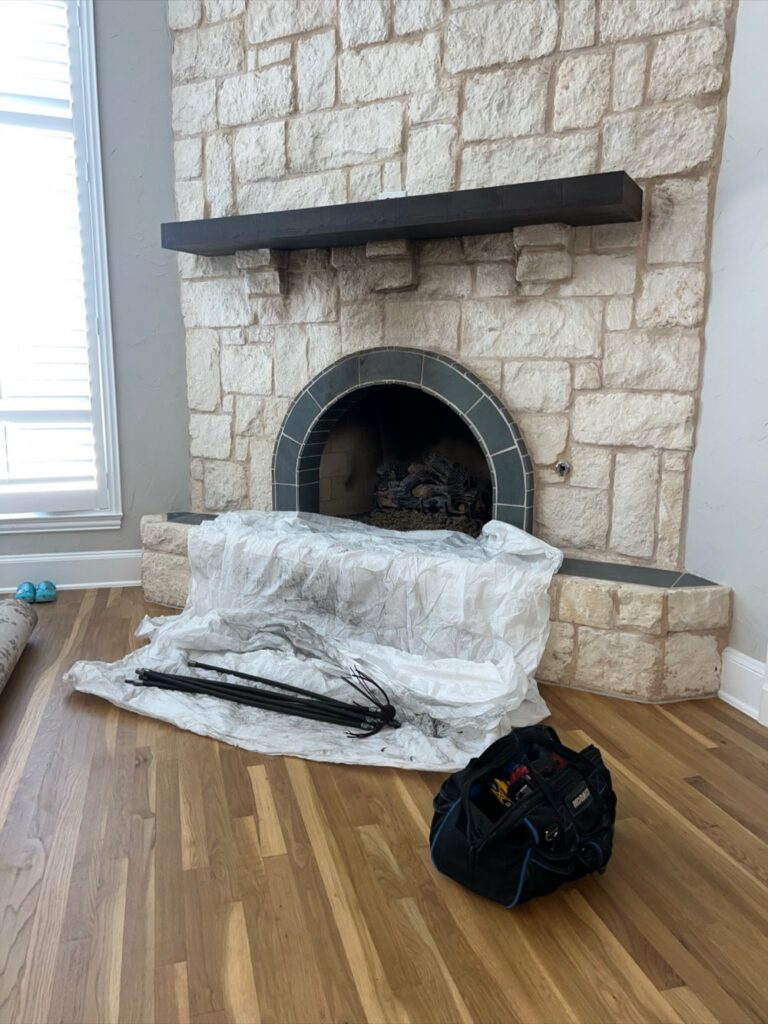
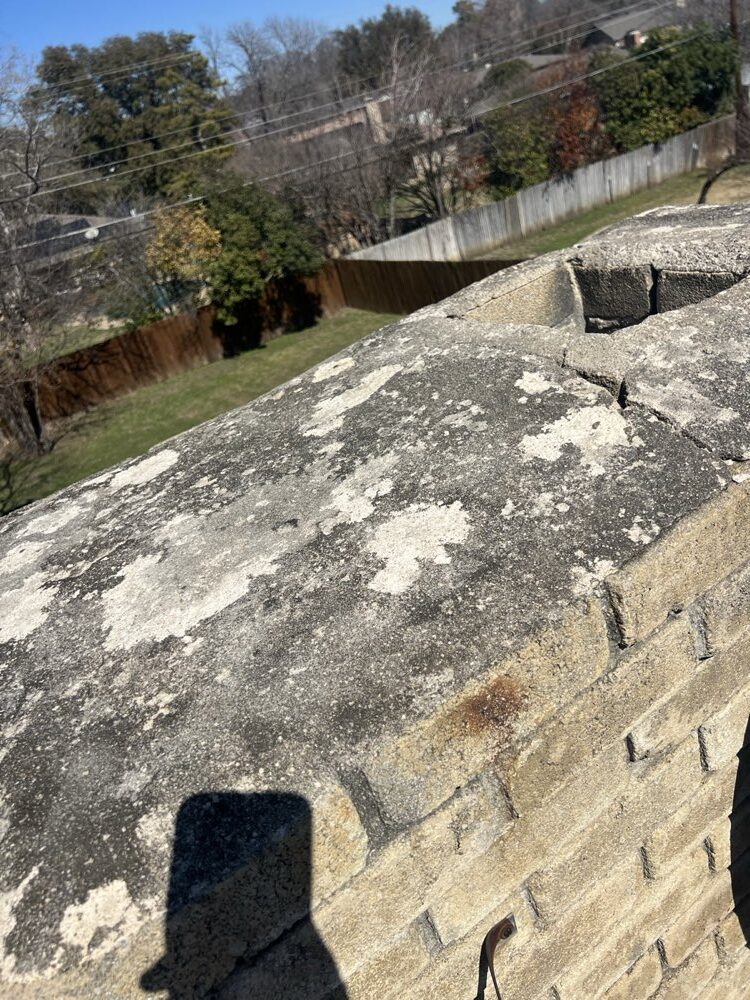
We are a new name in North Texas and we are not going to dress that up. What we do instead is photograph every visit, from the top of the chimney down to the firebox floor, and hand you the pictures whether the news is good or bad. If you want to take them to another company for a second opinion, take them.
YOU SEE WHAT WE SEE
You cannot see your own chimney. That is the whole problem with this trade, and it is why people feel talked into things.
Every visit ends with photographs of what we found, walked through with you before anything is quoted. If the pictures show nothing wrong, that is the report you get.
- Camera up the flue, not a guess from the hearth
- Every finding photographed before it is quoted
- The same spots photographed again after the work
- Written report in your inbox the same day
What Dallas weather actually does to a chimney
A chimney in Dallas has an easy winter and a hard rest of the year. The burning season here is short. A lot of fireplaces in this city get lit somewhere between Thanksgiving and February, and some only get lit when the power goes out. Creosote builds slowly when a fireplace is used like that.
Everything else does not go slowly.
- Heat. Summer sun sits on the crown, the cap and the metal chase lid all day long. Sealant dries out and splits, and mortar joints open up.
- Rain, then a hard freeze. We get soaking rain and then, some winters, a freeze inside a day or two. Brick that soaked up water and then froze flakes off in chips and sheets, which is the face of the brick coming away.
- Spring storms. North Texas takes hail and straight line wind every spring. A chimney cap is a thin piece of metal on the highest point of your house. It is one of the first things a storm bends, loosens or lifts off, and nobody looks up there afterwards.
- Nine months of nothing. An unused chimney with no cap is an open pipe into a warm, dry, protected space. Birds and squirrels work that out faster than homeowners do.
The clay under Dallas moves, and the chimney shows it first
This is the part that makes Dallas different from most of the country. Much of this city sits on heavy black clay. It swells when it gets wet and shrinks when it dries out, and in a normal year it does both. A dry August pulls the ground down. A wet spring pushes it back up.
Your chimney is a stack of brick or stone weighing thousands of pounds, standing on its own footing, attached to a house standing on a different one. When the ground moves, the two do not always move together.
You do not need a report to spot it. You need to walk outside and look at the line where the chimney meets the wall.
- A gap between the chimney and the siding or brick of the house, wide enough to slide a coin into.
- Cracks that step up through the mortar joints on the outside of the stack, following the brickwork rather than cutting straight across it.
- A stack that leans away from the house, which is easiest to see from across the street rather than from your own yard.
- A crack inside the firebox, or daylight where the firebox meets the wall.
- Water showing up at the roof line, because the metal collar around the chimney was bent and sealed for a chimney that has since moved.
We Cover Dallas.
Tell us what you are seeing and we will tell you which visit it needs.
Why so many Dallas chimneys leak
The flashing is the metal collar where the chimney comes through the roof. It is built on the assumption that two things stay where they are. When one of them shifts a quarter of an inch, the seal opens, and water follows the outside of the chimney down into the house.
So the stain on your ceiling is rarely above the hole. Water gets in at the top or at the roof line, travels down brick or down the outside of the flue, and comes out wherever it finds a way through. If yours leaks when it rains, that is where we look first, not inside.
The other two ways water gets into a Dallas chimney are simple. The crown, which is the concrete slab across the top of the stack, cracks in the sun and lets rain straight into the brickwork. Or the cap is missing and the flue is an open drain.
Dallas houses, and what each kind hands us
Dallas is not one housing stock. It is at least three, and they fail in different ways.
- The old East Dallas and Oak Cliff houses. Lakewood, the M Streets, Munger Place, Kessler Park, Winnetka Heights. These were built long before anybody was thinking about a stainless liner. Clay tile inside the flue cracks with age, the mortar between the tiles washes out, and a gas starter pipe or a set of gas logs was often added decades after the chimney was built.
- The 1950s and 1960s ranch houses. Lake Highlands, Casa Linda, Wynnewood, parts of Preston Hollow. Usually a wide, shallow firebox on a short chimney, and a short chimney pulls weakly. That is a common reason these push smoke back at you on a still, damp evening.
- The 1980s onward houses on the newer edges of the city. Plenty of these have no masonry chimney at all. They have a factory built metal firebox and pipe inside a wood framed chase with siding on it and a metal lid on top. The lid rusts, water runs down the inside of the chase, and the damage stays hidden behind the siding until somebody opens it up.
What Dallas homeowners actually call about
This is how people describe it on the phone. None of it is trade language and none of it needs to be.
- It leaks when it rains. A stain on the wall beside the fireplace, or water sitting on the firebox floor the morning after a storm.
- Smoke comes back into the room. Usually worst in the first ten minutes of a fire, or on a still evening when the air is heavy.
- Something is living in my chimney. Scratching, fluttering, chirping above the damper, or a smell with no obvious source.
- The fireplace stinks in the summer. Damp soot plus Dallas humidity plus the air conditioning pulling air back down the flue.
- There are white chalky patches on the outside brick. That is salt left behind by water moving through the masonry, so it is a water problem showing up on the outside of the house.
- The cap is gone. Sometimes noticed months after the storm that took it, usually because leaves and rain have been dropping in ever since.
- We just bought the house and nobody can tell us anything about the fireplace.
What we do in Dallas
Each of these has its own page with the detail on it. Short version.
- A chimney sweep. Brushing the flue, clearing the smoke shelf and the smoke chamber behind the damper, and taking out what comes down.
- A chimney inspection. A light and a camera on the whole thing, top to bottom, before you buy the house or before you light the first fire of the year.
- Chimney repair. Crown, mortar, brick, firebox and flashing work on a chimney that has moved, cracked or come apart.
- Chimney cap replacement. The simplest thing you can do to keep rain, leaves and animals out of an open flue.
- Chimney leak repair. Finding where the water is really getting in, which is almost never directly above the stain.
- Smoky fireplace. Working out why the smoke is coming at you instead of going up, and which part of the chimney is causing it.
Photos, not promises
We are a new name in Dallas. There is no wall of plaques here and we are not going to invent one. What we can do is show you your own chimney.
Every visit gets documented. The top of the stack and the cap, shot from the roof, because that is a part of your house you have never once seen. The line where the chimney meets the roof. Inside the flue. The smoke chamber and the smoke shelf. The damper, open and shut. The firebox floor. Anything that concerns us gets a close up and a note in plain words saying what it is.
All of it goes to you the same day and it is yours to keep. If the answer is that your chimney is in good shape, you get the pictures that show it, and you do not get handed work you do not need.
Where we go in Dallas
We are a service area business. There is no shop and no counter to walk into, which is normal for this trade. The truck comes to you.
Inside the city that covers East Dallas and Lakewood, White Rock and Casa Linda, Lake Highlands, Preston Hollow and Bluffview, North and Far North Dallas, Uptown and the neighborhoods around downtown, Oak Cliff, Kessler Park, Bishop Arts, Winnetka Heights and Pleasant Grove. We cover the Park Cities and the rest of the metro as well. If you are not sure whether your street is in, ask.
Get somebody on the roof before the first cold snap
Tell us what your fireplace or your chimney has been doing and you will get a straight answer back. Call, or send one photo of the firebox and one of the chimney from the yard, and we will tell you what we think we are looking at.
WHAT HAPPENS WHEN YOU CALL
You call (469) 333-3312 or send the form
We ask what you are seeing or hearing. A person, not a queue.
We arrive and cover everything
Tarps down and the vacuum ready before a tool comes out.
Camera, brushes, eyes on all of it
Firebox, damper, flue and the top of the chimney, photographed.
Photo report the same day
You see what we saw and decide what happens next.
COMMON QUESTIONS
Probably not a sweep every single year, no. Buildup in a Dallas fireplace used a handful of times a season is slow. What you do need is eyes on it once a year, because in this city most of what goes wrong has nothing to do with soot. It is water, storm damage, ground movement and animals. We would rather look, tell you it is clean, and hand you the photos, than brush a flue that did not need brushing.
In Dallas, very often yes. The clay under much of this city swells with rain and shrinks through a dry summer, and the chimney stands on its own footing while the house stands on another. A gap at the siding, cracks stepping through the mortar, or a stack that leans when you look at it from the street all point the same way. It matters because the metal collar at the roof gets pulled open at the same time, and that is how the water starts coming in.
It is the highest point on the house and the cap is thin metal, so it takes the hit first. After a bad North Texas storm the things worth checking are whether the cap is still there and still sitting flat, whether the crown across the top of the stack has cracked, and whether the flashing lifted. Most people find out months later, when the first fire of the winter smells like wet ash.
It depends what it is and what time of year it is. Chimney swifts nest in Texas chimneys through spring and summer and they are protected under federal law while the nest is active, so an active nest does not come out. Not by us and not by anybody. Once they have left, the flue gets cleared and a cap goes on so the next one cannot get in. Scratching in the middle of winter is a different animal and a different conversation.
The chimney part is. A vented gas set still sends everything up the same flue, and that flue can still be blocked by a nest, a fallen piece of clay tile or storm debris. What we do not touch is the gas itself. No gas lines, no valves, no burners. If somebody tells you that comes as part of a chimney visit, they are selling you something else.
Get it looked at before you light anything, whatever the seller told you. A home inspection looks at the fireplace from the room. It is not the same as getting a light and a camera up the flue. On older Dallas houses the two things that turn up most are cracked clay tile inside the flue and a gas starter pipe that has not been used in years.
There is not one on here on purpose. This is a service area business, so the work happens at your house and there is nothing to come and visit. We cover Dallas and the metro around it. If you want to know whether we come to your street, ask and you will get a yes or a no.
REQUEST A CALL BACK
A person calls you back about your chimney, not a dispatcher.
Is the Chimney Pulling Away From the House?
Dallas clay moves the stack on its own footing. Walk out, look for the coin-width gap at the siding, then send us one photo.