
Chimney Sweep & Fireplace Service in McKinney, TX
About 1,500 McKinney homes predate 1940 and roughly 78,000 went up after 1990. Your build year decides what is likely wrong, and we photograph all of it before anything is quoted.
LOCALLY BASED IN DFW
We drive to you, no national call center
WRITTEN PHOTO REPORT
Every finding shown before it is quoted
SAME-WEEK SCHEDULING
Booked in days, not weeks
OWNER-ANSWERED PHONE
The person who answers is the person who comes
A stain on the ceiling beside the chimney breast after a storm. A firebox that smells sour in August. A flue nobody has looked up since the house changed hands. McKinney raises those questions in two separate populations of houses, and the gap between them is wider here than almost anywhere else in North Texas.
Local Chimney Experts is new. Rather than talk about a history we do not have, we hand you evidence: images of your flue before anyone touches it, images of whatever we find, and the same views afterward. You see the pictures first and hear a number second. The technician takes the call and does the work.
This page is about McKinney houses specifically, because here the year on the deed predicts most of the diagnosis before we reach the driveway.
YOU SEE WHAT WE SEE
You cannot see your own chimney. That is the whole problem with this trade, and it is why people feel talked into things.
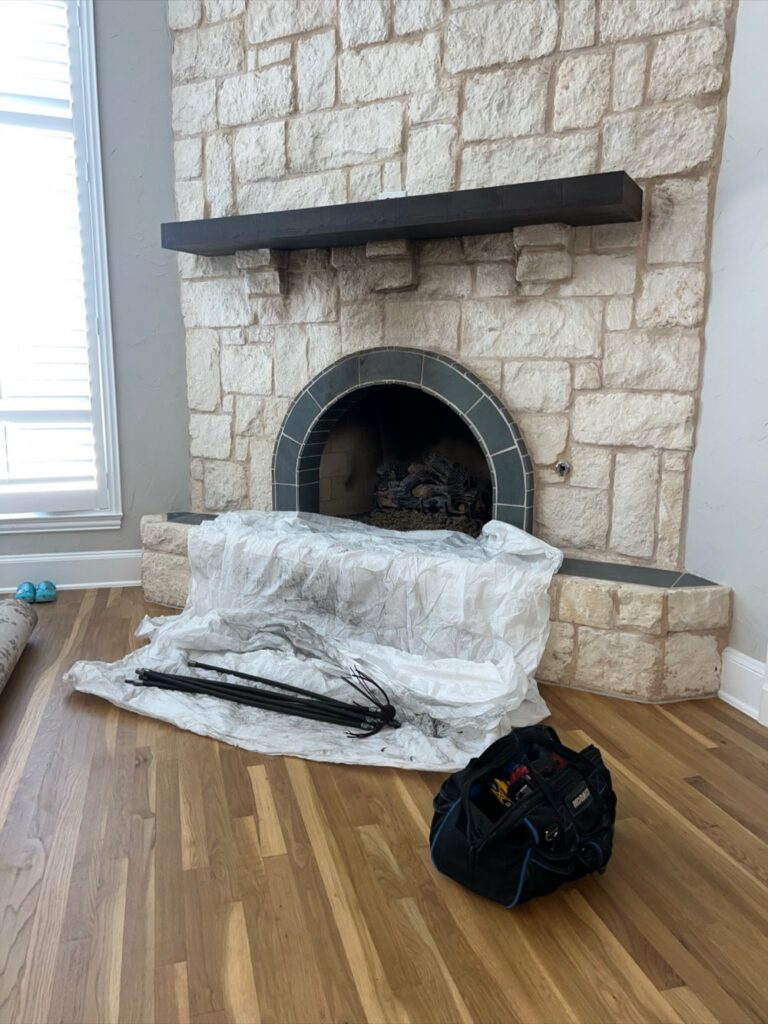
Every visit ends with photographs of what we found, walked through with you before anything is quoted. If the pictures show nothing wrong, that is the report you get.
- Camera up the flue, not a guess from the hearth
- Every finding photographed before it is quoted
- The same spots photographed again after the work
- Written report in your inbox the same day
McKinney Has Almost No Middle-Aged Houses
McKinney has been the seat of Collin County since 1848, and the courthouse square took its present shape in the 1870s. For more than a century after that, the town stayed small.
Census figures now count roughly 88,000 housing units inside McKinney. About 1,500 were finished in 1939 or earlier. Roughly 78,000 were finished in 1990 or later. The median McKinney home dates to around 2007.
The decades in between are the surprise. The 1940s, 1950s, 1960s and 1970s together account for under 5,000 houses in the whole city, and the 1980s added only about 4,300 more. The postwar ranch belt that fills Richardson, Garland and Mesquite barely reached McKinney. This was a county seat of about 21,000 people in 1990. It passed 195,000 by 2020.
For chimneys, that shape decides everything. Two populations, and nearly nothing between them.
The small old group is genuine masonry: brick stacks with clay tile liners, or with no liner at all, laid in soft lime mortar built to shift. They fail slowly and by water. A crown that opened decades ago. Joints gone soft enough to rake out with a house key. A firebox whose back wall has parted at the seams.
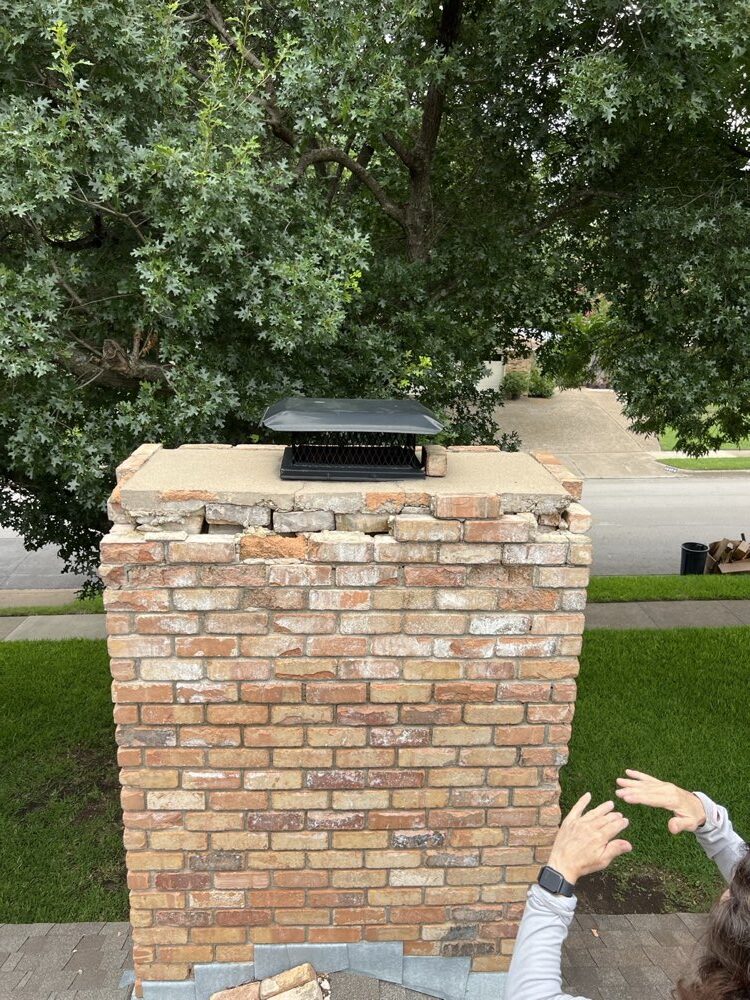
The large new group is not masonry in any structural sense. It is a steel firebox and a double-wall metal pipe standing inside a framed box, dressed in brick veneer or siding, with a sheet-metal lid on top. Those assemblies fail from the lid down, and on a schedule. Twenty to thirty years is when the builder-grade lid gives up.
Here is the piece unique to McKinney: about 40,000 homes were finished between 1990 and 2009. That whole cohort reaches the twenty-to-thirty-year mark now, subdivision by subdivision. Nobody scheduled a maintenance wave across McKinney. The build calendar did it.
So the first question on the phone is not what is wrong. It is what year the house was finished.
The Old Brick Sits in a Few Named Blocks
McKinney’s antique housing is not scattered around town. It sits in a compact grid near the courthouse square, entered on the National Register in 1987 as the McKinney Residential Historic District, drawn roughly by West Lamar, North Benge, West Louisiana and North Oak. Its listed periods of significance run 1875 through 1949, with Queen Anne among the named styles.
On the ground that reads as Folk Victorian on the earliest lots, then Craftsman bungalows filling in through the 1920s and 1930s. A 1925 bungalow on North Waddill. A 1930 Craftsman on Tucker. Cottages along Kentucky. Just south of the square on South Chestnut, Chestnut Square holds preserved buildings on two and a half acres, including the Faires House of 1854, the oldest house still standing in McKinney.
Flues in those blocks were built for wood and most have been altered at least once. What turns up: a clay liner split at a joint, a crown that was never more than a skim of mortar, flashing patched with roof tar three owners back, and soot from fires nobody alive remembers.
We Cover McKinney.
Tell us what you are seeing and we will tell you which visit it needs.
Near the Square, the City Has a Say in Chimney Work
Houses inside McKinney’s historic districts answer to the city’s Historic Preservation Office for exterior changes visible from the public right of way. The guidance names chimneys outright: adding one or taking one away calls for a Certificate of Appropriateness. Repair that keeps the same materials and design counts as ordinary maintenance and needs no approval.
That distinction matters the moment somebody proposes dropping a leaning stack to the roofline and capping it, the quick answer to an expensive problem. In the McKinney historic district that is a review item, not a same-day decision, and the Historic Preservation Advisory Board can refuse it. The city also advises against painting unpainted brick and against sandblasting to strip paint already on it, worth knowing before anyone treats an old McKinney stack with the wrong product.
We are not the permit office and do not speak for it. We will say when a repair looks likely to cross that line, and document the chimney well enough that you have something to bring to the city.
Reading a McKinney Address as a Build Date
West of US-75 the growth runs like a timeline, and the timeline predicts the failure.
Stonebridge Ranch broke ground in the mid-1980s and sold its first villages in 1988 across thousands of acres of west McKinney. Its earliest streets carry the oldest factory-built fireplaces in the newer half of the city: original lids well past their service life, caps corroding for three decades.
Craig Ranch, laid out over roughly 2,200 acres in the early 2000s toward SH-121, sits mid-curve. Those houses are old enough for seams to have opened and young enough that most owners have never been up there to look.
Trinity Falls, developed from 2015 at the north end of McKinney where US-75 and SH-5 split, is the young end. Its chimneys are usually sound. What we find there is build-day detail: a cap never installed, a flat lid with no cross-break so water sits on it, hail bruising from a spring nobody checked.
The Lid You Have Never Looked At
Across the roughly 78,000 newer McKinney homes, the most common source of trouble is a part most owners do not know they own. On top of the framed box around your fireplace pipe sits a metal lid. Builders through the 1990s often specified plain galvanized steel and left it flat, so rainwater pools instead of running off. Once a seam opens, everything under it stays damp long before a ceiling shows anything.
What we take on in McKinney is the masonry and the venting: sweeping, camera inspection, lids, caps, crowns, brickwork, liners, flashing, dampers, fireboxes. What we leave alone is the gas side. Valves, pilots, burners and piping belong to a different trade, and you hear that on the phone instead of in your driveway.
- Orange streaking down the siding or veneer under the chimney top
- A metal lid holding standing water after rain
- A cap with the spark screen torn away or missing
- Mortar joints on an older stack soft enough to scratch loose
- A damp, sooty smell that arrives with the weather and leaves with it
Evidence First, Number Second
We are new in McKinney and will not dress that up. What we offer instead is a way to check the work yourself. Before anything is priced you receive images of the crown, the lid, the flashing and the inside of the flue, then the same angles after the work. If your chimney turns out sound, that is the report you get.
The customer cannot see the part being described. Pictures end that argument.
Unsure where to begin: a chimney inspection suits a McKinney house with unknown history, a chimney sweep suits a firebox in regular use, and chimney brick repair or chimney crown repair suit damage already visible from the yard.
WHAT HAPPENS WHEN YOU CALL
You call or send the form
We ask what you are seeing or hearing. A person, not a queue.
We arrive and cover everything
Tarps down and the vacuum ready before a tool comes out.
Camera, brushes, eyes on all of it
Firebox, damper, flue and the top of the chimney, photographed.
Photo report the same day
You see what we saw and decide what happens next.
COMMON QUESTIONS
It depends on the work. McKinney treats repair using matching materials and design as ordinary maintenance, with no approval needed. Adding a chimney, or taking an existing one off a street-facing elevation, calls for a Certificate of Appropriateness through the Historic Preservation Office. We photograph the existing condition either way, so you have documentation if the city asks.
The most common call we take here. A 1998 build almost certainly wears its original metal lid, now close to thirty years old, and lids of that vintage are usually rusted at the seams or holding water. Start at the top of the chase and the cap. Both photograph in one visit.
Nobody can tell from the outside. Homes in that part of McKinney often have a clay tile liner with split joints, or masonry that predates liners entirely. A camera run up the flue settles it and leaves you with images. Until then, treat the fireplace as unknown rather than fine.
Newer is where most of our McKinney work happens. Around 78,000 homes here were finished in 1990 or later, and their fireplaces are manufactured assemblies with metal parts and rated clearances. Steel corrodes, refractory panels crack, lids fail, caps blow off in a spring storm. It goes quieter than old masonry, which is why it gets caught late.
It means the general inspector could not see up the flue, which takes a camera. In McKinney the answer splits by age. On a pre-1950 house the questions are the liner and the crown. On a 1990s or 2000s house they are the lid, the cap and the firebox panels. Either way you get the images in time to use them.
Yes, and it tracks age rather than the neighborhood name. The first Stonebridge Ranch villages sold in 1988, so the oldest streets carry the oldest factory-built fireplaces in west McKinney. On those roofs we most often photograph a lid rusted through at a low corner and a cap with the screen gone. On the later streets those parts are still fine and flashing is what to watch.
REQUEST A CALL BACK
A person calls you back about your chimney, not a dispatcher.
Which McKinney Is Your Chimney From?
A camera inspection answers it either way. You get photos of the brick, the lid, the flashing and the flue before anything is priced.