
Chimney Liner Replacement in Dallas-Fort Worth
Cracked clay tiles let heat and gas leave the flue. A camera run shows the truth before anyone talks about a new liner.
CAMERA INSPECTION
We look before we quote, every time
PHOTOS OF EVERY FINDING
No photo, no claim
MASONRY AND VENTING ONLY
Gas lines go to a gas fitter and we say so
SAME-DAY REPORT
In your inbox before we finish the day
A cracked chimney liner is a problem you cannot see from your living room. The fireplace looks fine. The fire burns fine. The damage happens inside the chimney, a few feet from wood framing.
The liner is the inner channel that carries smoke and hot gas from your fire up and out of the house. When it cracks, heat and gas reach parts of your home they should never touch.
Nobody at Local Chimney Experts quotes a liner from the driveway. We camera the flue first.
YOU SEE WHAT WE SEE
What Is Chimney Liner Replacement?
Chimney liner replacement is the removal of a cracked clay tile flue lining and its replacement with one continuous stainless steel liner, sized to the appliance below it and insulated along its length. Local Chimney Experts cameras the flue end to end first, photographs every finding, and installs the new liner from the rooftop, finishing with a top plate and cap, across Dallas-Fort Worth.
You cannot see your own chimney. That is the whole problem with this trade, and it is why people feel talked into things.
Every visit ends with photographs of what we found, walked through with you before anything is quoted. If the pictures show nothing wrong, that is the report you get.
- Camera up the flue, not a guess from the hearth
- Every finding photographed before it is quoted
- The same spots photographed again after the work
- Written report in your inbox the same day
What a Chimney Liner Actually Is
Look up inside most Dallas-Fort Worth chimneys and you will see square clay tiles stacked one on another, sealed with mortar joints. That stack is the liner. Its job is containment: keep heat, smoke and gas inside the flue until they exit above the roof.
Brick was never built to handle fire alone. When the National Bureau of Standards test-fired chimneys with no lining in them, the woodwork beside the chimney caught fire after roughly three and a half hours, and the test was stopped there.
Clearance rules follow. Common practice leaves about two inches of air between an interior masonry chimney and nearby framing, about an inch on an outside wall. The brick is not what catches. The joists and studs against it are.
Why Clay Tiles Crack, and What Cracks Them Here
Fired clay handles steady heat well. What it cannot handle is speed. Clay moves heat slowly, so when a flue warms fast the inner face of a tile expands while the outer face is still cold. Trade sources put the breaking point at a difference of roughly five hundred degrees across the thickness of the tile, and a chimney fire, which can pass two thousand degrees, gets there in minutes.
North Texas adds its own pattern. The freeze window runs from an average first freeze near the twenty-second of November to a last freeze near the twelfth of March, and the fires follow it. A flue sits idle eight or nine months, gets driven hard over a cold weekend, then goes quiet again.
Moisture makes it worse. Water soaked into a tile flashes to steam when the fire comes up, and flue gas mixing with that moisture forms acids that attack the mortar faster than the tile. That is why most liners open at the joints before any face breaks.
The ground adds one more. Soil under much of the metroplex swells with rain and shrinks in a dry spell, and a rigid column of tile cannot bend when the footing moves.
Clay Tiles Past Saving?
The camera shows whether relining is due or the tiles have seasons left.
What the Firebox Floor Is Telling You
A few things visible without equipment narrow the question and keep you from buying the wrong job.
- Hard orange or buff chips on the firebox floor, curved on one edge and glassy on the other. Those came off the inside face of a tile. Liner failure, not dirt.
- Fine grey or sandy powder on the smoke shelf. Usually mortar washing out of the joints rather than a broken face, which points at joint damage.
- A carbon monoxide alarm sounding during or after a fire. Stop burning that day. The alarm is doing the job the liner stopped doing.
- A smoky smell in an upstairs room with no fireplace. Smoke is finding a path sideways through the chimney wall instead of leaving the top.
- A wall near the chimney that feels warm while a fire burns. Heat is crossing masonry where nothing should cross.
- A crack in the outside brick. Tells you nothing about the liner.
What a Cracked Liner Puts at Risk
A crack in a flue tile is an open path, and three things travel through it.
Heat is the slow one. Wood held well under its normal ignition point, as low as around two hundred degrees, changes chemically over months and years. It dries, darkens and begins catching at a lower temperature than it used to, with nothing on the surface to show for it. That is pyrolysis, and it explains how a house burns from a chimney that leaked heat quietly for years.
Carbon monoxide is the fast one. A sound liner carries it above the roof every time you burn. A cracked one lets it work sideways through the chimney wall toward a bedroom or an attic.
Acid is the one that grows on its own. Condensing flue gas eats mortar faster than tile, so two cracked tiles this winter usually means open joints by the next.
Clay Tile Against Stainless Steel
The real difference is the number of joints. A stainless liner is one continuous run from the bottom connection to the top plate.
Alloy matters too. Wood work generally goes to 316-grade stainless, often the titanium-stabilized version, because it stands up to the acids in wood exhaust better than the 304 grade used on gas and oil appliances. Both are built to a product standard, UL 1777, which puts the liner through three ten-minute burns at 2100 degrees.
| Clay tile | Stainless liner | |
|---|---|---|
| Joints | Twenty feet of clay flue is roughly a dozen tile sections and a dozen mortar joints, every one a place to fail. | One continuous run from the bottom connection to the top plate. |
| Alloy | Wood work generally goes to 316 grade, often the titanium-stabilized version; it stands up to the acids in wood exhaust better than the 304 grade used on gas and oil appliances. | |
| Movement | Rigid; breaks when the stack shifts. | Flexible; bends past the offsets common in older flues. |
| Size | Whatever the bricklayer built in 1978. | Ordered to the diameter your appliance needs. |
- Movement: clay is rigid and breaks when the stack shifts. Flexible stainless bends past the offsets common in older flues.
- Size: a tile flue is whatever the bricklayer built in 1978. A liner is ordered to the diameter your appliance needs.
GET A LOOK BEFORE IT SPREADS.
You have just read how clay tile and stainless steel compare. One camera scan shows which one is above your firebox, and you keep the footage.
Sizing the Liner to What Burns Below It
Sizing is where a reline is done well or badly, and it is the part nobody can quote over the phone.
An open masonry fireplace is sized against its own opening. Published tables tie flue area to that opening: roughly a twelfth of it for a round flue and a tenth for a square or rectangular one, since the corners of a square flue carry less flow than the center.
An insert or a stove is a different question. Those vent through their own collar, commonly six inches round or a six by eight oval, and the liner is sized to that collar, not to the masonry around it.
- Too large: exhaust spreads, slows, cools past its dew point and condenses on the walls. Weak draft, corrosive liquid inside the flue, creosote forming faster than it should.
- Too small: the flue cannot carry what the fire makes. Smoke spills into the room and the appliance back-puffs.
Insulation Is Part of the Liner, Not an Add-On
The first job is draft. Exhaust that stays hot keeps climbing. Exhaust that cools slows, drops below its dew point, and leaves acid and creosote on the walls. An insulated liner in a cold chimney on an outside wall holds temperature the full height instead of bleeding it into twenty feet of cold brick.
The second is clearance. A liner listing records the conditions it was tested under, and for many liners the rating that allows framing close to the masonry assumes insulation is present. It also takes up room: a wrapped six inch liner will not pass down a flue a bare one slides through.
What a Reline Day Looks Like
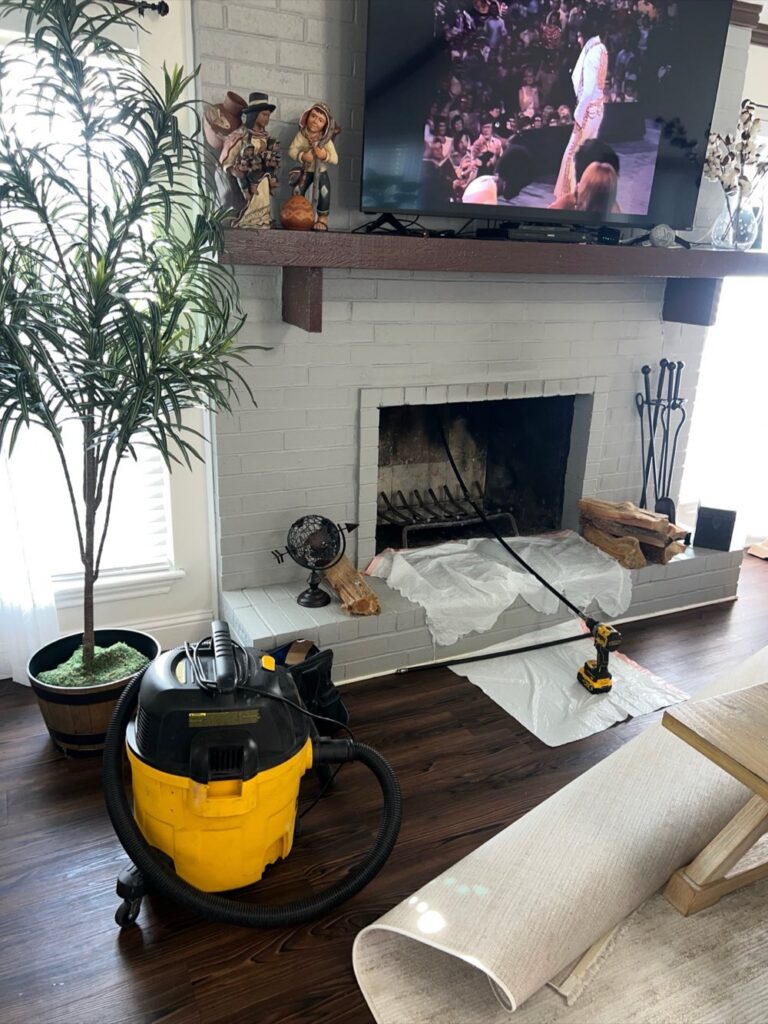
Done properly this is mostly a rooftop job. Inside the house the visible part is a sealed fireplace opening, drop cloths, and somebody making the bottom connection.
- Camera the full interior end to end, which is what the deeper level of inspection is defined to include, and measure height, dimensions, offsets and where the damage sits.
- Size the liner to the appliance rather than the hole, then check the wrapped diameter will pass.
- Protect the room, then open the top of the chimney and take off the old cap and top plate.
- Clear the path. Broken tile blocking the run comes out before anything goes in.
- Lower the liner from the top in one continuous piece, insulation already fixed to it.
- Make the bottom connection at the firebox or appliance collar, leaving access so a brush gets through in later years.
- Finish the top with a plate sealing the flue opening and a cap over it, so a new liner does not become a water problem.
- Camera the finished run and hand over both sets of footage.
Why One Reline Takes a Day and Another Takes Two
Tile in the way is the usual reason. A flue that measures fine on paper can be too tight for a wrapped liner once you allow for a bulging joint, and that tile has to come out first. Sharp offsets are next, since a flexible liner takes a gentle dogleg more willingly than a hard one. Then there is company in the stack: many chimneys here carry a second flue for a water heater or furnace, and if that one is cracked too, you should hear it in the same visit.
When Relining Beats Rebuilding, and When You Need Neither
Relining saves a chimney. It does not dress up one that is coming apart.
It is the right call when the masonry shell is sound and the failure is inside it: cracked tile, washed-out joints, a flue never lined at all, a flue still sized for an appliance that left the house years ago, or a chimney fire in the history. The brick is doing its job and the inner channel is not, so rebuilding that channel fixes the problem without touching the structure.
It is the wrong call when the shell has failed. A stack that leans, pulls away from the wall, or sheds brick faces above the roofline is a structural question first, and a new liner inside a failing chimney is money spent on the wrong layer. Rebuilding from the ground is masonry construction, not work we take on.
Some chimneys need nothing yet. If the camera shows sound tile and tight joints, you get a sweep and a date to look again, not a quote. If the complaint is dampness in the firebox after rain, that usually traces to the crown or a missing cap.
You Keep the Footage
The liner is the part of a chimney a homeowner cannot check, which makes it the easiest place in this trade to invent damage.
The technician runs the camera the full height before anything is priced, and you watch the same screen he does: every crack, every open joint, with the depth it sits at. The footage is yours to take anywhere.
WHAT HAPPENS WHEN YOU CALL
You call or send the form
We ask what you are seeing or hearing. A person, not a queue.
We arrive and cover everything
Tarps down and the vacuum ready before a tool comes out.
Camera, brushes, eyes on all of it
Firebox, damper, flue and the top of the chimney, photographed.
Photo report the same day
You see what we saw and decide what happens next.
COMMON QUESTIONS
You usually cannot tell from the firebox. The reliable way is a camera run the full height. Signs worth acting on: hard curved chips of clay tile on the firebox floor, or a smoky smell in a room with no fireplace.
We would not. Cracks give heat and carbon monoxide a path toward the structure of your house, and heat leaking onto framing does its damage slowly enough that nothing looks wrong until it is.
Sometimes. Isolated joint gaps and limited surface damage can be candidates for an applied sealant system that fills the joints from inside. What rules it out is scale: extensive cracking, missing sections, or a badly sized flue.
Often yes. Insulation keeps exhaust hot enough to keep climbing, which cuts condensation and creosote. It is also written into many liner listings, where the rating allowing framing near the masonry assumes it is there.
Decades, with normal use and regular sweeping. Stainless resists the acids that eat clay and mortar, and one continuous liner has no joints to fail.
Yes, and an insert is a common reason to reline. Inserts vent through their own collar, so the liner is sized to the appliance, not the old tile flue. We handle venting; the burner, valve and gas piping belong to another trade.
Often, yes. Clay tile cracks from the temperature difference across its own thickness well before a flue reaches the two thousand degrees a chimney fire can produce. Relining also calls for the deeper level of inspection. Get it scoped before lighting another match.
REQUEST A CALL BACK
A person calls you back about your chimney, not a dispatcher.
See Inside Your Flue First
Book a camera inspection. You keep the footage either way, and the reline conversation only happens if the tiles say so.