
Chimney and Fireplace Service in Richardson
Most of Richardson went up in one long postwar building run, which means thousands of chimneys here are reaching 50 to 70 years old at the same time. Here is what that looks like, with photos to prove it.
LOCALLY BASED IN DFW
We drive to you, no national call center
WRITTEN PHOTO REPORT
Every finding shown before it is quoted
SAME-WEEK SCHEDULING
Booked in days, not weeks
OWNER-ANSWERED PHONE
The person who answers is the person who comes
The house has been solid since the sixties. Lately the fireplace smells damp after a rain, or a white crust is creeping up the brick, or the home inspector wrote “have chimney evaluated” and moved on to the roof.
Richardson is unusual in one specific way: its housing stock aged together. The city grew from a small farm town into a tech-corridor suburb in a few fast decades, so the masonry chimneys built during that boom are now wearing out on roughly the same schedule, street after street.
Local Chimney Experts is new to the trade, and we say so plainly. What we offer instead of a long track record is careful work and a photo of everything we find, before and after. If nothing is wrong, that is the report you get.
YOU SEE WHAT WE SEE
You cannot see your own chimney. That is the whole problem with this trade, and it is why people feel talked into things.
Every visit ends with photographs of what we found, walked through with you before anything is quoted. If the pictures show nothing wrong, that is the report you get.
- Camera up the flue, not a guess from the hearth
- Every finding photographed before it is quoted
- The same spots photographed again after the work
- Written report in your inbox the same day
Richardson Grew Fast, So Its Chimneys Aged Together
In the early 1950s Richardson was a farm town of about 1,300 people. Then Central Expressway was extended through the city in 1954, Collins Radio arrived in the mid-1950s, and Texas Instruments built its campus right against the city limits. By 1960 the population had passed 16,000, and the building never really paused after that. By the city’s own count, forty percent of Richardson’s homes were built between 1970 and 1979.
A city built in one long wave ages in one long wave. The brick chimneys that went up with those houses are now 50 to 70 years old, and the parts that fail first on a masonry chimney, the crown, the mortar joints, and the clay tile liner, are failing across Richardson at roughly the same time. That is not a sales line. It is just what the construction dates say.
Your Neighborhood Roughly Dates Your Chimney
Heights Park, west of Central Expressway, is Richardson’s mid-century core: 1950s ranch homes, many of them on pier and beam foundations, most with the original brick chimney still standing. Canyon Creek, in the city’s northwest corner, came next: more than 2,800 single-family homes built around the country club in the 1960s and early 1970s, mostly ranch style, a large share with wood-burning fireplaces.
The boom rolled on through Buckingham, Prairie Creek, and Greenwood Hills in the 1960s and 70s. Homes from the 1980s onward are more likely to have a factory-built fireplace, a metal firebox and flue pipe inside a framed chase, instead of true masonry. And the newest layer, the CityLine district near the DART station, is mostly apartments and mid-rise buildings from the 2010s with sealed modern systems.
The practical version of all that history:
- 1950s and 1960s homes: original masonry, clay tile liners, aging crowns and mortar
- 1970s homes: masonry still common, often the last owners to ever have the flue checked
- 1980s and newer: watch the top of the chase for a rusting metal cover
- CityLine-era buildings: sealed systems, rarely a service call for us
We Cover Richardson.
Tell us what you are seeing and we will tell you which visit it needs.
What Fails First on a Boom-Era Masonry Chimney
The crown is the concrete cap that sheds water off the top of the chimney. After five or six decades of Texas sun and freeze cycles, most original crowns have cracked. Water follows the crack down into the brick, and every hard freeze widens it a little more.
Mortar joints go next. Mortar is softer than brick on purpose, so it wears first. When joints start to recess or crumble, water gets a path into the chimney’s core.
Inside the flue, the original clay tile liner takes the slowest damage. Decades of heating and cooling can crack tiles or open the joints between them, and a gap in the liner can let heat reach the wood framing around the chimney. You cannot see any of this from the living room, which is why a chimney inspection with a camera, and photos you can look at yourself, is the honest starting point for a Richardson home that has never had one.
Clay Soil, Freeze-Thaw, and Hail in Richardson
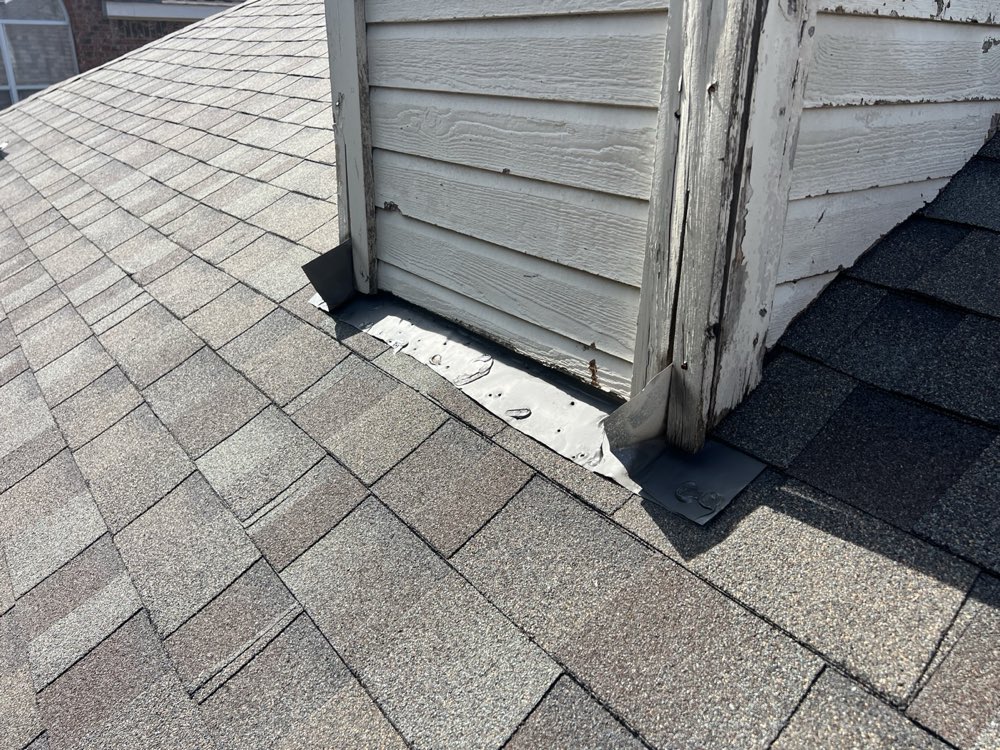
The ground under Richardson is expansive clay. It swells after rain and shrinks in the summer heat, and foundations ride along with it. A masonry chimney is heavy and rigid and often stands on its own footing, so the house and the chimney can move at slightly different rates. That is how a gap opens between the chimney and the siding. The pier and beam homes in Heights Park flex differently than slab homes do, but both types show up on our schedule with the same complaint: daylight where chimney meets wall.
Winter freezes do their damage quietly. Water sits in a cracked crown or an open mortar joint, freezes, expands, and pries the crack wider. One freeze does little. Fifty winters of them is how a 1960s chimney ends up loose at the top.
Spring hail finishes the list. The chimney is the highest thing on the house, so caps get dented, chase covers get punctured, and crowns take direct hits. After a storm the roof gets an adjuster’s attention and the chimney usually gets none.
- White staining on the brick, a sign water is moving through it
- A gap between the chimney and the house wall
- Chunks of mortar or crown found on the roof or in gutters
- A damper that no longer seats, often rust from water getting past the cap
Where Our Work Stops: The Gas Side
Plenty of Richardson fireplaces burn gas logs. We work on the structure and the venting: the firebox, the flue and liner, the crown, the cap, the flashing, and the damper. Gas lines, valves, and pilot assemblies are a different trade, and they belong to a gas fitter, not to us.
If we open up your fireplace and see something on the gas side that worries us, we photograph it, show you, and tell you to call a gas professional. We would rather lose a line item than touch work that is not ours.
New Company, Documented Work
We do not have decades of history in Richardson to point to, so we built the business around something you can check yourself: photos. The inside of your flue before we sweep it. The crack we found in your crown. The same spots after the work. We call it Photos Not Promises. You judge the work with your own eyes, not our adjectives. When you call, you talk to the technician, and the technician is who shows up.
If you are not sure where to start: a chimney inspection makes sense for a boom-era house with an unknown history, a chimney sweep if you burn regularly, and chimney repair if you already know something is broken.
Get A Photo Report On Your Richardson Chimney
Tell us what you are seeing or hearing and we will tell you whether it needs a sweep, an inspection, or a repair. If it is nothing, we will say that too.
WHAT HAPPENS WHEN YOU CALL
You call or send the form
We ask what you are seeing or hearing. A person, not a queue.
We arrive and cover everything
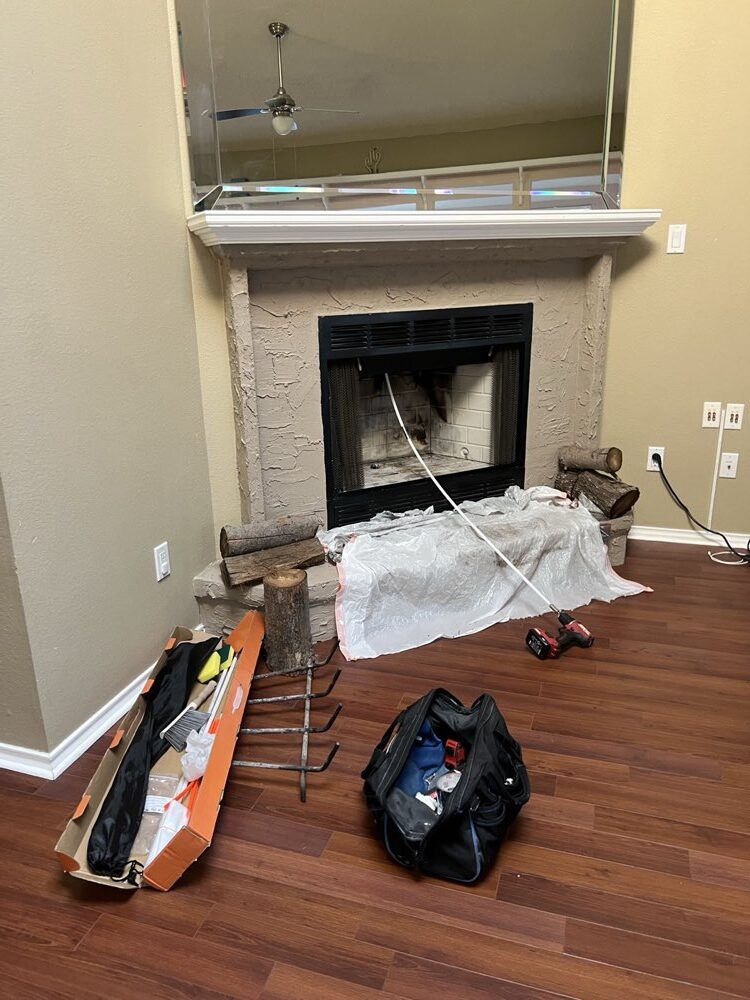
Tarps down and the vacuum ready before a tool comes out.
Camera, brushes, eyes on all of it
Firebox, damper, flue and the top of the chimney, photographed.
Photo report the same day
You see what we saw and decide what happens next.
COMMON QUESTIONS
Yes, and they need a lighter touch. Brick and mortar from that era are softer than modern materials, and many flues still have their original clay tile liners. We photograph the flue and the masonry before recommending anything, so you see exactly what shape it is in before any work is discussed.
It means the general inspector looked at the outside, saw a fireplace from the 1960s or 70s, and correctly passed the job to a specialist. A proper chimney inspection puts a camera up the flue and eyes on the crown, and you get photos of both. Often the answer is that the chimney is fine, and then that is the report.
Usually, yes. North Texas clay moves foundations, and a heavy masonry chimney can move at a different rate than the house it is attached to. A stable hairline gap is worth watching and photographing. A gap that keeps growing needs a real evaluation, not a bead of caulk over the top of it.
No, it is just a different system with different weak points. Factory-built fireplaces usually fail at the top, where the sheet metal chase cover rusts through and lets rain into the wood framing. Rust streaks running down the chase are the early warning. The fix is a new cover, not a rebuilt chimney.
No. We handle the masonry and venting side only: firebox, flue, liner, crown, cap, flashing, and damper. Gas lines, valves, and pilot work belong to a gas fitter. If we spot a gas-side concern during a visit, we photograph it and tell you to bring one in.
The burn season here runs roughly November through February. If you burn most weekends of that stretch, have the flue checked once a year before the first fire. If you rarely light it, start with an inspection instead; it will tell you whether a sweep is even needed. Buildup depends on your wood and your habits, not the calendar.
All of it: 75080, 75081, and 75082, from Heights Park and Canyon Creek to the newer areas near CityLine, plus the surrounding cities. We are a mobile company, so we come to you. Nearby, we also serve Dallas and Plano.
RELATED
REQUEST A CALL BACK
A person calls you back about your chimney, not a dispatcher.
Is Your Chimney as Old as Your Street?
If your house went up with Heights Park or Canyon Creek, its flue has earned a look. One visit settles it, in pictures.