
Chimney and Fireplace Service in Mesquite
Most of Mesquite went up between 1950 and 1980, which means thousands of its chimneys are hitting old age at the same time. Here is what we see, with photos to prove it.
LOCALLY BASED IN DFW
We drive to you, no national call center
WRITTEN PHOTO REPORT
Every finding shown before it is quoted
SAME-WEEK SCHEDULING
Booked in days, not weeks
OWNER-ANSWERED PHONE
The person who answers is the person who comes
Mesquite was built in a hurry. In 1950 this was a farm town of 1,696 people. By 1970 it held 55,131. That kind of growth left the city with block after block of brick ranch homes, and most of those homes have a chimney that is now fifty to seventy years old.
Local Chimney Experts is new to the trade in Mesquite, and we say so up front. What we offer instead is careful work and photos of everything we find, before and after. If nothing is wrong, that is the report you get.
This page is about Mesquite homes specifically: how the housing stock got here, what Blackland clay and North Texas weather do to it, and what to watch for in yours.
YOU SEE WHAT WE SEE
You cannot see your own chimney. That is the whole problem with this trade, and it is why people feel talked into things.
Every visit ends with photographs of what we found, walked through with you before anything is quoted. If the pictures show nothing wrong, that is the report you get.
- Camera up the flue, not a guess from the hearth
- Every finding photographed before it is quoted
- The same spots photographed again after the work
- Written report in your inbox the same day
A Railroad Town That Became a Boom Suburb
Mesquite started in 1873 as a depot stop on the Texas and Pacific Railway, and for its first seventy years it stayed a small farm town shipping cotton toward Dallas. Then the postwar boom hit. The census counted 1,696 people here in 1950, 27,526 in 1960, and 55,131 in 1970. Whole neighborhoods went up inside a stretch of about twenty years.
Town East Mall opened in 1971 and pulled the city’s center of gravity east, with new streets filling in around it. The rodeo identity is real too: the Mesquite Championship Rodeo has run since 1958, and in 1993 the Texas Legislature named Mesquite the Rodeo Capital of Texas.
Here is why any of this matters for your fireplace. A city built mostly in one burst is a city full of chimneys reaching old age together. The mortar, the crown, and the flue liner in a boom-era Mesquite home have been through decades of Texas weather, and most have never been looked at closely.
Two Generations of Mesquite Chimneys
The boom-era neighborhoods, places like Falcon’s Lair, Palos Verdes, Northridge Estates, and the streets around Town East, are mostly brick ranch homes with true masonry chimneys: brick walls, mortar joints, a poured concrete crown, and a clay tile liner inside. These fail slowly. Mortar softens, crowns crack, liner joints chip.
The newer subdivisions tell a different story. Creek Crossing Estates, for example, was mostly built between the late 1980s and 2000. Homes from that era usually have a factory-built fireplace instead: a metal firebox and flue pipe inside a wood-framed chase, wrapped in brick veneer or siding, with a sheet metal cover on top. These fail at the top, where the cover rusts through and lets rain into the framing.
The first thing we establish on any Mesquite job is which type you own, because it changes everything about what to check and what can go wrong.
We Cover Mesquite.
Tell us what you are seeing and we will tell you which visit it needs.
What Blackland Clay Does to a Heavy Chimney
Mesquite sits on the Texas Blackland Prairie, on expansive clay that runs through this side of Dallas County. The clay swells after rain and shrinks hard in the summer heat, and it drags foundations along as it moves. A masonry chimney is the heaviest, most rigid part of the house, so when the slab shifts, the chimney can lean or pull away from the wall it was built against.
A thin gap between chimney and siding is worth watching. A gap that widens season to season needs a real look, because the fix is structural, not cosmetic. A bead of caulk hides the symptom and stops nothing. Watering the foundation through the summer helps the slab, and it helps the chimney that rides on it for the same reason.
- A gap between the chimney and the house wall that grows over time
- Stair-step cracks in the brick near the chimney base
- A chimney that looks slightly tilted from the street
- Doors and windows near the fireplace that suddenly stick
Freeze, Hail, and a Crown Poured Decades Ago
North Texas winters bring a few hard freezes most years, and the February 2021 storm showed what a long one can do. Water soaks into brick and into hairline cracks in the crown, freezes, expands, and pries everything open a little wider each cycle. On a chimney whose crown was poured in the 1960s, those hairline cracks have had a long head start.
Spring hail works on the top of the chimney the same way it works on the roof: dented caps, punctured chase covers, chipped crown edges. After a storm, the shingles get checked and the chimney usually gets skipped. If your roof took hail, ask for photos of the chimney top too.
- White crusty staining on the brick, a sign water is moving through it
- Chunks of mortar or crown found on the roof or in the gutters
- Rust streaks running down a siding-wrapped chase
- A damp smell in the firebox after rain
Chattering in the Flue Is Usually Chimney Swifts
Every summer, Mesquite homeowners hear a rattling, chattering sound from the fireplace, usually in June or July. That is almost always chimney swifts, small birds that nest inside open flues across Texas. They are protected under federal migratory bird law, so no one can legally remove an active nest. The honest answer: wait until the birds finish nesting and move on, usually by late summer or early fall, then have the flue swept and a chimney cap installed so it does not happen again.
New Company, Documented Work
We do not have decades of history to point to, so we built the business around something you can check yourself: photos. The inside of your flue before we sweep it. The crack we found in your crown. The same spots after the work. We call it Photos Not Promises. You judge the work with your own eyes, not our adjectives. When you call, you talk to the technician, and the technician is who shows up.
One boundary we hold: we work on the masonry and venting side only. Gas lines, valves, and pilot assemblies belong to a gas fitter, and if your job touches one, we will say so instead of pretending otherwise.
If you are not sure where to start: a chimney inspection fits a house with an unknown history, a chimney sweep if you burn regularly, and chimney repair if you already know something is broken.
Talk To Someone Who Works In Mesquite
Tell us what you are seeing or hearing and we will tell you whether it needs a sweep, an inspection, or a repair. If it is nothing, we will say that too.
WHAT HAPPENS WHEN YOU CALL
You call or send the form
We ask what you are seeing or hearing. A person, not a queue.
We arrive and cover everything
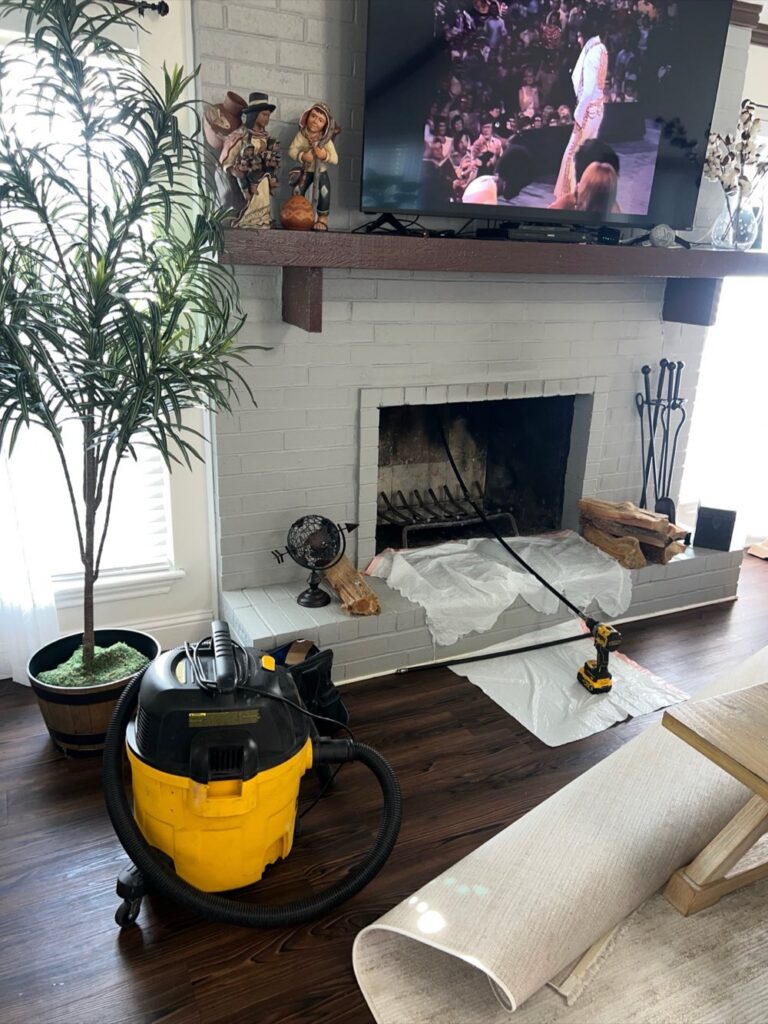
Tarps down and the vacuum ready before a tool comes out.
Camera, brushes, eyes on all of it
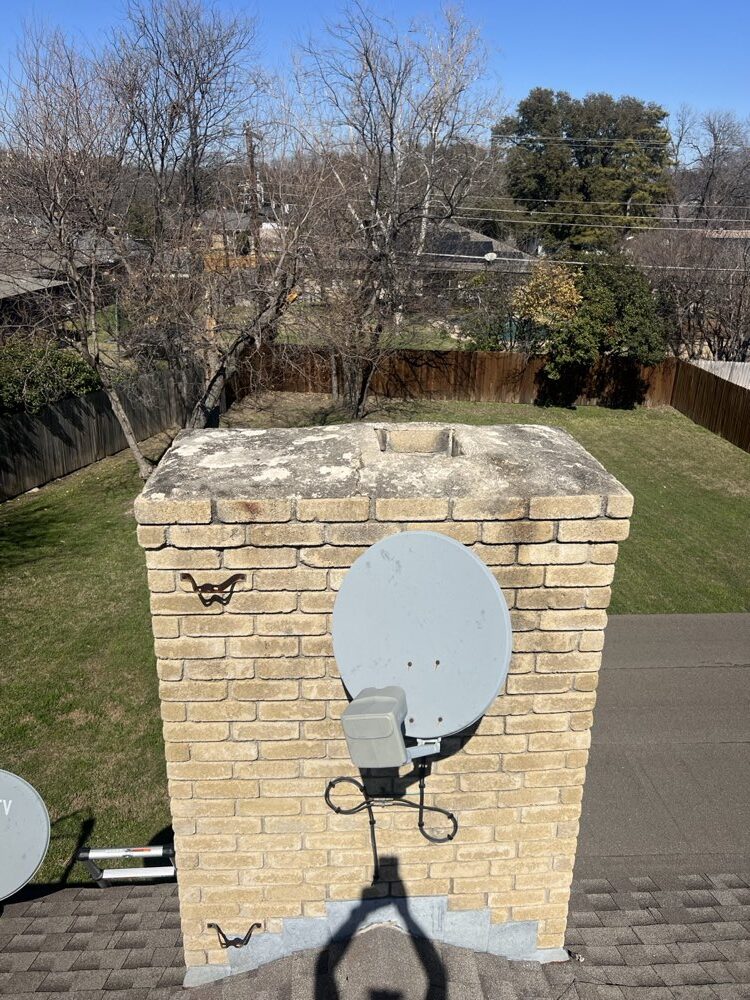
Firebox, damper, flue and the top of the chimney, photographed.
Photo report the same day
You see what we saw and decide what happens next.
COMMON QUESTIONS
Yes, and they are most of what we see in Mesquite. Boom-era homes have aging mortar, original clay tile liners, and crowns that have never been resurfaced. We photograph the flue and the masonry before recommending anything, so you see exactly what shape yours is in.
More common than most people expect. The Blackland clay under Mesquite moves foundations, and the chimney often moves with them. A small, stable gap is worth watching. A growing one needs a real look. We document what we find so you can compare it over time.
Not while a chimney swift nest is active. Federal law protects them, and that applies to everyone. Once the birds leave, usually by late summer or early fall, we can sweep the flue and add a cap so your chimney stops being a birdhouse.
The burn season here is short, roughly November through February. If you burn most weekends of that stretch, have the chimney checked once a year before the first fire. If you barely use it, an inspection will tell you whether a sweep is even needed. Buildup depends on your wood and your habits, not the calendar.
Start with an inspection, not a sweep. A sixty-year-old flue may be clean but cracked, or dirty but sound, and those need different answers. We photograph the liner, the crown, and the firebox first, and only then talk about what, if anything, to do.
On the masonry and venting side, yes: the firebox, the flue, the cap, the chimney structure. Gas lines, valves, and pilot assemblies are a gas fitter’s work, not ours. If your fireplace needs both, we will tell you plainly where our part ends.
All of Mesquite, from the boom-era core to the newer subdivisions on the city’s edges, plus nearby eastern Dallas County. We are a mobile company, so we come to you.
RELATED
REQUEST A CALL BACK
A person calls you back about your chimney, not a dispatcher.
Is Your Crown Older Than Town East Mall?
One visit and a same-day photo report tell you exactly where a boom-era crown stands, in pictures you can see for yourself.