
Chimney Flashing Repair in Dallas-Fort Worth
The metal joint where your chimney passes through the roof is the most common way water gets into a house. The technician finds the failure, cuts the fix back into the mortar, and photographs it.
CAMERA INSPECTION
We look before we quote, every time
PHOTOS OF EVERY FINDING
No photo, no claim
MASONRY AND VENTING ONLY
Gas lines go to a gas fitter and we say so
SAME-DAY REPORT
What Is Chimney Flashing Repair?
Chimney flashing repair replaces or reseats the metal that seals the joint where the chimney passes through the roof, the most common way water gets into a house. The failed apron, step flashing, back pan, or counter flashing is identified, the new metal is cut back into a mortar joint rather than caulked to the brick face, and every finding is photographed before it is quoted.
In your inbox before we finish the day
A tan ring spreading on the ceiling by the fireplace. A musty smell after a storm. Drips you can hear inside the firebox when it rains hard. Most Dallas-Fort Worth homeowners assume the roof is failing. Usually the problem is smaller: the flashing, the metal sealing the joint where your chimney passes through the roof deck.
Flashing leaks more than any other part of a chimney, and the reason is structural rather than accidental.
Local Chimney Experts is new in DFW. The technician runs it on one habit: Photos Not Promises. You see your flashing before we touch it, during, and after.
YOU SEE WHAT WE SEE
You cannot see your own chimney. That is the whole problem with this trade, and it is why people feel talked into things.
Every visit ends with photographs of what we found, walked through with you before anything is quoted. If the pictures show nothing wrong, that is the report you get.
- Camera up the flue, not a guess from the hearth
- Every finding photographed before it is quoted
- The same spots photographed again after the work
- Written report in your inbox the same day
Why flashing fails before the rest of the chimney
Your chimney is the one spot on the roof where brick meets shingles. Brick does not bend. Shingles and decking move with heat, cold, and settling. The flashing bridges that joint, so it absorbs all of the movement.
North Texas adds two loads. Roof metal here sits in full sun most of the year, growing and shrinking through every heat cycle while the masonry behind it barely moves. Then spring storms drive rain sideways into whatever gap that movement opened. Hail across the Metroplex runs roughly March into June and peaks in April and May, and a stone that dents a cap will also lift a flashing edge already working loose.
So a chimney with solid brick and a sound crown can still soak a ceiling.
- Water stains on the ceiling within a few feet of the chimney
- Peeling paint or bubbling drywall on the wall beside the chimney
- A leak that returns each spring and goes quiet in a dry autumn
Step flashing, counter flashing, and the two pieces nobody mentions
People say flashing as though it were one product. On a chimney it is four separate jobs, and a leak usually traces to whichever one was skipped.
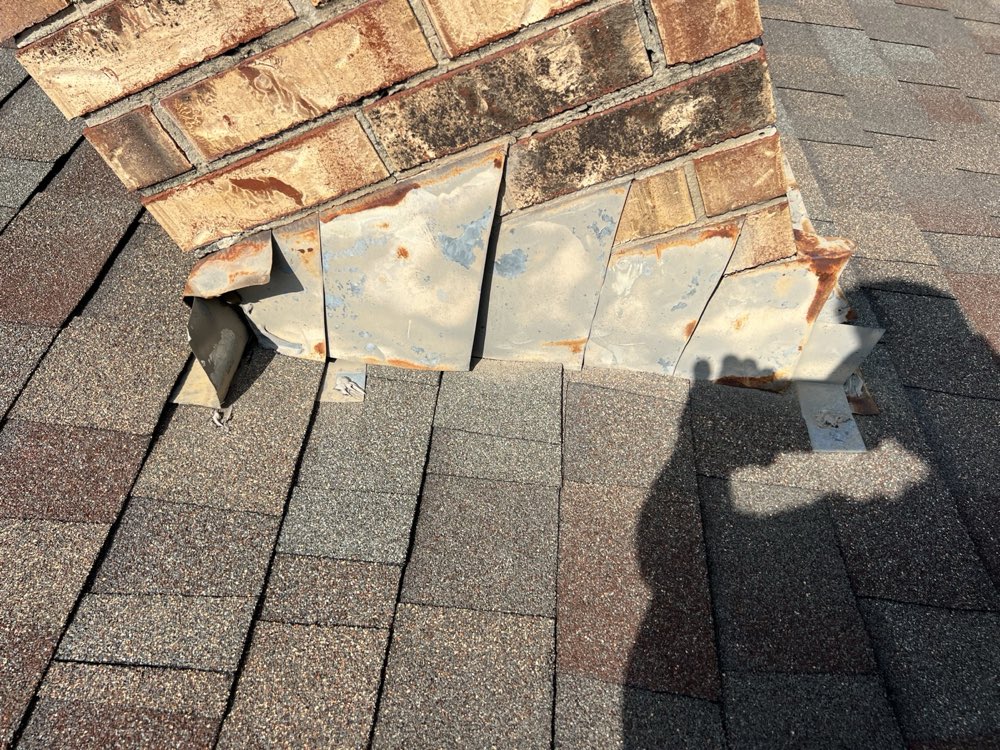
The downhill face gets an apron: one wide piece bent over the shingles below and turned up the brick above.
The two sides get step flashing, small L-shaped pieces woven under the shingles, one per course, each turned up against the brick. They are separate pieces on purpose, because separate pieces shift independently as house and chimney settle at different rates. One long bent strip cannot, so it splits.
The uphill face gets a back pan, also called head flashing. It fails most often, because it sits where the roof delivers everything it collects.
Over all of it sits counter flashing, the layer visible from the ground. It is cut into a groove in the mortar and bent down over the step flashing, like a hat brim over eyes, so water sliding down the brick gets thrown out onto the shingles instead of led in behind the metal.
Stain On The Ceiling Near The Chimney?
Flashing is the most common way water gets in.
What you can check without getting on the roof
You cannot inspect flashing from the ground, but you can narrow it down enough to tell whether someone is guessing.
Stand back in the driveway with binoculars or your phone camera zoomed in and find the horizontal line where metal meets brick. On correct work that line sits inside a mortar joint and steps down the slope with the shingle courses. If the metal lies flat on the brick face with a bead of sealant along its top edge, or crosses the middle of a brick rather than a mortar line, it was stuck on the surface instead of cut in.
Inside, the attic tells you more than the ceiling does.
- Dark staining on the decking uphill of the chimney with dry wood downhill points at the back pan, not the sides
- Staining down one side of the masonry points at the step flashing on that side, and at the direction storms arrive from
- Wet insulation in a band leading away from the chimney means water is travelling a rafter first
- Daylight beside the chimney from inside the attic is an open gap, and it needs no storm to prove it
Tar smears and caulk beads: the red flag we photograph
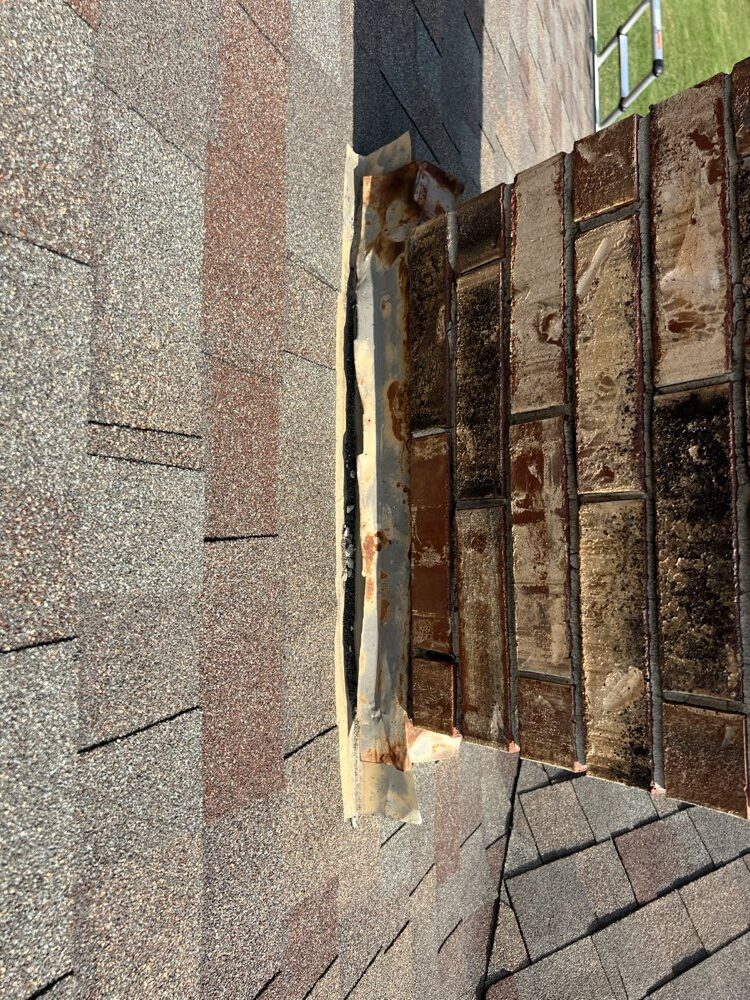
Black roofing tar or a fat bead of caulk where metal meets brick means someone took a shortcut. Tar over failing flashing holds a season or two, then cracks, and the real repair now starts with scraping hardened goo off brick and metal.
Sealant still has a place: a thin line of urethane inside a clean mortar groove, holding a properly cut edge of metal. What it cannot be is the thing keeping water out. Home inspection guidance treats a caulked joint at the top of counter flashing, or one built on asphalt cement, as a temporary condition needing repeat maintenance, not a finished repair. A Texas roof bakes sealant, and baked sealant shrinks away from whatever it was gripping.
The metal itself, and why aluminum and mortar do not get along
Two flashing jobs can look identical from the driveway and age completely differently, because of the metal.
Aluminum is cheap, soft, and easy to bend on a roof, which is why it turns up on work done quickly. It is also the wrong choice against masonry: the alkalis in mortar attack unpainted aluminum, so the groove meant to anchor the metal starts eating it instead. Materials normally accepted against masonry are galvanized steel, galvalume, copper, lead, and lead-coated copper, with stainless in the same company.
Mixing metals causes its own trouble. Aluminum step flashing under copper counter flashing corrodes as though something acidic had been poured on it, because two dissimilar metals sharing rainwater set up a reaction. Keep the metal consistent from the step flashing to the nails.
- White powdery pitting near the mortar line usually means aluminum where aluminum should not be
- Rust bleeding onto the shingles below means galvanized steel with its coating gone
The cricket question on a wide chimney
Some flashing repairs fail because the flashing was never the problem. On a wide chimney sitting mid-slope, everything the roof collects above it arrives at the back pan at once, and no metal joint sheds water it is being asked to hold.
The residential building code sets the line at 30 inches, measured parallel to the ridgeline, and applies it where the chimney does not intersect the ridge. The same chimney is two different situations depending on where it sits. Straddling the peak, the roof never delivers water to its uphill face. Partway down the slope, it works like a dam. The code also requires the joint between cricket and chimney to be flashed and counter flashed like any other roof-to-chimney intersection, which is where a chimney cricket gets built and leaks anyway.
When a new roof leaves old flashing behind
Plenty of flashing calls in this metro follow a roof replacement by six months to a year, and the cause is a seam between two trades rather than bad intent.
Step flashing is woven in with the shingles, so the only moment it can be replaced is while the shingles are off. Counter flashing belongs to the chimney, cut into masonry that no roofing scope covers. The fast version goes like this: bend the old counter flashing up out of the way, shingle past it, bend it back down, run a bead along the top. You now have a new roof, metal work-hardened by being bent twice, and a sealant line doing the job a mortar groove was supposed to do.
This is also the one honest case for waiting. If your roof is due for replacement within a season or two, have the flashing done with the roof rather than ahead of it. What is not sensible is letting an active leak run in the meantime.
What the repair involves, and what makes one bigger
We trace the water before blaming the flashing. A ceiling stain near the chimney usually means flashing, but a cracked crown or a missing cap produces the same stain, so the visit starts at the attic and the chimney top. To have everything checked while we are up there, ask about a full chimney inspection.
The counter flashing groove separates honest work from fast work. It is cut into the mortar joint, roughly an inch to an inch and a half deep, never into the face of the brick. The metal edge is bent, set into that groove, wedged so it holds mechanically, then sealed. Below it, the counter flashing overlaps the step flashing by several inches so water crossing between layers never meets an open seam.
Size comes down to four things: chimney width, which sets how much groove to cut and how many courses to lace; roof pitch; cladding, since a stucco or sided chase has no mortar joints and needs a different termination; and soft decking, which means carpentry first.
- Trace the leak from the ceiling stain and the attic side first
- Grind the joint, set new counter flashing into it, replace step flashing where the shingles allow
Maybe it is not the flashing. We will say so.
Some chimney leaks start above the metal. A cracked crown soaks water into the brick from the top. A missing cap lets rain fall down the flue. Some are not the chimney at all: a worn patch of roof directly above it, or a valley aimed at its back wall, leaves a stain exactly where you would blame the chimney.
If the flashing turns out sound, you hear that, with photos, and we point you at the real fix, whether that is chimney crown repair, a chimney cap installation, or broader chimney leak repair.
WHAT HAPPENS WHEN YOU CALL
You call or send the form
We ask what you are seeing or hearing. A person, not a queue.
We arrive and cover everything
Tarps down and the vacuum ready before a tool comes out.
Camera, brushes, eyes on all of it
Firebox, damper, flue and the top of the chimney, photographed.
Photo report the same day
You see what we saw and decide what happens next.
COMMON QUESTIONS
Location and timing are the clues. A stain within a few feet of the chimney that appears during or after rain points to flashing. One far from the chimney, or one that grows in dry weather, points elsewhere. We confirm it from the attic and the roof first.
Caulk smeared over failed flashing is the exact shortcut we photograph on other people’s work, so no. Sealant belongs in a clean mortar groove over properly cut counter flashing. Used as a patch over bad metal, it cracks and the leak returns.
Galvanized steel, galvalume, copper, lead, and lead-coated copper are normal against masonry, and stainless belongs on that list. Bare aluminum does not, because mortar chemically attacks it. Mixing metals at one joint, such as aluminum under copper, starts a reaction that eats the softer one.
Both do. The difference is what else gets looked at. A roofer reads the shingles. We check the crown, the cap, the mortar joints, and the flashing together, because chimney leaks often have more than one source, and fixing one leaves a smaller leak instead of no leak.
Ideally yes, because step flashing can only be laced in while the shingles are off. What often happens instead is that the old counter flashing gets bent up, the roof goes on, and the same metal is bent back down and sealed. A photo settles which version you got.
No. Texas dry spells hide leaks, they do not fix them. The gap in the metal is still there, and the next storm will find it. Water that already got in has been sitting in your insulation and framing, which is worth checking too.
Most fit in a single visit. Cutting new counter flashing into the mortar on a large chimney takes longer than resealing one joint, and a steep roof slows everything down. We tell you which job yours is before we start.
Water follows the same path every storm. First it stains drywall, then it soaks insulation and rots the roof decking around the chimney. Caught early, a flashing repair stays a metal job. Put off long enough, it becomes a carpentry job with a metal job on top.
RELATED
REQUEST A CALL BACK
A person calls you back about your chimney, not a dispatcher.
Get eyes on your flashing before the next storm
Call or text the technician for a straight answer on that ceiling stain. You get photos of everything we find and everything we fix, including the parts that are sound.