
Chimney Waterproofing in Dallas-Fort Worth
A breathable water repellent that keeps rain out of your brick, applied only when your chimney is actually ready for it.
CAMERA INSPECTION
We look before we quote, every time
PHOTOS OF EVERY FINDING
No photo, no claim
MASONRY AND VENTING ONLY
Gas lines go to a gas fitter and we say so
SAME-DAY REPORT
In your inbox before we finish the day
Brick looks solid. It is not. A brick chimney works like a stack of hard sponges, and every North Texas storm pushes water a little deeper into it. Over time that water breaks mortar apart from the inside, stains ceilings, and turns small repairs into big ones.
Waterproofing slows that down. We spray a breathable water repellent onto clean, sound brick. Rain beads and runs off instead of soaking in, while moisture already inside can still escape as vapor.
One honest note before you book: waterproofing is a finish step, not a cure. If your crown is cracked or your flashing leaks, a repellent will not save you. Everything below is the reasoning behind that.
What is chimney waterproofing?
Chimney waterproofing is the spraying of a breathable, penetrating water repellent onto clean, sound brick so rain beads off while moisture inside still escapes as vapor. It is a finish step, not a cure: crown, flashing, cap, and mortar repairs come first, since a repellent cannot bridge a crack wider than about half a millimeter. Local Chimney Experts applies it across Dallas-Fort Worth, test patch first.
YOU SEE WHAT WE SEE
You cannot see your own chimney. That is the whole problem with this trade, and it is why people feel talked into things.
Every visit ends with photographs of what we found, walked through with you before anything is quoted. If the pictures show nothing wrong, that is the report you get.
- Camera up the flue, not a guess from the hearth
- Every finding photographed before it is quoted
- The same spots photographed again after the work
- Written report in your inbox the same day
How rain actually gets into a brick chimney
Brick and mortar are full of tiny pores, and a pore behaves like a thin straw: left alone it pulls water in. That pull is capillary suction, and it is why dry brick goes dark the instant you splash it. A penetrating repellent flips the pull, lining the pore so the surface that drew water in now pushes it away.
A chimney is the most exposed masonry on the house, unshaded on all four faces. The prevailing wind recorded at DFW airport comes from 170 degrees, roughly south-southeast, at a mean near 10.5 miles an hour, which is why the south and southeast faces of a stack here weather worse than the north face.
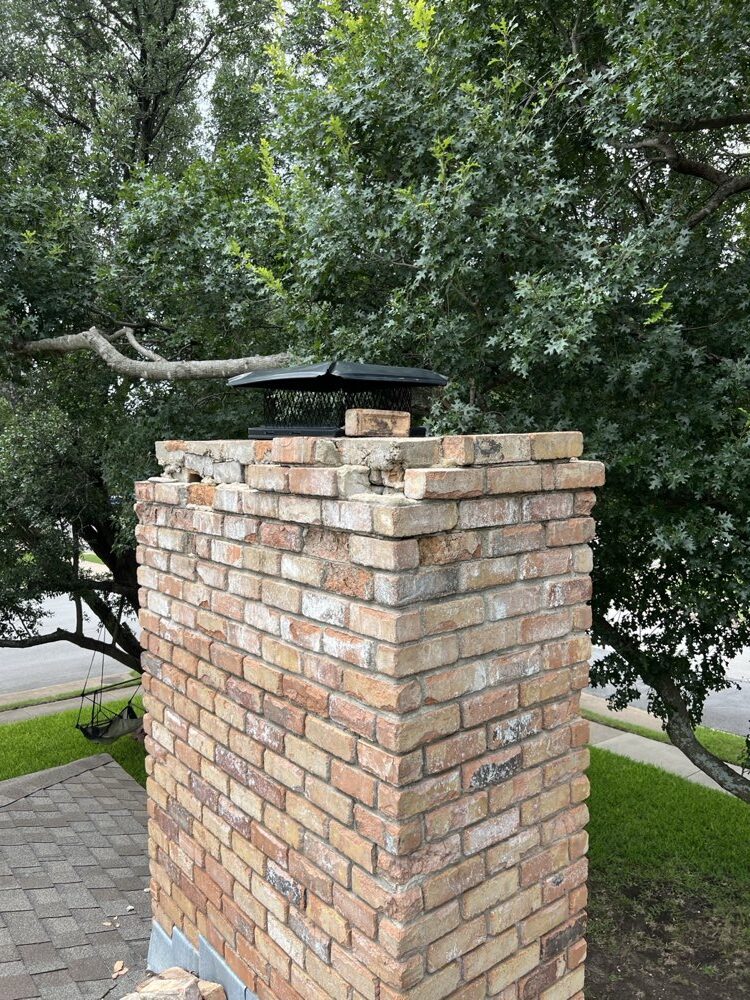
Where the water gets in matters as much as how much arrives, and usually it is not through the middle of a brick but through the hairline separation between a brick and the mortar around it. That sets the hard limit on this page. The Brick Industry Association’s technical notes state that a water repellent cannot keep water out of a crack wider than about 0.02 inches, half a millimeter, thinner than a credit card. Anything wider is masonry work, not spray work.
The white powder has a name, and it carries a message
That chalky bloom on the brick is efflorescence. Not mold, not paint failing. It is mineral salt that was already inside the wall, dissolved by water, carried to the face, and left there when the water evaporated. Three conditions have to hold at once: soluble salts in the brickwork, water touching them long enough to dissolve them, and pores open enough to carry that solution out.
Timing tells you which problem you have. Efflorescence on brickwork under a year old is usually what the trade calls new building bloom, the wall shedding water it was built with, and it fades on its own. Efflorescence appearing more than a year after the masonry went up generally means water is getting in and staying in, and it runs worst in winter.
One piece of advice that catches people out: do not hose it off. Washing adds the exact ingredient that produces it, and in cool damp weather you draw out more salt than you removed. Dry brushing lifts most of it.
- Faint and even, on a house under a year old. Most likely the wall drying out. Leave it.
- Heaviest near the top of the stack. Look at the crown before anything else.
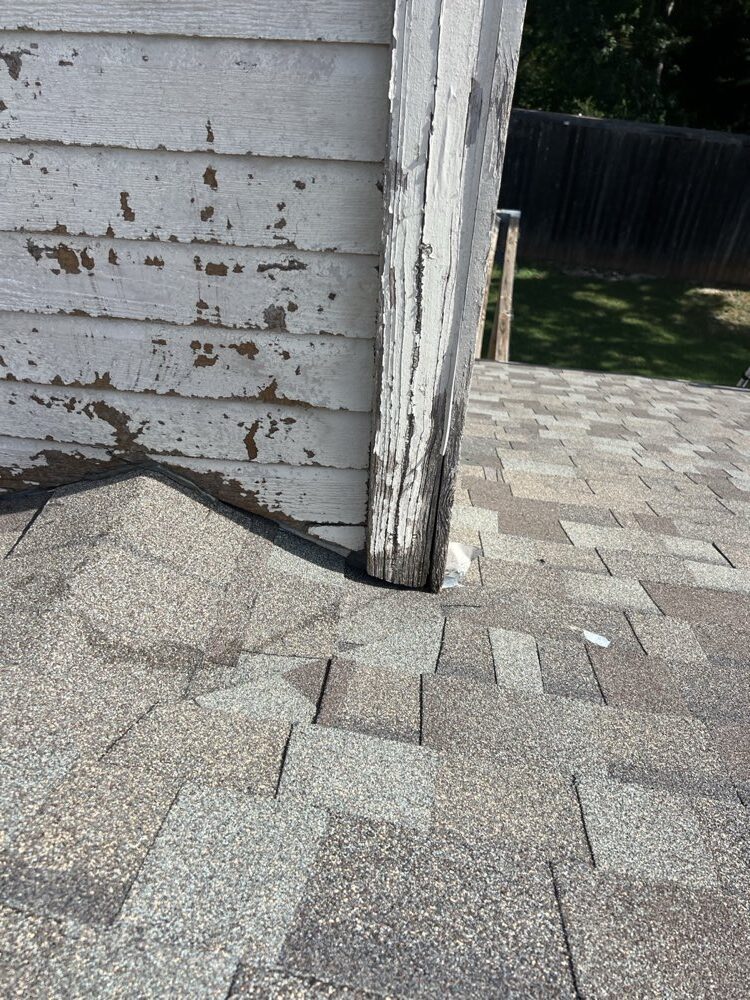
- A band following the roofline. Flashing is the usual suspect.
- Back after every wet spell, years on. A spray alone will not settle that.
Brick Drinking The Rain?
Repairs first, repellent second. In that order on purpose.
What a sealer does to brick where you cannot see it
Water still gets into a wall with paint or a film-forming sealer on it, because a film on the face does nothing about a cracked crown or an open joint at the roofline. On the way in it dissolves salt, then heads back out to evaporate and cannot get there. The solution stops just behind the coating, typically an eighth to a quarter inch below the surface, the water passes through as vapor, and the salt crystallizes inside the brick instead of on top of it.
Salt crystals growing in a confined pore generate real pressure. The Brick Industry Association calls this cryptoflorescence, or subflorescence, and names brick spalling as the outcome. It is the mechanism behind every painted chimney losing its faces in sheets: the paint did not peel and then let water in, water got in, could not get out, and pushed the brick off from behind. Freezing runs the same play faster, and Dallas-Fort Worth averages around 29 nights a year at or below freezing. The guidance is blunt: film-forming coatings should not go on brick in freeze-thaw environments.
Which gives you one number to demand from anyone quoting this work: a water vapor permeability of 0.98 or greater, measured by ASTM E96. If nobody can tell you that figure, you have your answer.
What we spray, and what we refuse to spray
We use a breathable, penetrating water repellent made for masonry. The depth is real: penetrating repellents reach up to about three eighths of an inch into brick and mortar, lining the pores rather than bridging them.
Penetrating is not one product. Siloxanes have a larger molecule, grip chemically to the silica and alumina in brick and mortar, and carry a published service life of up to ten years. Silanes use a smaller molecule at higher concentration, which suits denser material. Blends of the two are what most chimney brick calls for. Avoid the cheap end: plain silicone resins and stearates do not attach the same way and often need redoing yearly.
All of which is why we will not paint your chimney or coat it in a gloss sealer, even if you ask nicely.
Application is less casual than it looks. The wall has to be genuinely clean, since dirt blocks penetration. Glass and shingles get masked, because siloxane grabs unprotected glass. We work between roughly 40 and 100 degrees, never on a windy day, spraying low to high until the product runs several inches below the spray line, then coming back wet on wet. And we hold to the coverage rate on the label. Over-applying is not extra protection. It reduces the breathability that is the entire point.
What you can check yourself before anyone gets on a roof
Take a cup of water to a reachable part of the chimney, wet a patch of brick, and watch. Water that beads and runs means the brick still sheds rain on its own. Brick that darkens within a few seconds is drinking. Do the same on a mortar joint, because the two often give different answers and the joint is usually thirstier. Then notice when the trouble shows up. It is the most useful thing you can tell us.
- Damp only after hard, wind-driven rain, usually on one side of the house. Absorption through the wall face, exactly what a repellent is for.
- Damp after any rain, including a gentle straight-down one, points upward instead. Crown, cap, or flashing.
- Damp appearing hours after the rain stopped rather than during it. Absorption again.
- Damp in cold weather with no rain at all. Usually condensation from inside, which no outside coating will touch.
- Mortar you can dig out with a key, or brick faces flaking. Repair first, cure, then treat.
The order of the work, and what a repellent will never fix
Waterproofing is the last step in a sequence, and jumping the queue is how people waste money on a chimney. Crown first, because it is the horizontal surface taking the direct hit. Flashing next, where roof and chimney meet and disagree. Cap, so rain is not dropping down an open flue. Then repointing and brick replacement. Only then a repellent, on brick that is sound and dry.
Two waits are built in. Freshly repointed mortar and sealant need a minimum of 72 hours to cure before anything goes over them. On new brickwork the published guidance is a month at the very least and a full year preferred, so new building bloom can vent instead of getting shut inside the wall.
There is a third wait, and it costs us work. Once repairs are done, give the chimney a few months of real weather and see whether the problem is already solved. Fixing a crown and a flashing line very often ends the story.
- A cracked crown, failed flashing at the roofline, or a missing cap. Water gets in above the wall face, where no spray reaches.
- The roof itself. A valley dumping onto the chimney, or shingles at the end of their life, is a roofer's problem.
- Damp at the base below the roofline or in a crawl space. Drainage and ground water, not chimney masonry.
- A chimney somebody already painted. The paint comes off first, and that is the expensive version.
- Worth doing, by contrast: porous brick that fails the splash test, cured masonry repairs, and a tall unshaded stack taking its share of the 37 inches of rain DFW averages in a normal year.
Photos, not promises
Local Chimney Experts is young, Dallas-Fort Worth based, and open about both. What we offer instead of badges is documentation.
Before anything gets sprayed you see photos of your crown, flashing, cap and brick, close enough to judge for yourself. We treat a test patch somewhere nobody looks, so you see the finish before the whole stack gets it. Afterward you get photos of the finished surface, the product name, the coverage rate, and the date. Keep the file. It is what another company should be shown if you ever want a second opinion.
WHAT HAPPENS WHEN YOU CALL
You call or send the form
We ask what you are seeing or hearing. A person, not a queue.
We arrive and cover everything
Tarps down and the vacuum ready before a tool comes out.
Camera, brushes, eyes on all of it
Firebox, damper, flue and the top of the chimney, photographed.
Photo report the same day
You see what we saw and decide what happens next.
COMMON QUESTIONS
It depends on the chemistry more than most people are told. Published guidance puts most masonry coatings at five to 15 years, many warranted by their makers for a decade, and siloxanes at up to ten years on brick. Plain silicone resins and stearates can need redoing yearly, which is why the product name matters.
No. A breathable repellent soaks in and dries clear, with no gloss and no film. Your brick looks the same, it just sheds rain.
No, and be wary of anyone who says yes. A repellent cannot bridge a crack wider than about half a millimeter, so spraying over cracked mortar or flaking brick locks the problem in behind a treated surface. Repairs first, 72 hours of cure, then the repellent.
Paint and gloss sealers form a skin that closes the pores. Water still gets in from above, dissolves salt on the way, then stops behind that skin and crystallizes inside the brick, pushing the faces off from within. Published guidance says film-forming coatings should not go on brick in freeze-thaw climates, and North Texas averages around 29 freezing nights a year.
No. A breathable product needs open pores to get into, and paint has closed them. A vapor-permeable coating over a vapor-blocking one gives you the worst of both. The paint has to come off first, which is stripping work with its own contractor, and the brick has to dry after.
Probably not, and we would rather say so on the phone than sell you a spray. Active leaks usually start at the crown, the flashing, or a missing cap. One clue helps: if it only leaks in hard wind-driven rain, the wall face is part of it. If it leaks in any rain, look up.
Often not. Guidance for freshly built brick is to wait a month at minimum and preferably a year, so the wall finishes drying and new building bloom vents instead of being sealed in. After that the splash test decides.
Four things. The product name in writing. Its water vapor permeability, since the recommendation for exterior brick is 0.98 or greater by ASTM E96. The coverage rate. And whether they will do a test patch first.
REQUEST A CALL BACK
A person calls you back about your chimney, not a dispatcher.
Get a straight answer on your brick
Call or text the technician with a photo of your chimney. If waterproofing is not what it needs, you will hear that first.