
Chimney Sweep & Fireplace Service in Corsicana, TX
Oil money built this town’s oldest chimneys more than a century ago. Here is what they need now, documented in photos before anything is quoted.
LOCALLY BASED IN DFW
We drive to you, no national call center
WRITTEN PHOTO REPORT
Every finding shown before it is quoted
SAME-WEEK SCHEDULING
Booked in days, not weeks
OWNER-ANSWERED PHONE
The person who answers is the person who comes
Corsicana sits about an hour south of Dallas on I-45, and much of its housing is older than most of the metroplex’s. A crew drilling a water well here struck oil in 1894, the first significant oil find in Texas, and the money that followed built street after street of substantial homes. Many of them still stand, and so do their original chimneys.
Local Chimney Experts is new to the trade, and we will not pretend otherwise. What we offer instead is careful work and photos of everything we find, before and after, so nothing rests on our word alone. If nothing is wrong with your chimney, that is the report you get.
This page is about Corsicana homes specifically: the oil-boom housing stock, what Blackland clay and North Texas weather do to it, and what to watch for in yours.
YOU SEE WHAT WE SEE
You cannot see your own chimney. That is the whole problem with this trade, and it is why people feel talked into things.
Every visit ends with photographs of what we found, walked through with you before anything is quoted. If the pictures show nothing wrong, that is the report you get.
- Camera up the flue, not a guess from the hearth
- Every finding photographed before it is quoted
- The same spots photographed again after the work
- Written report in your inbox the same day
The First Texas Oil Boom Built These Chimneys
In June 1894, a contractor drilling a new water well for the city hit oil instead, at just over a thousand feet down. That accident made Corsicana the first real oil field in Texas, seven years before Spindletop, and by 1898 the state’s first modern refinery was running here. The boom money went into houses, and plenty of those houses are still lived in today.
That history matters for chimney work. A home built in the 1890s or early 1900s has a true masonry chimney: brick laid in lime-based mortar, with a clay tile liner if the flue was ever updated, or bare brick inside if it was not. Mortar that old is softer than modern mix. It can be repointed and preserved, but it punishes shortcuts. Grinding the joints too aggressively, or patching with hard modern mortar, traps moisture and speeds up the very decay it was meant to stop.
The discovery well site downtown is on the National Register of Historic Places. So, in a quieter way, are a lot of the chimneys this town’s oil money paid for.
The Carriage District, Mills Place, and Old Brick
Corsicana has three National Register historic districts, all listed in 1995: the downtown Commercial district, Mills Place, and the West Side district, which locals call the Carriage District for the side entrances some of its 1800s homes built to shelter horse carriages.
Chimneys in these neighborhoods need a specific kind of attention. The brick is often original. The flues may never have been lined. Decades of settling have usually opened a hairline crack somewhere in the stack. None of that automatically means the fireplace is unsafe, but it does mean nobody should light a first fire in one of these homes on faith. A camera run up the flue answers the question in an afternoon, and you get the pictures either way.
If an old flue turns out to be unlined, or the clay tiles are cracked, a stainless liner is usually the fix that preserves the chimney instead of rebuilding it.
We Cover Corsicana.
Tell us what you are seeing and we will tell you which visit it needs.
Blackland Clay Moves Houses, and Chimneys Move With Them
Corsicana sits on the Texas Blackland Prairie, a belt of dark clay soil that swells after rain and shrinks hard in the summer heat. Foundations ride that movement, and a masonry chimney, being the heaviest and most rigid part of the house, often shows it first. A chimney that leans, or a gap opening between the chimney and the siding, usually started in the soil rather than in the brick.
The honest answer on a leaning chimney is that the masonry repair and the foundation question are two different trades. We can document the lean, measure the gap, repair the brick and mortar damage, and tell you plainly whether what we see suggests the foundation needs its own evaluation. What we will not do is tuckpoint over a structural problem and call it fixed.
Freeze, Rain, and Hail Work on the Top of the Chimney
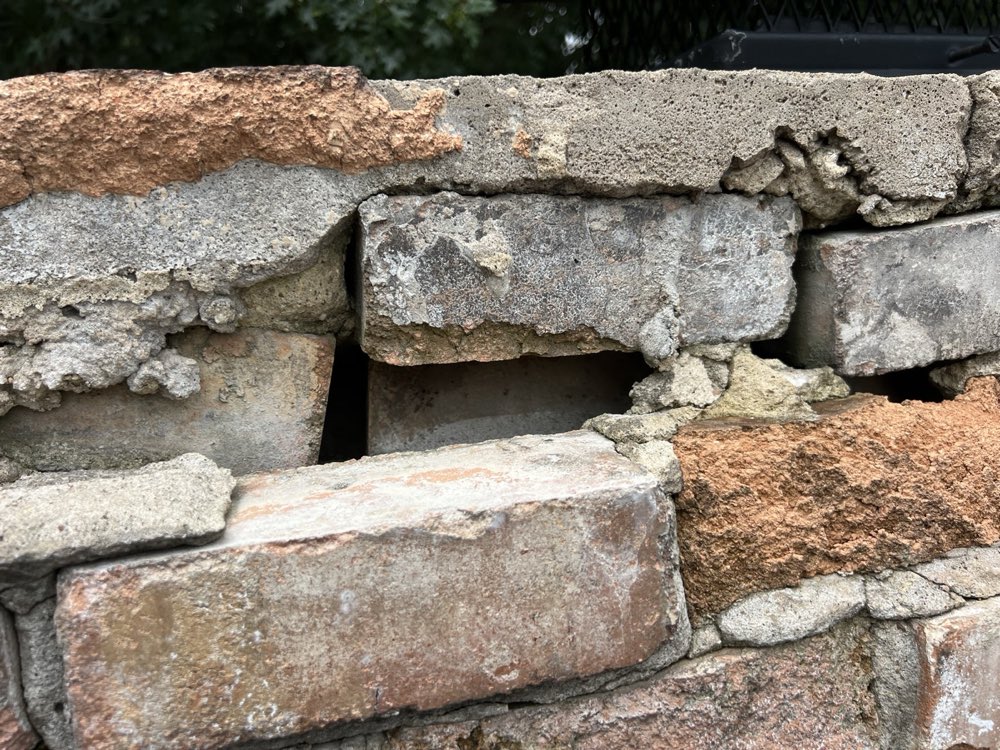
North Texas winters bring a handful of hard freezes most years, and the long February 2021 freeze showed what an extended one can do. Water soaks into brick and into any crack in the crown, freezes, expands, and opens the masonry a little wider each cycle. On a chimney that is already over a century old, freeze-thaw is the main engine of decay.
Hail does its damage in a single afternoon. The top of the chimney takes the first hit: dented or torn caps, cracked crowns, punctured chase covers on newer homes. After a storm the roof gets an inspection and the chimney usually gets skipped, which is backwards, because the chimney is the tallest thing up there.
- White, chalky staining on the brick, a sign water is moving through it
- Chunks of mortar or crown found on the roof or in the gutters
- A damp smell in the firebox after rain
- Daylight or a widening gap where the chimney meets the wall
Newer Corsicana Homes Have a Different Chimney Problem
Not every chimney in town dates to the boom. Houses built from the 1980s onward mostly use a factory-built fireplace: a metal firebox and flue pipe inside a wood-framed chase, wrapped in brick veneer or siding, with a sheet metal cover on top.
These fail at the top, not in the mortar. The chase cover rusts through, rain gets into the wood framing, and by the time a stain shows up on a ceiling the framing has been wet for a while. Rust streaks running down the chase are the early warning. A chase cover replaced in time is a small job. A rotted chase is not.
What We Do in Corsicana, and What We Do Not
We handle the masonry and venting side: sweeping, camera inspections, crown and brick repair, liners, caps, chase covers, flashing, and waterproofing. Every visit produces photos of what we found, before anything is quoted, and photos of the finished work after.
Two things we do not do. We do not touch gas lines, valves, or pilots; that is a gas fitter’s trade, and if your gas fireplace needs that kind of attention we will say so and step aside. And we do not invent problems. If your flue is clean and your crown is sound, the photos will show a clean flue and a sound crown, and that is the report you get.
When you call, you talk to the technician, and the technician is who shows up.
Talk To Someone Who Works In Corsicana
Tell us what you are seeing or hearing and we will tell you whether it needs a sweep, an inspection, or a repair. If it is nothing, we will say that too.
WHAT HAPPENS WHEN YOU CALL
You call or send the form
We ask what you are seeing or hearing. A person, not a queue.
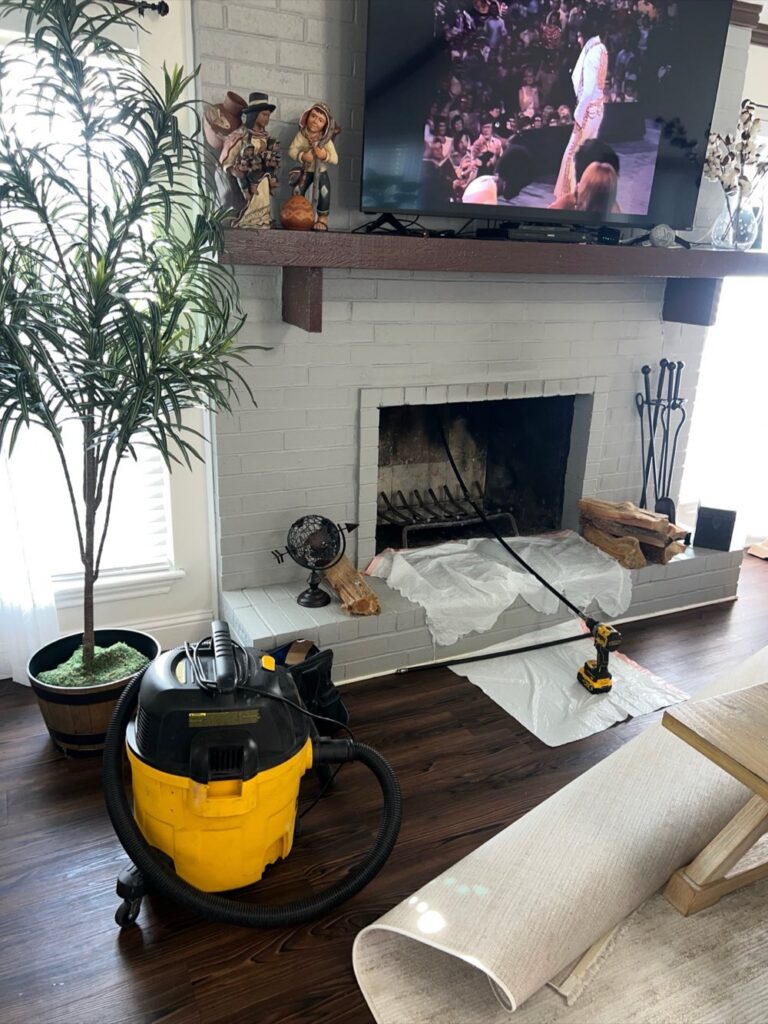
We arrive and cover everything
Tarps down and the vacuum ready before a tool comes out.
Camera, brushes, eyes on all of it
Firebox, damper, flue and the top of the chimney, photographed.
Photo report the same day
You see what we saw and decide what happens next.
COMMON QUESTIONS
Yes. Homes from the late 1800s and early 1900s need a lighter touch: softer brick, lime-based mortar, and flues that may never have been lined. We photograph the flue and the masonry before recommending anything, so you see exactly what shape it is in before any work is discussed.
It is a Blackland Prairie thing. The clay under Corsicana swells and shrinks with the weather, foundations move, and the chimney often moves with them. We document the lean and the gap with photos, repair the masonry damage, and tell you honestly if what we see points to a foundation question, which is a separate trade.
Not on faith. An unlined flue in soft old brick can let heat and gases reach the house structure. A camera inspection shows the actual condition, and if a liner is needed, a stainless liner usually solves it without rebuilding the chimney. Sometimes the flue turns out to be in better shape than expected. The camera decides, not a guess.
The burn season is short, roughly November through February. If you burn most weekends of that stretch, once a year before the first fire is the sensible rhythm. If you barely use the fireplace, an inspection will tell you whether a sweep is even needed. Buildup depends on your wood and your habits, not the calendar.
If it is summer, they are almost certainly chimney swifts, and federal migratory bird law protects active nests, so no one can legally remove them. Once the birds leave, usually by late summer or early fall, we sweep the flue and install a cap so it does not happen again next June.
Yes. We are a mobile company working out of Dallas-Fort Worth, and Corsicana is inside our range, about an hour down I-45. We schedule Navarro County visits like any other job, and you get the same photo documentation on every one.
The venting and masonry around it, yes: the flue, the firebox, the cap, the chase. The gas line, valve, and pilot, no. That work belongs to a gas fitter, and we will tell you plainly if that is what your fireplace needs.
REQUEST A CALL BACK
A person calls you back about your chimney, not a dispatcher.
Is That Old Flue Ready for a Fire?
If your Corsicana home dates to the oil boom, a camera run answers it in an afternoon, and you keep the pictures either way.