
Chimney Repair in Dallas and Fort Worth
Cracked crown, crumbling mortar, brick flaking off, a stain on the ceiling by the fireplace: almost all of it starts the same way, and it starts with water.
CAMERA INSPECTION
We look before we quote, every time
PHOTOS OF EVERY FINDING
No photo, no claim
MASONRY AND VENTING ONLY
Gas lines go to a gas fitter and we say so
SAME-DAY REPORT
In your inbox before we finish the day
Most chimney problems in North Texas are water problems wearing a costume. The crack you can see, the mortar that crumbles under a thumb, the brown ring on the ceiling by the fireplace. Those are symptoms.
A chimney has a job it never advertises, which is keeping rain out of the middle of your roof. Three parts do that work. The crown on top, the cap over the flue opening, the flashing where brick meets shingles. When one fails, everything under it goes, slowly enough that nobody notices for years.
Crown, brick and mortar, flashing and firebox are all sections on this page. So is the part most repair pages skip: telling a crack that is only ugly from one that is getting worse.
Local Chimney Experts repairs chimney crowns, brick and mortar joints, flashing, caps and chase covers across Dallas and Fort Worth. Most of the damage starts with water, so every job begins with a camera inspection and photographs of each finding before anything is quoted, followed by a written report the same day. The work stays on masonry and venting; gas lines go to a gas fitter.
YOU SEE WHAT WE SEE
You cannot see your own chimney. That is the whole problem with this trade, and it is why people feel talked into things.
Every visit ends with photographs of what we found, walked through with you before anything is quoted. If the pictures show nothing wrong, that is the report you get.
- Camera up the flue, not a guess from the hearth
- Every finding photographed before it is quoted
- The same spots photographed again after the work
- Written report in your inbox the same day
Water Is What Is Actually Breaking Your Chimney
Brick and mortar are porous. They soak water up, hold it, and let it back out, and a healthy chimney does that every year without trouble. It stops being fine when water gets in faster than it can leave.
A cracked crown does not shed rain, it funnels it into the brick and around the flue tile. A missing cap drops rain onto the damper and the firebox floor. Failed flashing runs water behind the brick and into the roof deck.
So we start at the top even when the complaint is at the bottom. The stain on your ceiling is almost never made where you are looking at it.
What Freeze and Thaw Does Here, Even in a Mild Winter
Freeze damage does not need a northern winter. It needs two things at once: brick holding water, and a temperature crossing freezing. North Texas gives you both, often in the same week.
A storm soaks the brick. A front moves through, the afternoon was in the sixties, the overnight low drops below freezing. Water inside the brick expands as it freezes and pushes the face outward from within. One cycle does nothing you can see. Enough cycles and the face comes off in thin sheets. That is spalling, and it does not stop on its own, because every flake exposes softer material underneath.
February 2021 was the extreme version, days below freezing instead of hours, with no chance to dry in between. And because fireplace season here is short, a leak gets months of quiet to work before anyone lights a fire and notices.
Crack Getting Longer?
Masonry damage compounds quietly. Photos first, then a number.
Start Here: Brick on Top, or a Metal Box?
This decides the whole repair path, and you can answer it from the driveway.
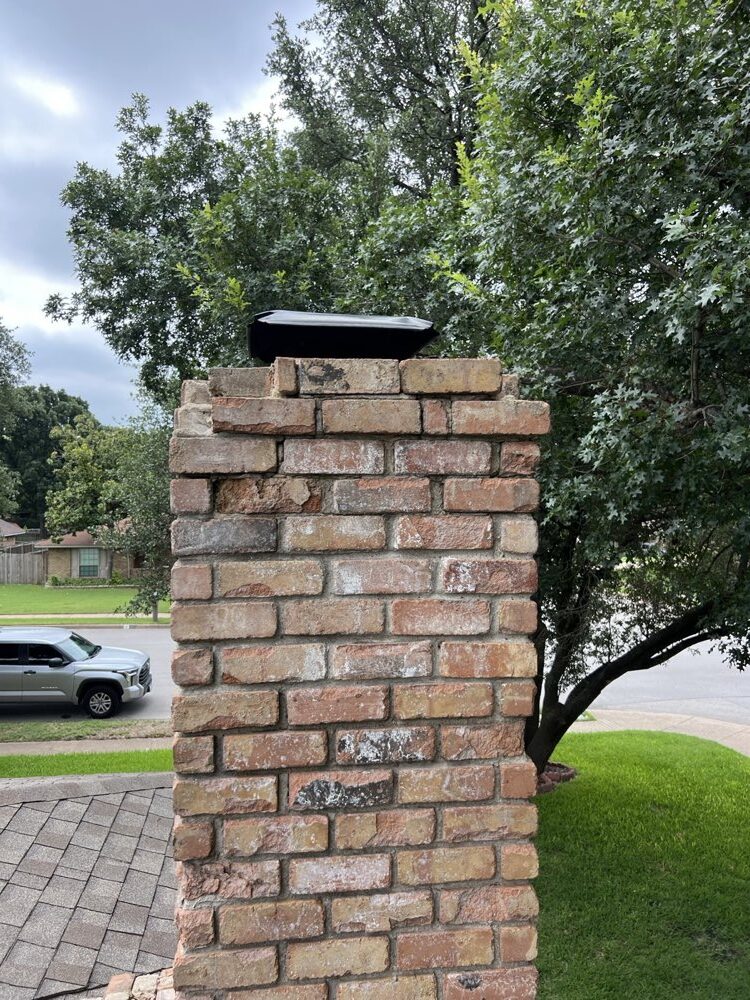
Brick or stone with a concrete surface on top is a masonry chimney, and that surface is a crown. A boxed chase with siding and a metal lid is a factory built fireplace, and that lid is a chase cover. A crown cracks. A chase cover rusts through at the low spot where water sits, then drips down the outside of the metal flue. Hail dents both, and a dented cover holds water where it used to run off.
Crown Repair
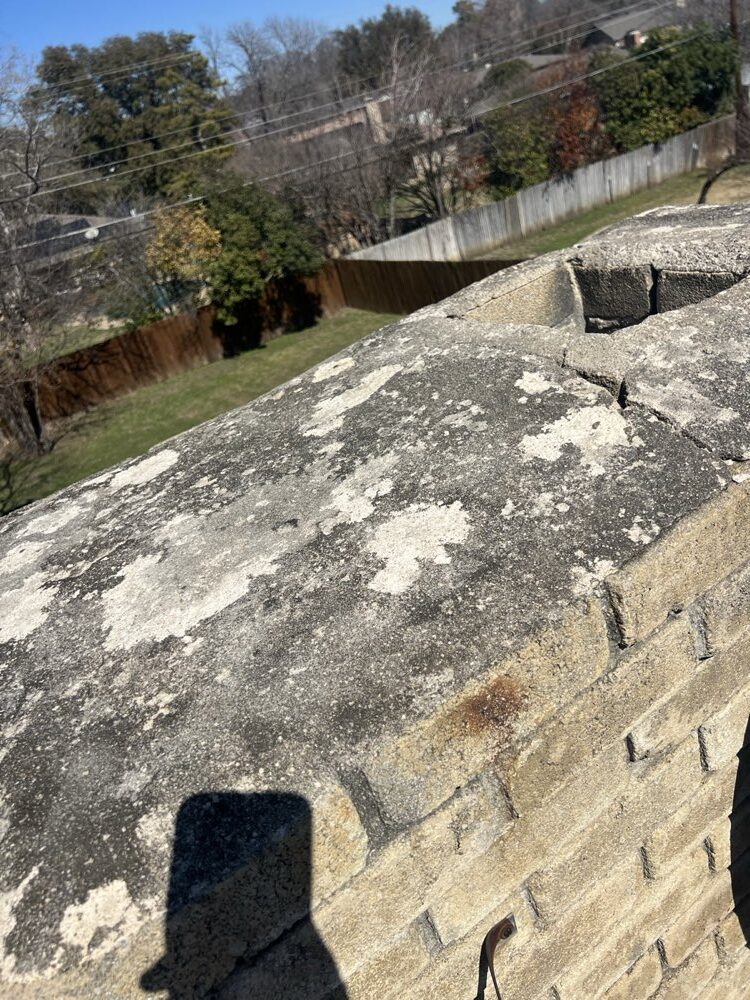
The crown caps the brick. It should slope so water runs off, and hang past the brick so runoff drips clear. Cheap crowns get poured flat, flush to the edge, and tight against the flue tile. Concrete and brick move at different rates, so a crown poured tight to the tile cracks again no matter what gets brushed over it.
Three levels of crown work, and the difference between them is real money.
- Coat it. A flexible coating over a crown that is sound but surface cracked. The right call more often than people expect.
- Patch it. Remove the broken section, bond new to old, repour that part.
- Repour it. Break out the old crown, build forms, pour a new one with slope, an overhang, and a gap around the flue tile.
Brick and Mortar Joints
Mortar is the sacrificial part. It belongs softer than the brick, so when the wall moves the joint gives instead of the brick. That one rule explains most bad brick repair. Pack hard cement heavy mortar into an older chimney and the joint becomes stronger than the brick beside it, so movement breaks brick faces instead of joints.
Repointing is the fix while the brick is still good. Grind the failed joints out to depth and refill with mortar matched to what is there. Once the faces are gone, joints alone will not save it.
- Never let anyone put a film forming sealer or silicone on chimney brick. It traps the water already inside, and trapped water is what causes the flaking.
- The right material is a penetrating repellent that soaks in and still lets vapor out, so the brick can dry.
Flashing Where the Chimney Meets the Roof
When water shows up inside the house, this is where we look first. It is where most chimney leaks start.
Done right it is two layers. Step flashing goes in with the shingles, one piece per course. Counter flashing sits over it, tucked into a groove cut in the mortar joint, so water running down the brick gets thrown onto the shingles instead of behind them.
Caulk across the seam is not that. It is a patch with a clock on it, and our summers run the clock fast. Roofs here get brutally hot, and sealant that looked fine in March can be split by fall.
- A wide chimney needs a small ridge behind it, called a cricket, to split the water and send it around. Without one, water pools against the brick every time it rains.
Firebox
The firebox is the brick box the fire sits in, built from firebrick and a heat resistant mortar. We look for cracked firebrick, joints that have opened or washed out, and rust. Cracks and open joints matter because the whole point of that box is keeping heat off the framing behind it. Rust matters for a different reason. Metal inside a chimney does not rust on its own.
- A rusty damper or a damp smell after rain usually traces back to a missing cap or a cracked crown, not to the firebox.
GET A LOOK BEFORE IT SPREADS.
Every repair visit ends the same way: photos of the crown, cap, flashing, flue and firebox, reviewed with you on screen before any quote, and yours to keep either way.
How to Tell Cosmetic From Getting Worse
Most repair pages avoid this question, because a worried customer buys faster. The question is not how bad it looks. It is whether water has a path in.
Usually cosmetic: light soot shadowing above the flue opening, color variation from age and sun, hairline lines in a crown that do not go through, a shallow chip from hail or a ladder. Everything below is different, because every item on it is evidence of water moving.
- Pieces of brick face on the roof, in the gutter, or in the flower bed.
- Mortar you can dig out with a house key using hand pressure.
- A crack in the crown you can get a fingernail into, especially one running to the edge.
- White chalky bloom spreading across the brick.
- A brown ring on the ceiling near the fireplace, or a damp smell in the firebox after rain.
- Rust on the damper, or a gap opening between the chimney and the wall of the house.
When a Rebuild Is Not Our Job
If the top several feet have to come down and go back up, or the chimney is leaning, that is masonry construction with staging and a crew. We will say so on site instead of selling a patch over it.
A chimney pulling away from the wall is the clearest case. North Texas sits on clay that swells when wet and shrinks when dry, and that movement is hard on anything carrying its own footing. That gap is a ground question before it is a brick question, and repointing will not hold it.
Gas is the other line. Gas logs, gas lines, valves and burners are not what we work on, and we will say so on the phone rather than take the trip. Telling you a job is not ours costs us the job. It also means you get a straight answer instead of a repair that buys six months.
Photos, Not Promises
You cannot see your own crown, and you cannot see your own flashing. Nearly everything that matters on a chimney happens where the homeowner has no way to look, which is most of why this trade has the reputation it has.
So we photograph it. The technician goes up, shoots the crown, cap, flashing, flue and firebox, then goes through the pictures with you on a screen. What leaks now gets separated from what will want attention later. You keep the photos either way.
We are new. We would rather earn the work by showing you what is on your roof than by making claims about ourselves you have no way to check.
Tell Us What You Are Seeing
Where the stain is, what fell in the yard, when it started. If you can get a photo from the ground, send that too. We will get up on the roof and show you the rest.
WHAT HAPPENS WHEN YOU CALL
You call or send the form
We ask what you are seeing or hearing. A person, not a queue.
We arrive and cover everything
Tarps down and the vacuum ready before a tool comes out.
Camera, brushes, eyes on all of it
Firebox, damper, flue and the top of the chimney, photographed.
Photo report the same day
You see what we saw and decide what happens next.
COMMON QUESTIONS
They answer two different problems. Cleaning deals with what is inside the flue, mostly soot and creosote from burning. Repair deals with water and structure: crown, brick, flashing, firebox. If your complaint is smell or smoke, start with a sweep. If it is a stain, a crack, falling brick or rust, start here.
That is a useful clue, and it usually points at flashing rather than the crown. Wind driven rain gets pushed sideways under a seam that handles straight down rain fine. Tell us which direction the storm was coming from when it leaked. It narrows down where to look before anyone gets on the roof.
Not with a sealer, no. A film forming sealer traps the moisture already inside the brick and makes the flaking worse. A penetrating repellent that lets the brick breathe is a real product and it does help, but it is a last step, not a first one. If the crown is cracked or the flashing has failed, repelling water off the face of the brick does nothing about the water pouring in above it.
It is called efflorescence, mineral left behind by water that traveled through the brick and evaporated at the surface. The powder washes off. What it tells you does not: water is moving through that brick, and it is worth finding out where it gets in before another winter.
Depends what it is. Anything with water actively moving through it gets worse with every rain, and our spring storms are the hard ones. Anything cosmetic can wait as long as you like. Making that split clear is what the photos are for, so you are choosing instead of guessing.
Both, with one difference worth knowing. On a factory built fireplace the water parts are the chase cover, the cap and the flashing, and that is repair work. The firebox on those units is a manufactured assembly built from matched parts, so whether something gets repaired or replaced depends on the unit. We will look and tell you which one you are in.
No. Taking a chimney down and building it back up is masonry construction, not a repair call, and pretending otherwise is how people pay for the same chimney twice. If that is what yours needs, we will say so, and you will have photos showing why.
REQUEST A CALL BACK
A person calls you back about your chimney, not a dispatcher.
Not Sure If It Needs Repair or Just a Look?
We photograph the damage before quoting anything, so you can see what is being repaired and why, or hear that it can wait.