
Chimney Leak Repair: The Five Places Water Gets In
A brown ring on the ceiling by the chimney, a drip in the firebox after a storm, or a damp wall beside the fireplace traces back to one of five spots, and each one leaks in its own way.
CAMERA INSPECTION
We look before we quote, every time
PHOTOS OF EVERY FINDING
No photo, no claim
MASONRY AND VENTING ONLY
Gas lines go to a gas fitter and we say so
SAME-DAY REPORT
In your inbox before we finish the day
You noticed it after a storm. A brown ring on the ceiling near the chimney, water sitting in the firebox, or a wall beside the fireplace that feels cool and damp.
The water almost never gets in where the stain shows up. It enters at the top of the chimney or at the roof line, runs along brick or framing, and comes out wherever gravity lets it. That is why painting the ceiling never holds, and why sealing the wrong thing buys one dry month and another wet season.
Five places let water in. Once you know which pattern you have, the repair is usually simple. Finding it is the job.
YOU SEE WHAT WE SEE
You cannot see your own chimney. That is the whole problem with this trade, and it is why people feel talked into things.
Every visit ends with photographs of what we found, walked through with you before anything is quoted. If the pictures show nothing wrong, that is the report you get.
- Camera up the flue, not a guess from the hearth
- Every finding photographed before it is quoted
- The same spots photographed again after the work
- Written report in your inbox the same day
Two questions that narrow it down before anyone climbs a ladder
Tell us two things on the phone and we can usually name the suspect before we see the house.
When does it leak? If a light rain does it too, water is coming straight down from the top: the crown, the cap, or the chase cover. If it only leaks when the rain blows sideways, it is getting in through the brick or the flashing.
Where does it show up? Water in the firebox came down the flue. A stain on the ceiling beside the chimney came in at the roof line.
- Only in windy storms: brick face and flashing first.
- Every rain, even a light one: the top of the chimney first.
- Wet firebox or a rusting damper: it came down the flue.
- Ceiling stain a few feet away: still the chimney, because water travels along framing before it drips.
1. The crown: the concrete top that should shed rain
On a brick chimney, the flat concrete top around the flue tile is the crown. Its job is to throw rain off the brick, the way a windowsill does. Around here they crack, because the weather goes from weeks of dry heat into a downpour and thin concrete moves with it. One crack through, and every rain runs into the chimney instead of off it.
We check it from the roof, never from the ground: cracks wide enough to take a coin, a gap where the crown meets the flue tile, and whether the crown overhangs the brick at all.
- Surface hairlines are normal on concrete. Cracks that run all the way through are not.
- A crown poured flush with the brick sends water down the face every rain.
- A gap around the flue tile is an open door into the chimney.
Water Getting In?
Five spots let water in, and the camera finds which one is yours.
2. The cap: the metal lid over the open flue
The cap is the metal hood with mesh sides that sits over the flue opening. Missing, too small, or rusted through, and your chimney is an open pipe pointed at the sky. Water lands in the firebox, and the damper starts to rust and stick.
We look straight down the flue from the roof. Is there a cap, does it cover the whole opening, is the mesh torn, are the fasteners still gripping. The same open hole is how birds and squirrels get in, so scratching above the damper is usually the same story.
- No cap means rain, leaves, and animals go straight down the flue.
- A bent lid or torn mesh is usually hail damage.
- A wet firebox with a dry ceiling points at the cap and the crown.
3. The flashing: where the chimney meets the roof
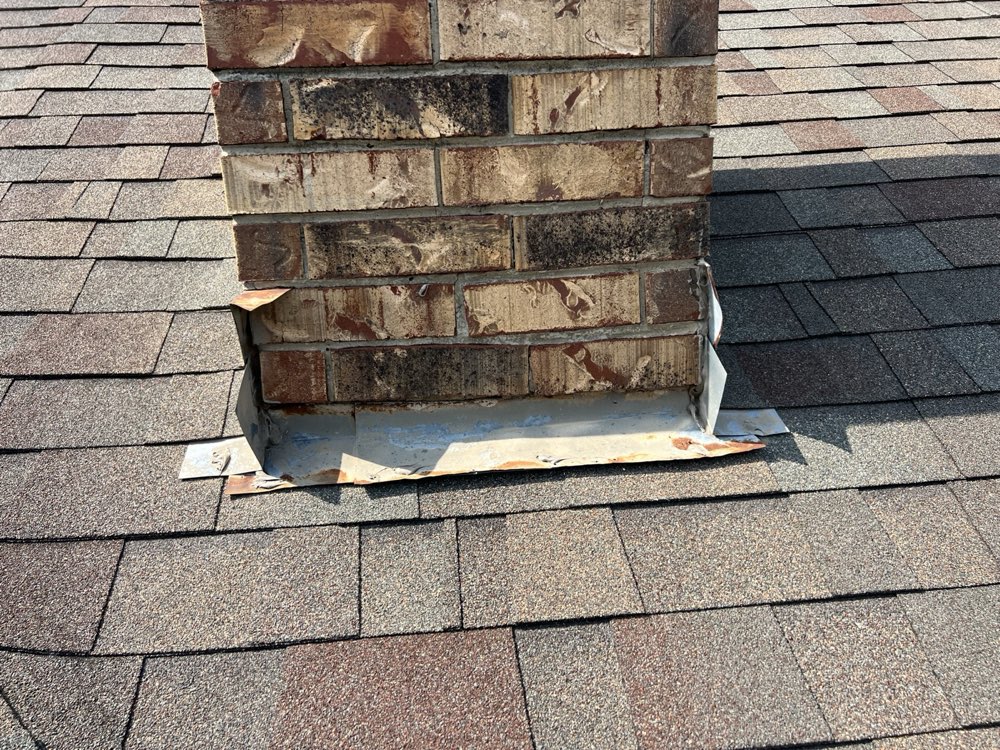
This one fools people, because the water shows up nowhere near the fireplace. Flashing is the metal that seals the joint between the chimney and the shingles. Done right it is two layers: pieces woven in under each row of shingles, and a second piece bent into a cut in the mortar joint above.
Done fast, it is black roof tar smeared over the joint. Tar bakes in a Texas summer, shrinks, and splits. It looks like a repair while it funnels water into the joint it was meant to close.
We photograph the joint on all four sides, and on the uphill side of a wide chimney we look for a small peaked saddle. Without one, everything the roof collects piles against the back of the chimney and sits there.
- Black tar over the joint is a patch, and often the reason it leaks now.
- Flashing laid on top of the shingles instead of woven under them.
- No saddle behind a wide chimney on a sloped roof.
4. The brick and mortar: rain soaking in from the side
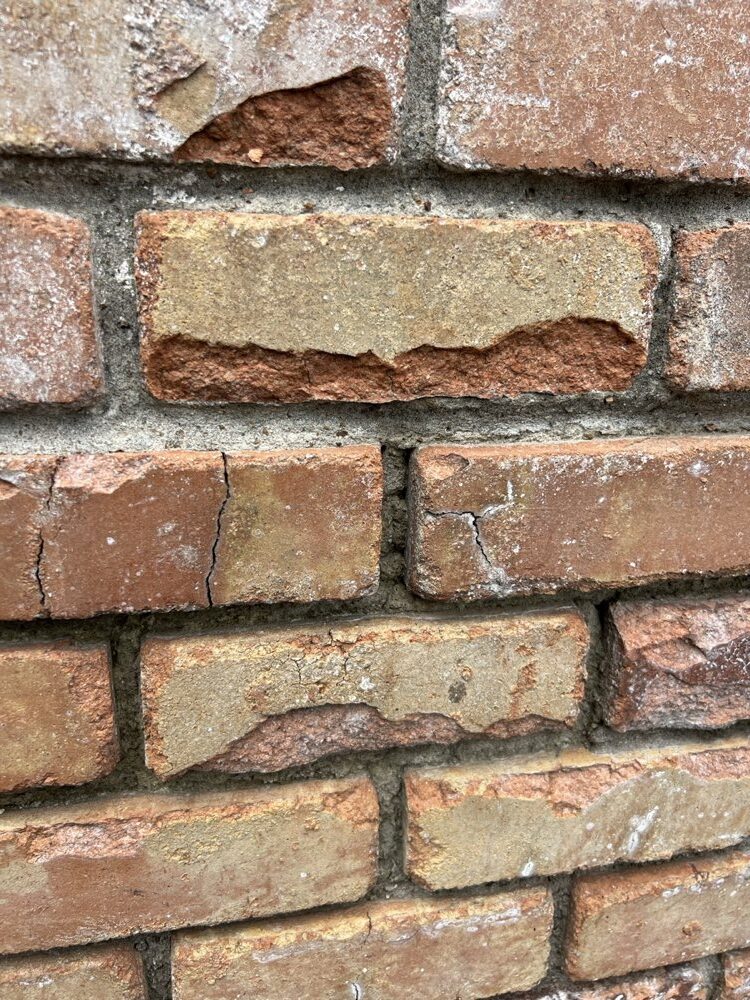
Brick drinks water and dries back out. That is normal. It stops being normal when mortar joints are missing chunks, when brick faces have flaked off, or when a crack has opened along the side.
This is the leak that only happens in a real storm, which is why people chase it for years. The clay soil under a lot of North Texas houses swells when it is wet and shrinks when it is dry, and a chimney that moves with it can crack along the corner where it meets the house.
Sealer brushed over open joints just traps the water inside. Joints get fixed first.
- Leaks only in a driving rain: this is the usual suspect.
- White chalky powder on the outside brick means water is moving through it.
- Brick faces flaking off: water got in, then froze in a cold snap.
WATER COMING IN?
Tell us where the water shows up and we will tell you which of the five entry points it usually means.
5. The chase cover: the metal top on a framed chimney
Plenty of homes around here have no brick chimney at all. They have a tall wood framed box, sided or faced with brick veneer, with a metal fireplace inside and a big metal lid on top. That lid is the chase cover.
Galvanized covers rust. A flat one holds a puddle after every rain, and the puddle rusts a pinhole straight through. The giveaway is outside: rust colored streaks running down the siding below the top.
We look at the top surface itself: standing water, pinholes, and the seal where the pipe comes through.
- Rust streaks down the siding below the top of the chimney.
- A flat cover holding a puddle after rain.
- A split seal where the pipe passes through the cover.
When it turns out not to be the chimney
Sometimes it is not. The chimney is the tall thing standing next to the real leak, so it takes the blame. Worn shingles above it, a roof valley dumping water at its back wall, or a gap around a nearby vent all leave a stain right where you would expect a chimney leak.
And not every wet chimney is a leak. A flue too large or unlined for the appliance venting into it can run cold and drip condensation down the inside, with no rain at all.
If the chimney is fine, we say so, and you keep the photos that show it.
How we check it, and what you actually get
We are new in Dallas, so we are not asking you to take our word for anything. The technician gets on the roof, photographs all five spots, and you get the pictures with the plain English version of what each one shows, including the parts that are fine.
Inside first, where you can see the water, so we know which pattern we are chasing. The attic next when there is access. Then the roof.
Photos, not promises. You should be able to see the crack before you agree to any work on it.
- Inside first: firebox, damper, and where the stain actually sits.
- Then the roof: crown, cap or chase cover, flashing, and brick.
- You get every photo, including whatever we find is sound.
Water showing up when it rains? Let's find where it gets in.
Tell us when it leaks and where you see it. We will check all five spots and send you the photos, even if the answer turns out to be that your chimney is fine.
WHAT HAPPENS WHEN YOU CALL
You call or send the form
We ask what you are seeing or hearing. A person, not a queue.
We arrive and cover everything
Tarps down and the vacuum ready before a tool comes out.
Camera, brushes, eyes on all of it
Firebox, damper, flue and the top of the chimney, photographed.
Photo report the same day
You see what we saw and decide what happens next.
COMMON QUESTIONS
Often, yes. Water gets in at the roof line, runs along a rafter or across the top of the drywall, and drips out wherever the framing lets it go. The stain marks the exit, not the entry, so we work backwards from it.
That the water is hitting the side of the chimney rather than the top. Wind pushes rain into the brick face and against the flashing joint, and straight down rain never reaches those spots the same way. Masonry and flashing get checked first.
We would rather not, because tar is usually what we find as the cause. It holds for a season, then it dries out and splits in the summer heat, and now the leak is hidden under a black smear that has to come off before anything real can be done.
It is minerals left behind by water moving through the masonry and drying out. A symptom rather than the leak itself, and it points us at the mortar joints, the crown, and whether the top of the chimney is shedding water or soaking it up.
If the water is in the firebox or on the damper, start with the chimney, because it came down the flue. If the stain is on a ceiling next to the chimney it could be either, and a photo of the flashing settles it in a minute. If it belongs to the roofer, we will say so.
For the roof and the outside, no. For the inside part it helps to have someone who can point at the stain and say when it appears, because the timing narrows the cause down faster than anything we can see from up top.
A slow leak that keeps a firebox damp rusts the damper until it will not close, softens the mortar inside the flue, and works on your drywall the whole time. Waiting also means hunting for it again in the next storm.
REQUEST A CALL BACK
A person calls you back about your chimney, not a dispatcher.
Water Coming In. Where Is It Getting Through?
Crown, cap, flashing and mortar all leak differently. We find which one it is and photograph it before proposing a fix.