
Chimney Brick Repair and Rebuilding in Dallas-Fort Worth
Spalling faces and failing joints: what is breaking inside the brick, how joints get cut and repacked, and when patching stops being honest.
CAMERA INSPECTION
We look before we quote, every time
PHOTOS OF EVERY FINDING
No photo, no claim
MASONRY AND VENTING ONLY
Gas lines go to a gas fitter and we say so
SAME-DAY REPORT
In your inbox before we finish the day
The brick faces on your chimney are flaking off. Red chips and dust collect on the roof or in the gutters. The mortar between them is cracked or missing, and crumbles to sand at a touch.
This is not cosmetic. Brick and mortar are the structure of the chimney, and once water gets past them, every wet week and every cold night makes it worse. Homeowners call it brick repair. The trade calls it tuckpointing or repointing. Same job: take out what has failed, put back something compatible, shut the weather out.
Chimney brick repair in Dallas-Fort Worth means cutting out failed mortar joints and repacking them in compacted lifts with a mix that stays weaker than the surrounding brick, plus replacing individual spalled bricks matched for size, texture and color. Tuckpointing and repointing are the trade names for the same work. Every finding is photographed and shown to you before any number is discussed.
YOU SEE WHAT WE SEE
You cannot see your own chimney. That is the whole problem with this trade, and it is why people feel talked into things.
Every visit ends with photographs of what we found, walked through with you before anything is quoted. If the pictures show nothing wrong, that is the report you get.
- Camera up the flue, not a guess from the hearth
- Every finding photographed before it is quoted
- The same spots photographed again after the work
- Written report in your inbox the same day
Spalling brick: why the faces pop off
A brick is fired clay. The kiln hardens the outside more than the middle, so the face you look at is denser than the core behind it. That outer skin sheds the rain.
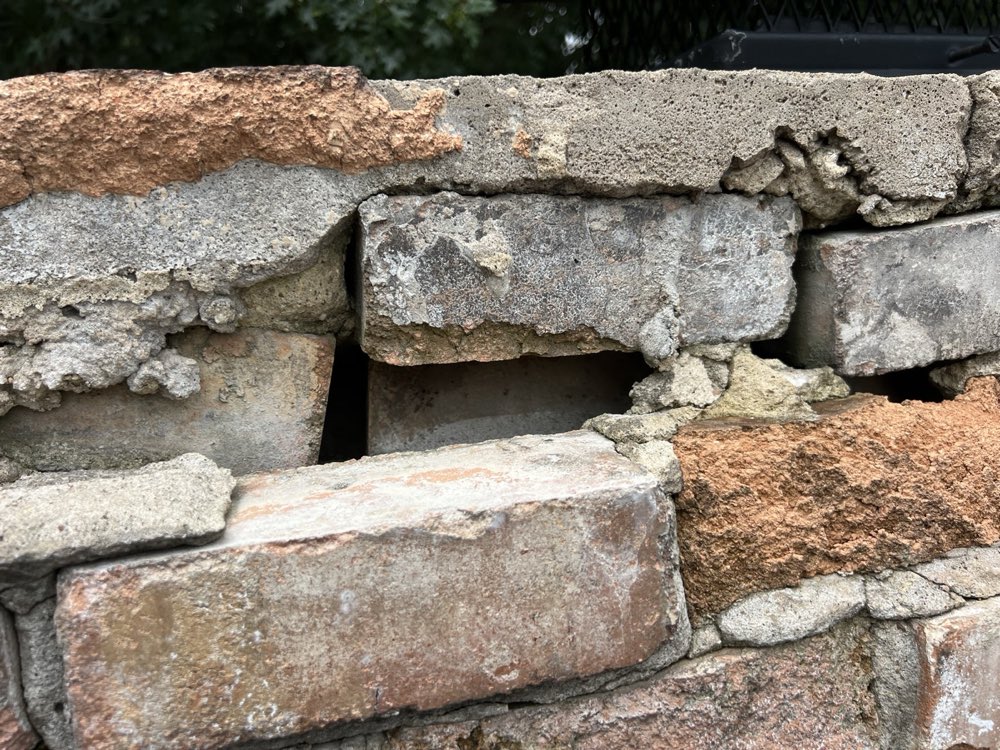
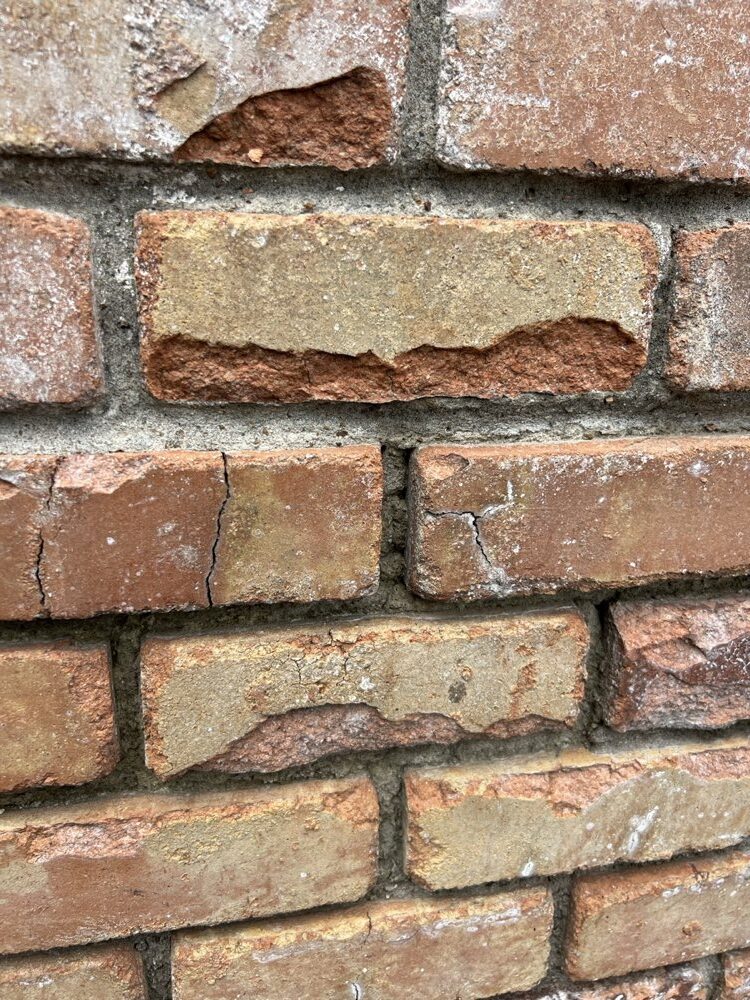
Water gets behind it through a hairline crack, an open joint, a worn chimney crown, or simply porous brick that has been drinking all autumn. A fully saturated brick has no empty pore space left, so when the temperature drops there is nowhere for ice to expand into. The pressure pushes outward against the back of the face until the face lets go, as a flake, a chip, or a thin sheet.
That is spalling, and what follows is the real problem. The exposed core is softer and thirstier than the skin it lost, so the brick now drinks faster and the next cold night has more to work with. The damage is done in winter, but most people notice in spring, when the flakes are already lying in the flowerbed.
- Flakes, chips, or red dust on the roof or the ground below
- Brick faces that look pitted, peeled, or hollowed out
- A white powdery bloom, which is salt carried out by water and left as it dries
- Joints that give up sand when you drag a key across them
Reading your own chimney from the ground
You can get most of the way to a diagnosis without a ladder. Use binoculars or a zoomed phone camera for the top, and check the brick you can reach by hand at the bottom. Each observation rules something in or out.
- Drag a key along a joint. If it powders and comes away as sand, that joint has lost its binder and has to be cut out. If it only scratches, the problem is elsewhere.
- Tap a suspect brick with a screwdriver handle. A sound brick answers with a sharp ring. A dull, hollow thud means the face has already separated behind the surface and will come off later.
- Diagonal cracking that steps from joint to joint points at movement under the chimney, not at the mortar, and repacking those joints just moves the crack. A crack running straight down through the bricks themselves is a larger force again than pointing answers.
- Damage on one face only, usually the side taking driving rain, reads as exposure. Damage even on all four sides means water arriving from the top.
- Dark streaks running down from the top say the same thing. Sort the top out first, because repointing a wall fed water from above is work you pay for twice.
Mortar Turning To Sand?
Repointing early costs a fraction of rebuilding later.
Mortar is supposed to be the soft part
Mortar is designed to lose. It belongs weaker than the brick around it, so that when the wall moves, and every wall moves, the joint cracks and the brick survives. Joints are replaceable. Brick faces are not.
That rule sits behind most of the bad masonry we get called out to look at. Mortar strength is graded under ASTM C270: Type O must reach at least 350 psi, Type N 750, Type S 1800, Type M 2500. Pack Type S into an older chimney laid with something far softer and the joint becomes the strongest thing in the wall. The Brick Industry Association states the consequence plainly, that repointing mortar stronger than what it replaces concentrates stress at the brick and mortar interface and spalls the brick face. The repair then manufactures the damage it was hired to stop.
What repointing actually involves, in order
Repointing is not new mortar smeared over old. Anything troweled onto the surface of a dead joint has nothing to bond to and sheets off within a season. The work is subtractive first.
Curing is the step people skip. Masonry practice treats a mean daily temperature above 100 degrees, or above 90 with wind over roughly 8 mph, as hot-weather work, calling for new masonry to be fogged damp several times a day. DFW normals put the metroplex at 20.2 days a year at 100 or better, and cold-weather rules begin below 40.
- Cut out. Failed mortar comes out to roughly two to two and a half times the width of the joint, which on a standard brick joint lands between half an inch and an inch, and deeper wherever material is loose past that. The back of the cut is left square, not tapered, so new mortar has a shoulder to key against.
- By hand where it counts. An angle grinder is quick, and it is also how brick edges get nicked and joints get widened permanently. Short vertical joints and soft brick get chiselled by hand.
- Clean and damp. A dry joint pulls water straight out of fresh mortar, and mortar that dries instead of curing never reaches the strength it was mixed for.
- Pack in lifts. Mortar goes in as layers, each compacted and left until thumbprint firm. Filling a deep joint in one push leaves voids you will never see and water will always find.
- Tool it. The joint is tooled to the profile of the originals, compressing the surface so rain runs off the face instead of resting on a ledge.
Matching brick that is no longer made
Three things have to line up on a replacement brick, and only one of them is colour.
Size comes first, because it cannot be fudged. Dimensions shifted with the move to modular sizing. Older imperial brick runs around 8 3/4 by 2 3/4 by 4 inches, while a modern modular brick is closer to 7 5/8 by 2 1/4 by 3 5/8. Half an inch of height difference does not blend. It throws the coursing out, and that reads from the street permanently.
Texture is second. A wire-cut face, a sand-struck face and a smooth pressed face catch light differently in identical colour, and the eye registers that before it registers shade.
Colour is third, and it gets close rather than exact. The plant that made yours may no longer exist, and the brick has had decades of Texas sun on it since, so salvage stock from a wall of the same era often beats anything in production. You get shown the candidate against your own wall in daylight first.
When a partial rebuild beats patching
Spot repair is the goal and usually the right answer: cut out the failed brick, replace it, repack the joints around it, finished in a visit. There are points where continuing to patch is the more expensive road, and they are recognisable rather than a matter of opinion.
- Concentration rather than scatter. Spalled bricks spread over the stack get replaced individually. A band where every brick above a line has lost its face, typically the top few courses, comes down and gets relaid.
- Depth of joint failure. If mortar has washed out through the thickness of the wall rather than at the surface, the top courses rock under hand pressure, and pointing the outside face is decoration.
- The top is coming off anyway. If the concrete cap has to be broken out and repoured, the upper courses are already exposed, and one setup beats two a year apart.
What is not ours, and what can wait
A leaning stack, or one pulling away from the wall, is a ground question before it is a masonry one. Much of the metroplex sits on Blackland Prairie clay, among the most shrink-swell reactive soil mapped in the country, lifting as it takes on water and pulling back as it dries. A narrow, heavy column standing on that moves, and the joints absorb it. That is one reason joints here wear out faster than the brick does, and why some cracking is a foundation conversation we point you toward instead of billing for.
Water on a ceiling near the chimney is nearly always a flashing or crown fault, so it is a chimney leak repair question and repacking the wall will not stop it. Hail chips faces in one afternoon and leaves a different signature to slow weathering, which makes it a storm damage discussion. Gas logs, valves and burners we do not work on at all.
Waiting is sometimes fine. Hairline cracking in otherwise sound joints, two bricks with light pitting, a stack dry inside and photographed as such: that goes on a watch list for next year. What changes the answer is water getting in, and establishing that is what a chimney inspection is for.
What you get in pictures and in writing
Local Chimney Experts is early in its life in Dallas-Fort Worth, and we would rather be judged on a record than a slogan. Masonry makes that easy, because the stage that proves the work is one you would otherwise never see.
- The damage before any number is discussed, close enough to see into the open joints yourself
- The joints after cut-out and before mortar goes in, which shows whether the old material came out or merely got skimmed over
- The finished joints, plus a note of the mortar used and the date, so whoever works on this chimney after us knows what is in there
- A count you can check. If eleven bricks were replaced, the photos let you count eleven
WHAT HAPPENS WHEN YOU CALL
You call or send the form
We ask what you are seeing or hearing. A person, not a queue.
We arrive and cover everything
Tarps down and the vacuum ready before a tool comes out.
Camera, brushes, eyes on all of it
Firebox, damper, flue and the top of the chimney, photographed.
Photo report the same day
You see what we saw and decide what happens next.
COMMON QUESTIONS
Look for chips or red dust below the chimney, flaking faces, gaps in the mortar, and white powdery staining. If a key digs sand out of a joint, that joint is finished. If tapping a brick gives a dull thud instead of a ring, the face is already loose.
For most homeowners, nothing. Both words get used for the same job: removing failed mortar and packing in new. Strictly, repointing is the repair and tuckpointing is an old two-colour decorative style. Call it brick repair and we know what you mean.
Spot replacement is normal, and it is the point of catching damage early. We cut out the spalled units, match replacements as closely as your brick allows, and repack the joints around them. It stops being spot work when the failure runs in a continuous band.
Premixed mortar repair in a tube is a sealant, not mortar. It sits on a joint that failed underneath, with nothing but dust to bond to, and it has to come out before the real repair. Renting a grinder carries its own trap: overcut a joint by a fraction and you have widened it for good.
Not over damage. Paint and film-forming sealers trap moisture inside the brick, which speeds up spalling. Repair first. Then, if the brick is sound, chimney waterproofing with a breathable repellent helps it shed rain while still letting vapour out.
Most spot work finishes in a single visit and larger sections take longer, but either way fresh mortar has to cure afterwards. Mild weather cures it best, so spring and autumn are the easy windows here. If your chimney is shedding brick now, we can protect what is open and book the repointing into weather that lets it set.
RELATED
REQUEST A CALL BACK
A person calls you back about your chimney, not a dispatcher.
Get eyes on your brick before it gets worse
Send a photo of the damage or book a visit. The technician will tell you exactly what he sees, with close-up pictures of every problem and a fix sized to what your chimney actually needs.