
Birds in Your Chimney: Read This Before You Do Anything
That chirping in a Dallas-Fort Worth chimney between May and August is almost always chimney swifts. They are protected by federal law, and the fix is patience, then a cap.
CAMERA INSPECTION
We look before we quote, every time
PHOTOS OF EVERY FINDING
No photo, no claim
MASONRY AND VENTING ONLY
Gas lines go to a gas fitter and we say so
SAME-DAY REPORT
In your inbox before we finish the day
You hear flapping, then a raspy chattering above the fireplace that gets louder every day. Your first instinct is to get whatever it is out today.
Hold on. If it is May through August in Dallas-Fort Worth, you are almost certainly hearing chimney swifts. They are protected by federal law, and while the nest is active nobody may remove it. Not you, and not any company you hire.
That reads worse than it is. Below: the biology behind the sound, what you can tell from your own living room, the one case where waiting is wrong, and the order the work goes in.
YOU SEE WHAT WE SEE
You cannot see your own chimney. That is the whole problem with this trade, and it is why people feel talked into things.
Every visit ends with photographs of what we found, walked through with you before anything is quoted. If the pictures show nothing wrong, that is the report you get.
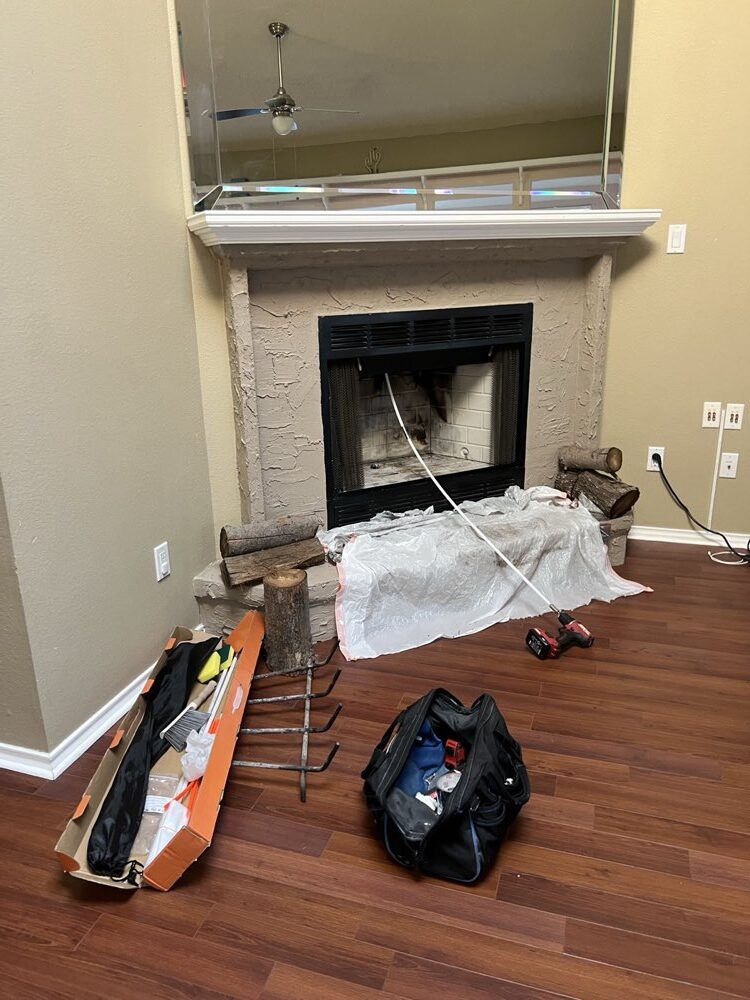
- Camera up the flue, not a guess from the hearth
- Every finding photographed before it is quoted
- The same spots photographed again after the work
- Written report in your inbox the same day
The bird making that noise, and its Texas calendar
Chimney swifts are small dark birds built like a cigar with wings, airborne almost the whole day. They cannot grip a branch or a wire; their feet hook onto rough vertical surfaces only. Hence hollow trees for most of the species’ history, and masonry flues now.
The nest is smaller than people picture. A half cup of short twigs, snapped off in flight and glued to the flue wall with the birds’ own saliva. Texas breeding records place it in the bottom third of the shaft, which is why the sound sits inside the wall above your mantel rather than up on the roof.
They also nest alone. One active nest per chimney. If a sweep later pulls out three, two are leftovers from earlier seasons.
- Late March: swifts arrive back in Texas from South America.
- Late April into early May: first eggs. Earliest Texas egg dates on record run April 21 to May 5.
- 19 to 21 days later: hatching, and the chimney is still quiet.
- 28 to 30 days after that: the young fly. The begging noise is the last two weeks of that.
- July: late clutches still go in, with Texas egg dates recorded as late as July 28.
- Late August through late October: swifts leave Texas.
What you can tell from the living room
Nothing here needs the damper opened or a camera lowered. Four observations do most of the identifying.
- The rhythm. Swift chicks go quiet, erupt in a hard mechanical rattle for a few seconds, then go quiet again. Each burst is a parent arriving with food. Constant, unbroken noise is not a feeding nest.
- The trend across days. Chicks get louder for about two weeks, then stop inside a day or two. A sound that fades day by day is an animal running down, which is a different problem.
- The clock. Feeding runs from first light to dusk. Activity only after dark is not a swift.
- The chimney top at dusk in June. Stiff winged birds dropping into the flue and shooting back out confirms an active nest from the driveway, nothing opened, nothing disturbed.
Hearing Something In Yours?
We identify what is up there before anything gets sealed.
Why nobody may remove an active nest
The protection comes from the Migratory Bird Treaty Act of 1918. The birds it covers are set by regulation at 50 CFR 10.13, and the chimney swift is on that list. While a nest holds eggs or young, taking it out, sealing it in, or killing the birds is a federal violation, and the law treats a homeowner and a hired contractor the same way.
Removing an occupied nest is permit work, and permits get issued for defined reasons. Household noise is not one of them. So a company offering to scrape a swift nest out of your flue in June is offering to break federal law on your invoice.
Two things cut the other way. Protection ends with occupancy: once the birds have gone, the nest is just debris and clearing it is legal. And 50 CFR 10.13 lists native birds only, so starlings, house sparrows and feral pigeons carry no protection under it. The catch is that you cannot name a bird by sound through a closed damper, and in a North Texas summer the odds run heavily toward swifts.
The statute gets enforced because the numbers are bad. The North American Breeding Bird Survey has the species falling about 2.3 percent a year from 1966 to 2023, a cumulative loss near three quarters, and the U.S. Fish and Wildlife Service lists it as a Bird of Conservation Concern.
What to do while they are up there
The job for the next couple of weeks: keep the birds out of your house, your fireplace out of their way, and the volume livable.
- Close the damper and leave it shut. It keeps a chick that slips below the nest out of the room, and it takes real volume out of the sound.
- If the damper is broken or missing, wildlife agencies suggest packing the space below it with insulation or foam to muffle the noise. A stopgap for two bad weeks, not a repair.
- Do not light a fire, and do not vacuum, poke, or drop anything down the flue. Nest material partway down pushes smoke back into the room, and smoke that kills protected birds is still a violation.
- If a chick lands in the firebox, do not carry it outside; it cannot launch from flat ground. Fully feathered with open eyes, the standard advice is to set it on the flue wall above the damper so it can climb back up. Bare or injured, call a wildlife rehabilitator first.
- Book the cleaning around them. The usual guidance is at least six weeks from finding eggs, or four weeks from first hearing young.
The autumn crowd is something else entirely
There is a second version of this, and it looks nothing like a nest.
Once nesting finishes in late summer, swifts stop being solitary and start stacking up. Ahead of migration they pack a single large flue to sleep in, hundreds of birds and sometimes thousands, arriving in the last twenty minutes of daylight. They circle above the opening in a slow column, then pour down into it, a descent the Fish and Wildlife Service calls reverse smoke.
The sound is different too. A rush of wings and mass chittering at dusk and again at first light, silence in between, instead of daytime feeding bursts.
Roost flues tend to be large and old, so this usually lands on a school or a church rather than a house. If it lands on yours in September, that is not the week to cap it.
If your flue is metal, the advice flips
Everything above assumes masonry and clay tile. A large share of Dallas-Fort Worth houses built from the eighties on have neither. They have a factory built metal fireplace venting through a metal pipe inside a framed chase.
Swifts need a rough vertical surface to cling to and to glue a nest onto. Sheet metal offers neither. A bird that drops into a metal flue slides to the bottom, cannot climb, and cannot get back out. State wildlife guidance is blunt: metal chimneys are unsuitable for nesting and should always be capped so birds and other animals are not trapped inadvertently.
That reverses the advice on this page. In a masonry flue in June, waiting is correct. In a metal flue, waiting is how a bird dies above your damper.
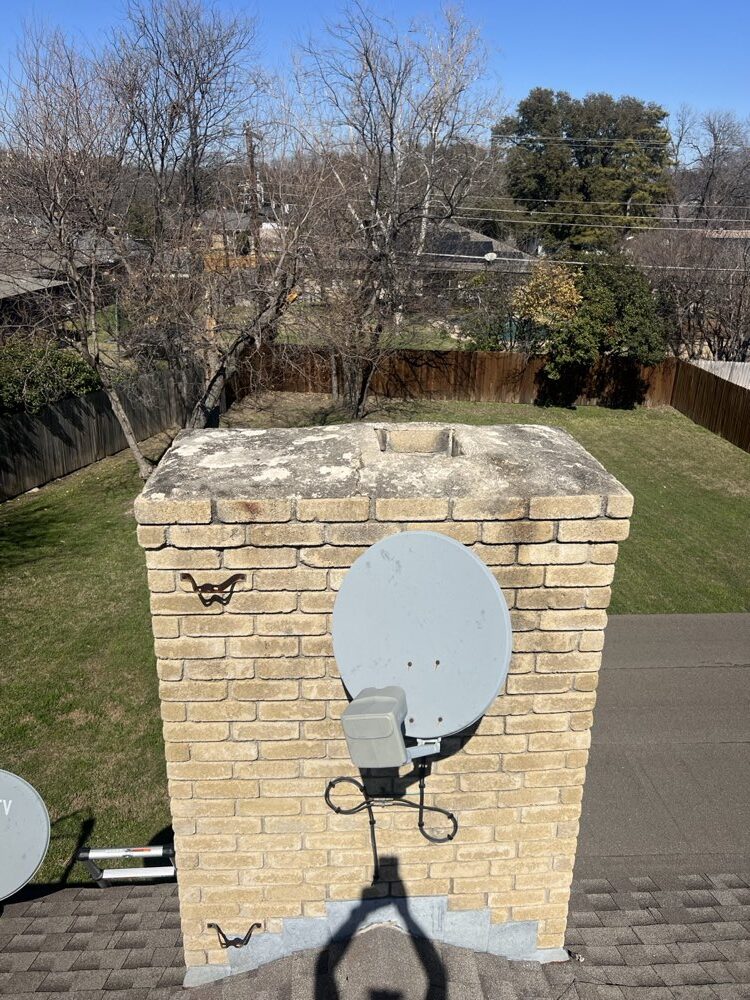
Telling them apart from the ground is easy. Masonry runs brick or stone to the top, with a concrete crown and clay tile showing above it. A prefabricated chimney is siding or stucco over a wood frame, topped with a flat metal chase cover and a round cap.
After they migrate: camera, sweep, then cap
Swifts head south in the fall. Once the chimney has been quiet for a week, the work runs in a fixed order.
The camera goes first. It confirms the flue is genuinely empty before anything mechanical goes in, and it shows how many seasons have piled up.
Then the sweep. Old nests come off the wall, often more than one, because swifts return to a chimney that worked and the abandoned nests stay glued where they were. Droppings collect on the smoke shelf behind the damper, the one spot nobody reaches from the room. All of it is dry and sits in the path of your next fire.
Then a cap sized to the flue, with mesh sides.
What makes one job bigger is what the camera finds. Four seasons of stacked nests take longer than one. A dead bird adds odor work. A cracked crown, or a top too irregular for a standard cap, turns capping into masonry work first.
North Texas gives two clean windows: late fall once the birds have gone, or the narrow slot between your last fire of the season and their return in late March.
One honest note. Every capped masonry flue is habitat subtracted from a species that has lost most of its numbers in living memory, so leaving a masonry chimney open and swept every fall is a real choice. Most people cap.
When it is not a swift
Not every noise over a firebox is a swift, and the rules move with the animal. Name it before acting. The long version sits on our chimney animal removal page; this is the short one.
- Bulky rustling starting in late winter, with a strong smell: likely a European starling. They hunt cavities in Texas as early as late February, well before swifts return, and heap in grass, straw and litter rather than gluing up a twig cup. Not native, not federally protected, but the material harbors mites and leaves in a sealed bag.
- Heavy movement and low growling after dark, mostly in spring: usually a raccoon mother with kits on the smoke shelf. Texas has its own handling rules, and live removal at that size belongs to a wildlife control professional.
- Frantic daytime scrabbling with no feeding rhythm: usually a squirrel that fell in. Flue tile is too slick to climb, so it is stuck rather than settled, and this one is time sensitive.
- Fluttering at dusk with a musty smell: possibly bats. Texas law protects them, removal has to be nonlethal exclusion, and state guidance avoids excluding between May 1 and August 15, when flightless pups are in the roost. Never handle a bat bare handed.
WHAT HAPPENS WHEN YOU CALL
You call or send the form
We ask what you are seeing or hearing. A person, not a queue.
We arrive and cover everything
Tarps down and the vacuum ready before a tool comes out.
Camera, brushes, eyes on all of it
Firebox, damper, flue and the top of the chimney, photographed.
Photo report the same day
You see what we saw and decide what happens next.
COMMON QUESTIONS
The loud phase runs about two weeks. Young swifts fly 28 to 30 days after hatching, so most families are out of the flue within four to six weeks of the first sounds, and all of them have left Texas by late October.
No. Nest material can block enough of the flue to push smoke into the room, and killing chimney swifts is a federal violation whether the tool is a brush or a fire. Shut the damper and wait it out.
While it holds eggs or young, yes. The Act protects the active nest and applies on your own property. Taking one out early needs a federal permit, and noise is not a reason those get granted. Once the birds go, the empty nest comes out legally.
Capping an occupied flue seals the birds inside, the same violation as pulling the nest out, and it leaves you with a smell that lasts months. Right answer, wrong moment. Fit it after they migrate, or between your last fire and their return in late March.
A swift nest is dry twigs and barely smells. A sour ammonia note usually means heavy droppings or a bulky starling nest. A sweet, heavy smell means something died. Both call for a camera down the flue rather than an air freshener.
Often, yes. Swifts return to a chimney that worked for them. If you would rather not host them next summer, cap the flue between late fall and the middle of March, before they get back from South America.
REQUEST A CALL BACK
A person calls you back about your chimney, not a dispatcher.
The week it goes quiet is the week to book it
Once the swifts have gone south, we run a camera, clear the old nests, sweep the flue, and fit a cap. Photos before and after come to you either way. The technician answers the phone across Dallas-Fort Worth.