
Chimney Sweep, Inspection and Repair in Arlington, TX
Arlington filled in between two larger cities in about thirty years, so its chimneys arrive in four clear vintages. The vintage decides what fails first.
LOCALLY BASED IN DFW
We drive to you, no national call center
WRITTEN PHOTO REPORT
Every finding shown before it is quoted
SAME-WEEK SCHEDULING
Booked in days, not weeks
OWNER-ANSWERED PHONE
The person who answers is the person who comes
Most Arlington calls start with water or smoke, not soot. A stain widening on the ceiling beside the chimney. Smoke rolling back into the den on a still evening.
The city filled fast. Arlington held 7,692 people in 1950, 160,123 by 1980 and 261,721 by 1990. Nearly every fireplace here went in during one of a handful of building pushes, and the push a house belongs to tells you most of what you need to know about how its chimney is aging.
Local Chimney Experts is new in Arlington and states that plainly. In place of a long history we hand over evidence: the chimney photographed top to bottom, shown to you before anything is quoted.
YOU SEE WHAT WE SEE
You cannot see your own chimney. That is the whole problem with this trade, and it is why people feel talked into things.
Every visit ends with photographs of what we found, walked through with you before anything is quoted. If the pictures show nothing wrong, that is the report you get.
- Camera up the flue, not a guess from the hearth
- Every finding photographed before it is quoted
- The same spots photographed again after the work
- Written report in your inbox the same day
Four Building Pushes, Four Kinds of Arlington Chimney
Arlington was laid out in 1876 along the Texas and Pacific Railway and stayed a small town for its first seventy years. The oldest housing survives in two pockets listed on the National Register: the Old Town Historic District, roughly seven blocks of late nineteenth and early twentieth century homes bounded by Sanford, North, Elm and Oak, and the South Center Street Historic District, the Craftsman bungalows in the 500 and 600 blocks, whose core addition was platted in 1916. Chimneys of that age are true masonry, soft brick set in lime mortar, and a fair number were never lined at all.
The second push was industrial. General Motors opened its Arlington assembly plant on January 6, 1954, and the same plant is still turning out full-size SUVs today. Six Flags Over Texas followed in 1961. Houses chased the payrolls, and the city went from under eight thousand residents to a hundred and sixty thousand in three decades. That run produced the low brick ranch that still defines most of central and west Arlington: masonry stack, poured concrete crown, clay tile liner inside. Those parts have been in place five to seven decades now, and they give out in a fairly reliable order: crown, then the mortar joints, then the liner.
The third push, roughly the 1980s into the 2000s, brought the factory-built fireplace to south Arlington and the outer edges: a steel firebox and metal flue standing inside a wood-framed chase, dressed in veneer, capped with a sheet-metal lid. Nothing in that assembly is masonry, so nothing crumbles. It corrodes instead, starting at the seams of the lid, and the water it lets past goes into framing nobody sees from the ground.
The fourth push is still running. Viridian, off North Collins Street at the northern edge of Arlington, broke ground in 2011. Its fireplaces repeat the 1990s design, only younger, which is exactly why nobody looks at them.
Arlington Sits on Sand, Not Black Clay
Most North Texas foundation advice quietly assumes Blackland Prairie clay, the heavy dark ground under Dallas and the suburbs east of it. Arlington is not on that. The city sits in the Eastern Cross Timbers, a strip of sandy, sandstone-derived soil no more than about fifteen miles wide, running down through eastern Tarrant County between the Blackland Prairie to the east and the Grand Prairie to the west. Beneath most of Arlington lies the Woodbine formation, some three hundred feet of sandy clay, ironstone and shale.
At the chimney that reads as a patchwork rather than one behavior. Sand settles. The shale in the same formation weathers into clay that takes on water and gives it back. Two corners of one Arlington house can stand on different material and move at different rates.
A chimney is the heaviest thing hung on a house and usually rests on its own footing, so it reports that split first. From the yard, check for a lean against a vertical wall line and for daylight where the stack meets the siding.
We Cover Arlington.
Tell us what you are seeing and we will tell you which visit it needs.
Arlington Streets That Date Their Own Flues
Woodland West, on the west side, dates to 1962 and runs mostly 1960s and 1970s houses. Assume a masonry chimney with an original crown that has never been resurfaced.
Interlochen was cut in the early 1970s by developer Bob Findlay around a private twelve-acre lake with five channels through it. Larger custom houses, taller and more elaborate stacks, more flashing joints for water to exploit, and canal air that keeps masonry damp longer after rain.
The blocks around the University of Texas at Arlington, whose campus traces to an 1895 founding, mix the oldest housing in the city with decades of conversion to rentals. Those flues are the likeliest in town to have gone twenty years unopened.
South Arlington beyond Pleasant Ridge Road, and the streets filling toward Lake Arlington, are chase country. From the driveway those chimneys read as brick. They are boxes with brick on the outside.
Two Towns Inside Arlington, on Their Own Housing Clock
Pantego and Dalworthington Gardens look on a map like Arlington neighborhoods. They are separate incorporated towns, wrapped almost entirely by Arlington, and their housing histories are not Arlington’s.
Dalworthington Gardens began in 1934 as a federal subsistence homestead colony, roughly 593 acres bought south of Arkansas Lane so Depression-era families could hold part-time work and farm a plot beside the house. Residents voted to incorporate as a town in 1949, and later sections filled in from the 1960s onward along the west side of Bowen Road. One small town therefore holds 1930s homestead cottages and 1960s ranch houses a few blocks apart, with chimneys three decades apart in every way that matters.
Pantego incorporated in 1949 specifically to avoid annexation by Arlington, briefly dissolved, and reincorporated on May 22, 1952. We cover both towns. Give us the street name and you get a straight yes or no.
Why So Many Arlington Fireplaces Push Smoke Back Inside
A boom-era ranch is long and low with a shallow roof, so a chimney built to clear it by the minimum ends up short. Draft depends heavily on the height of the warm column inside the flue. A short stack pulls weakly, and on a mild, damp, windless evening it can lose the argument to the house and its exhaust fans. The smoke takes the easier route, into the room.
That is a design condition, not dirt, and it turns up all over the ranch streets of central Arlington. Sweeping an already clean flue changes nothing about it. Establishing which cause you actually have takes a camera and a proper look at the smoke chamber and damper.
Chase-built systems in south Arlington smoke for other reasons: a flue section crushed during a roof job, a cap screen packed with debris, or a kitchen fan outmuscling the fireplace.
What We Handle in Arlington, and What We Hand Off
We work the masonry and venting side of the system. Anything on the gas supply itself is a gas fitter’s trade, and we name it as theirs rather than improvise. Each item below has its own page with the detail.
- A chimney sweep for the flue, smoke chamber and firebox.
- A chimney inspection with light and camera, before you buy or before the first fire.
- Chimney repair for mortar, brick and firebox.
- Chimney crown repair, usually the first failure on an Arlington ranch chimney.
- Chimney liner replacement where an old flue is cracked, or was never lined.
- Prefab chimney repair for the metal systems in south Arlington and the newer subdivisions.
- Smoky fireplace diagnosis, for the short-stack problem above.
Nothing Here Rests on Our Word
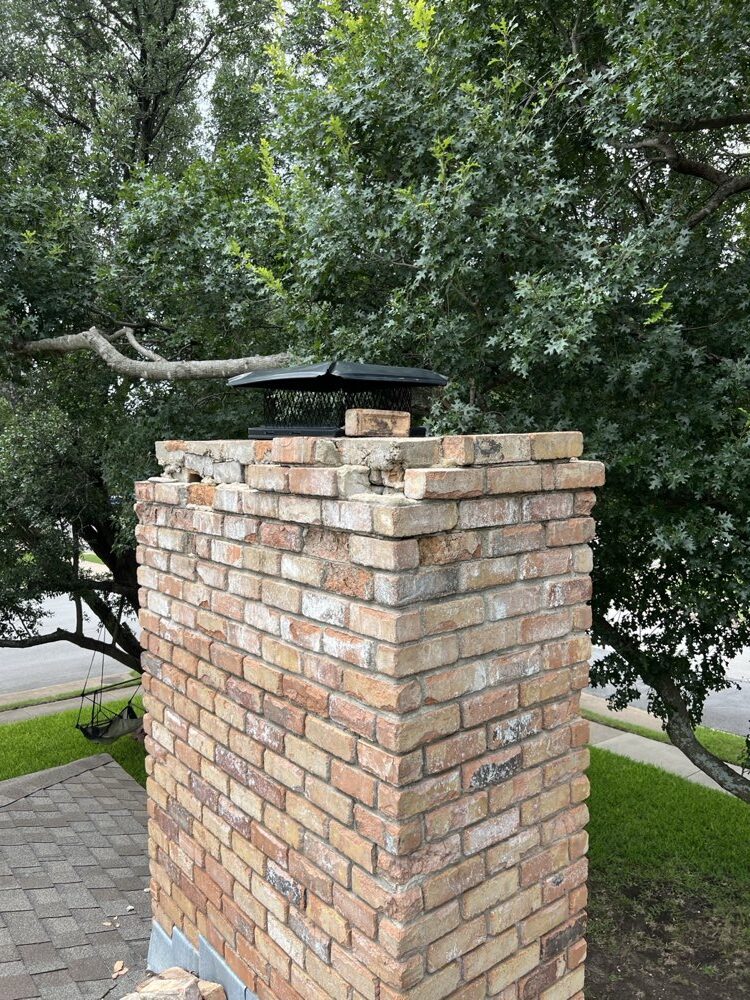
Arlington has no shortage of chimney trucks and we cannot point to twenty years of ours. What we can do is leave you holding the evidence. Every visit produces the same images: the top of the stack, the crown, the flashing line, the flue from inside, the smoke chamber, the damper, the firebox floor. Anything that concerns us gets a close shot and one plain sentence. A sound chimney gets the same treatment.
The phone reaches the person who ends up on the ladder. The truck runs across Arlington and neighboring Tarrant County, Fort Worth included.
WHAT HAPPENS WHEN YOU CALL
You call or send the form
We ask what you are seeing or hearing. A person, not a queue.
We arrive and cover everything
Tarps down and the vacuum ready before a tool comes out.
Camera, brushes, eyes on all of it
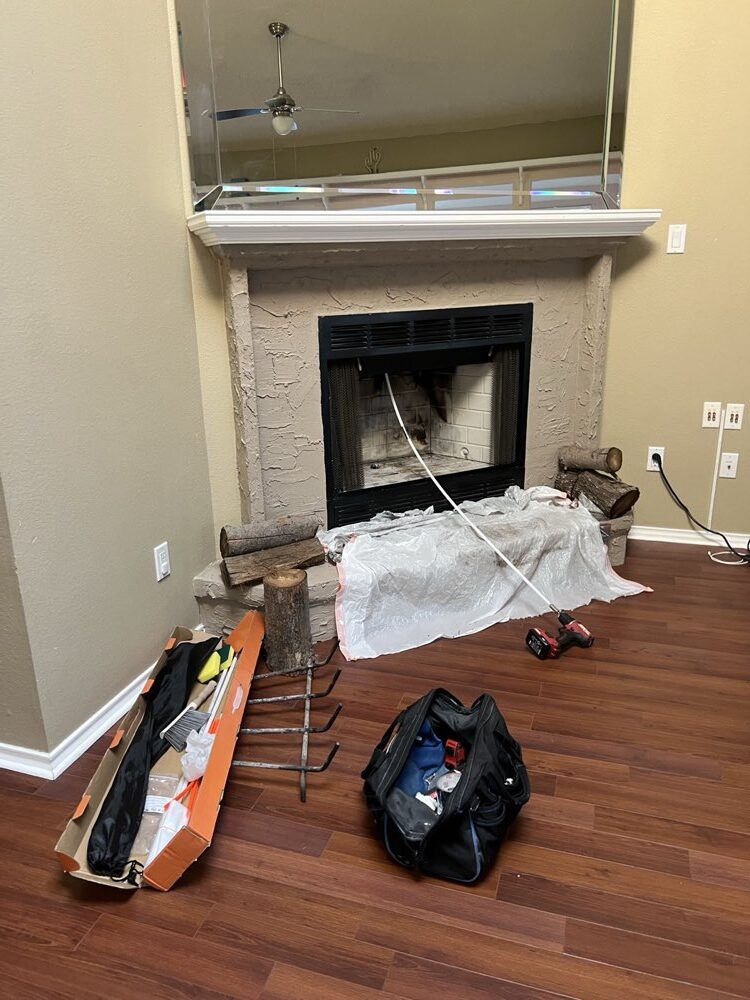
Firebox, damper, flue and the top of the chimney, photographed.
Photo report the same day
You see what we saw and decide what happens next.
COMMON QUESTIONS
Yes, and to Dalworthington Gardens as well. Both are their own towns sitting inside the Arlington city limits, which matters for your water bill and not at all for your chimney. It does change what we expect to find, since the housing in both runs older and more mixed than the Arlington streets around them.
Your yard is telling the truth. Arlington sits in the Eastern Cross Timbers, on sandy soil over the Woodbine formation, not on the black clay under Dallas. Sand settles rather than swells, and the shale mixed through the same formation still moves with moisture. Since the chimney stands on its own footing, it can drift away from a house that is sitting still. Photograph the gap now with something in frame for scale.
Not until somebody has been inside it. An unlined flue from that era can be perfectly sound, or it can have open joints running behind a bedroom wall, and the two look identical from the hearth. A camera settles it with pictures instead of opinion, and if lining is the answer, that is a solvable job.
One thing, and you cannot see it from the ground: the sheet-metal lid on top of the chase. Builder-grade lids are thin, they hold standing water instead of shedding it, and they corrode at the seams first. Add the cap and the flashing and that is the whole checklist for a newer Arlington chimney.
Two suspects, with different fixes. Houses of that vintage often pair a wide firebox with a stack that barely clears a shallow roof, which drafts poorly on still, humid evenings, and Interlochen sits on the water. The other suspect is a real restriction in the flue. A camera separates them in one visit, which saves paying for a sweep that was never going to help.
REQUEST A CALL BACK
A person calls you back about your chimney, not a dispatcher.
Which Arlington Building Push Built Your Chimney?
Tell us the street and the year and we will read the vintage, then photograph the part that vintage loses first.