
Chimney Sweep & Fireplace Service in Frisco, TX
Frisco counted 6,138 residents in 1990. Nearly every chimney in the city is sheet metal, sealant and framing lumber rather than brick and mortar, and it fails in ways brick never does.
LOCALLY BASED IN DFW
We drive to you, no national call center
WRITTEN PHOTO REPORT
Every finding shown before it is quoted
SAME-WEEK SCHEDULING
Booked in days, not weeks
OWNER-ANSWERED PHONE
The person who answers is the person who comes
A rust line down the siding of a chimney on a house that still feels new. A brown ring on the ceiling by the fireplace after a hard rain. Most Frisco calls are one of those two, and both begin at the metal lid on the chase.
The census counted 6,138 people in Frisco in 1990 and 200,509 in 2020, and essentially all of the housing went up inside that gap. The median Frisco house dates to around 2008. Nobody here worries about soft 1890s brick; they worry about why something built in 2011 is already staining a wall.
Local Chimney Experts has no long history in Frisco to point at, and inventing one is not on the table. What we put up instead is documentation: photos of what we find, before anything is quoted.
YOU SEE WHAT WE SEE
You cannot see your own chimney. That is the whole problem with this trade, and it is why people feel talked into things.
Every visit ends with photographs of what we found, walked through with you before anything is quoted. If the pictures show nothing wrong, that is the report you get.
- Camera up the flue, not a guess from the hearth
- Every finding photographed before it is quoted
- The same spots photographed again after the work
- Written report in your inbox the same day
What Frisco Was Built Out Of, and When
Frisco began as a railroad water stop. In 1902 the St. Louis and San Francisco Railway ran a line through this part of Collin County, and because Lebanon sat too high on Preston Ridge, the watering stop went in four miles west. People moved down to it, some dragging their houses on logs, and by 1904 the town had taken the railway’s nickname.
Then very little was built for ninety years. The census counted 6,138 people in Frisco in 1990, 33,714 in 2000, and 116,989 in 2010. The city’s own estimate now runs close to 248,000 across roughly 69 square miles, with buildout projected around 330,000.
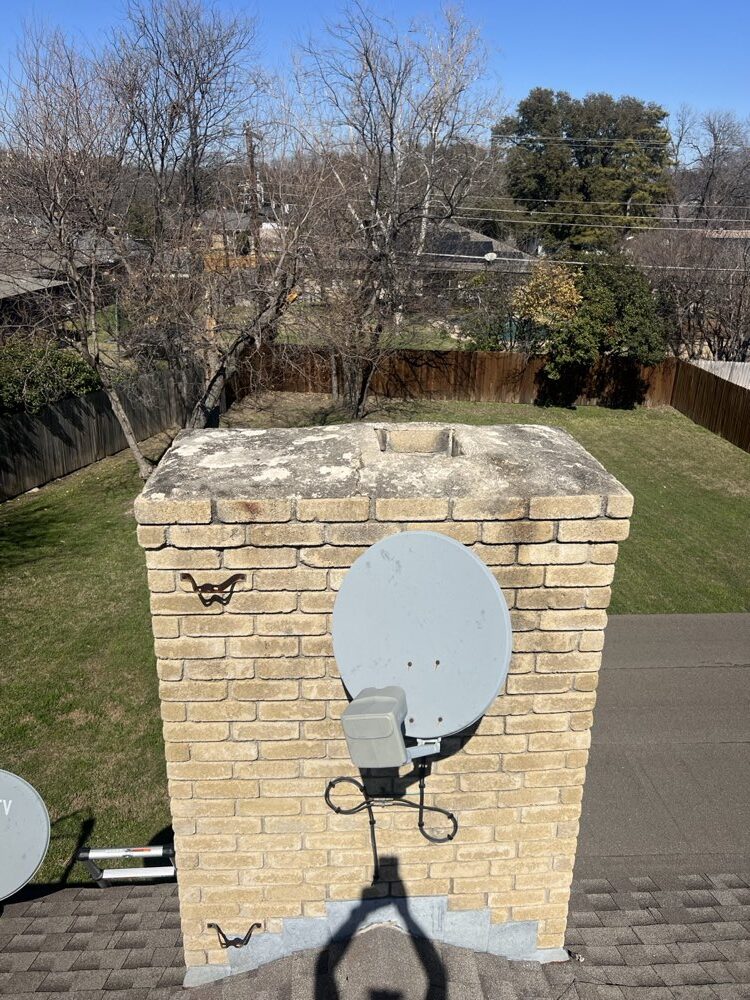
So the usual split between masonry and factory-built chimneys is not really a split in Frisco. It is a landslide. A true masonry chimney is brick, mortar, a poured crown and a clay tile liner on its own footing, and in Frisco that describes the old town center and almost nothing else.
Everything from the 1980s onward got a factory-built system: a steel firebox, a double-wall metal flue pipe, and a wood-framed box called a chase, wrapped in brick veneer or siding so it reads as a chimney from the street. The lid on top is a flat sheet of metal, not concrete.
Frisco is also still building, so there are two different jobs in the same city: brand-new systems whose only problem is a builder-grade part, and late-1980s ones now past thirty-five years, where the firebox itself is the question.
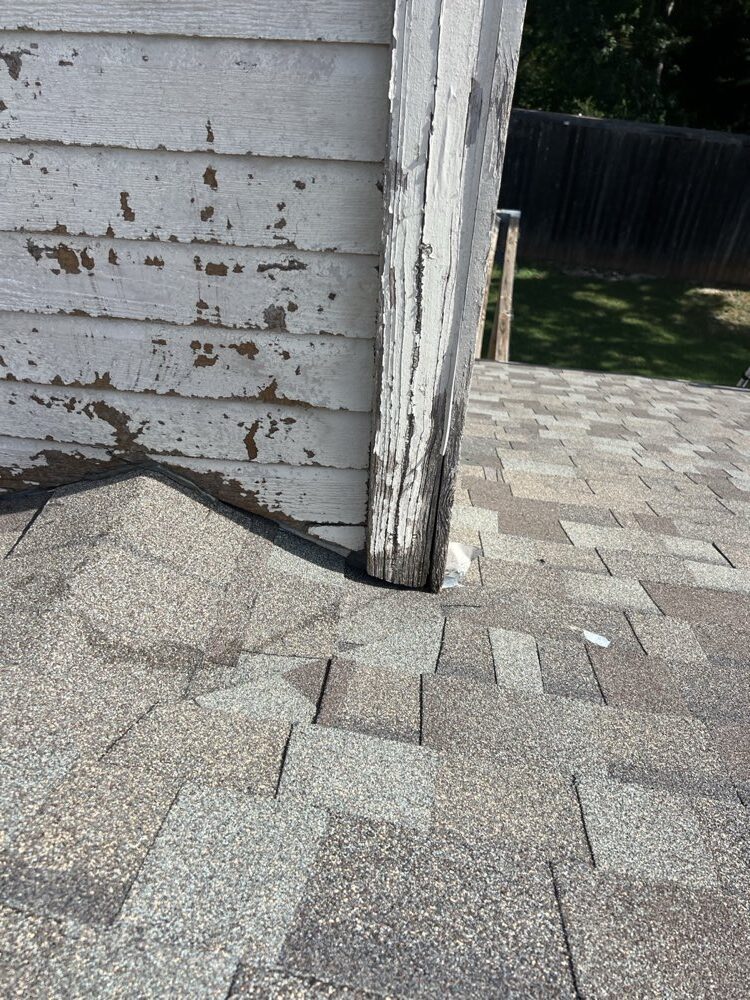
That rewrites the failure list. Frisco chimneys do not lose mortar joints, because they have none. They corrode. Sealant hardens and splits, galvanized steel pits and rusts through, flashing lifts, and water reaches framing lumber that has no business being wet. The damage is quiet, it starts at the top, and from the ground the chimney still looks like new brick.
Your Frisco Fireplace Has a Model Number on It
Because the stock is new, nearly every fireplace in Frisco is a listed factory-built appliance, and listed appliances carry a rating plate: a small metal tag riveted inside the firebox showing the manufacturer and the model number. On a century-old brick firebox there is nothing to read. In a Frisco firebox there almost always is.
That tag shapes the job. Refractory panels, doors, screens and flue components are made for one model, and a part that merely looks close is a different part. Photographing the plate is the first thing we do on a Frisco visit, because a recommendation without a model number is a guess.
You can look yourself: open the doors, take a flashlight, check the metal above the firebox opening. Send us a photo of that tag and we can tell you what you own before anyone drives out.
We Cover Frisco.
Tell us what you are seeing and we will tell you which visit it needs.
The Chase Cover Is Where Frisco Homes Lose Water
The chase cover is the metal lid closing off the top of that framed box, with a hole cut for the flue pipe. Across Frisco’s newer stock it is the part most likely to have failed first, because the builder-grade version is flat and galvanized.
Flat is the problem before rust is. Water that cannot run off sits in the middle of the sheet and works at the coating until it reaches bare steel. After that, every rain runs down inside the chase.
A replacement that lasts is not the same part again: measured to your chase instead of pulled off a shelf, folded from stainless, formed with cross breaks so it slopes from the center out, finished with a drip edge that throws water clear of the wall. What gets photographed most often on Frisco roofs:
- Ponded water and rust blooming from the middle of a flat cover
- Orange streaks on brick veneer or siding below the chimney top
- A cap with its screen torn out, or gone entirely
- Collar sealant cracked open and pulling off the flue pipe
- Soft or stained framing where the chase meets the roofline
In Frisco, the Neighborhood Dates the Chimney
Frisco filled in ring by ring, so the subdivision name is a fair first guess at what sits on your roof.
The Rail District, the old center along Main Street, is the only part of Frisco with genuinely old housing. The townsite was platted and auctioned in 1902, and some of what stands there predates the plat because it was moved in: the T.J. Campbell house at 7026 Main was built in Lebanon in 1869 and hauled to the new railroad town, making it the oldest home in Frisco. The 1917 house at 7110 Main and the 1927 Smith-Muse house come from the same short era. Own something there and you may have real brick, mortar and a clay-lined or unlined flue, which deserves a camera before anyone lights a fire.
Stonebriar is where the modern city starts. The club was founded in 1988 and houses filled in along the course through the 1990s, so those are among the oldest factory-built systems in town. Starwood, gated and roughly 550 acres, dates to 1996 with more than 900 custom homes.
Frisco Lakes, on the west side toward Lake Lewisville, is a different animal: Del Webb broke ground in 2006 on single-story, age-restricted homes, meaning low roofs, short chases, and owners with no business climbing up to check. Phillips Creek Ranch came to market in 2011 on the old B.F. Phillips ranch land, where a cover from 2013 is not old but its collar sealant is usually first to go.
Two Counties, One City
Frisco sits across a county line. Most of the city is in Collin County and the western edge runs into Denton County, which is why two Frisco neighbors can face different county offices and different burn ban notices in the same dry August.
City rules are the same in both halves. Frisco’s Building Inspections Division handles residential permits, and the city runs a self-service track for a short list of work, including a same-material re-roof. Chimney and chase work is not on that list, so when a job touches the roof structure we ask the city.
What We Handle in Frisco, and What We Hand Off
Sweeping, camera inspection, leak tracing and repair, on the masonry and venting side. On Frisco’s housing stock that mostly means chase covers, caps, flashing, firebox panels, dampers and liner work.
Gas is where we stop. Lines, valves and pilot assemblies belong to a gas fitter. If something on the gas side looks wrong, you get a photo and an instruction to call that trade.
An inspection fits a house you just bought, or one nobody has checked since the builder left. A sweep fits a firebox that gets used. Leak repair is where to start when the evidence is a stain.
Photos Before Quotes, Every Time
The company is new, which is why the work is built to be checked.
Every visit produces images: the inside of the flue, the top of the chase, the seam we believe is leaking, then the same frames afterward. You keep them whether you hire us or not. If your chimney is fine, that is the report. You talk to the technician on the phone, and the technician is who arrives at the house.
WHAT HAPPENS WHEN YOU CALL
You call or send the form
We ask what you are seeing or hearing. A person, not a queue.
We arrive and cover everything
Tarps down and the vacuum ready before a tool comes out.
Camera, brushes, eyes on all of it
Firebox, damper, flue and the top of the chimney, photographed.
Photo report the same day
You see what we saw and decide what happens next.
COMMON QUESTIONS
The metal ages, not the house. A flat galvanized chase cover can start pitting inside its first decade of Texas sun and hail, and the collar sealant splits on the same schedule. The upside is that a ten-year-old Frisco system usually has one small problem instead of five.
Look at the top. A masonry chimney finishes in a poured concrete crown that overhangs the brick and slopes away from the flue tile. A chase finishes in a flat metal lid, with screws or caulk visible at the edges. Send a photo and we will tell you which you own.
Both can be true. Water entering at the chimney top runs down inside the chase and shows up several feet from where it got in, so an inspection that stops at the shingles passes. A failed cover, lifted flashing and a cracked collar seal are three different jobs. Fixing the wrong one changes nothing.
It can. A dated photo report turns a suspicion into something you can hand over. We record the condition and put it in writing with images. We do not make warranty determinations or interpret your paperwork, but you get evidence with a date on it.
Not for the work itself. It can change which county burn ban applies to you, since Frisco city limits cross from Collin into Denton on the west side. Permits stay a city matter either way, through Frisco’s Building Inspections Division.
For the venting, the cap, the chase cover and the flashing, yes. For gas lines, valves and pilot assemblies, no, and we say so instead of opening something that belongs to a gas fitter. A gas unit still sends moisture up a metal flue, and the lid over it rusts on the same clock as the neighbor’s.
REQUEST A CALL BACK
A person calls you back about your chimney, not a dispatcher.
Is Your Flat Chase Cover Ponding Water?
We photograph the cover, cap and collar from your Frisco roof and send the pictures before anyone quotes a replacement.