
Chimney Crown vs Cap: What's the Difference?
One is a metal lid over the flue opening. The other is the concrete the whole top of the chimney is finished with. How to tell them apart from your driveway, and which one costs you if you wait.
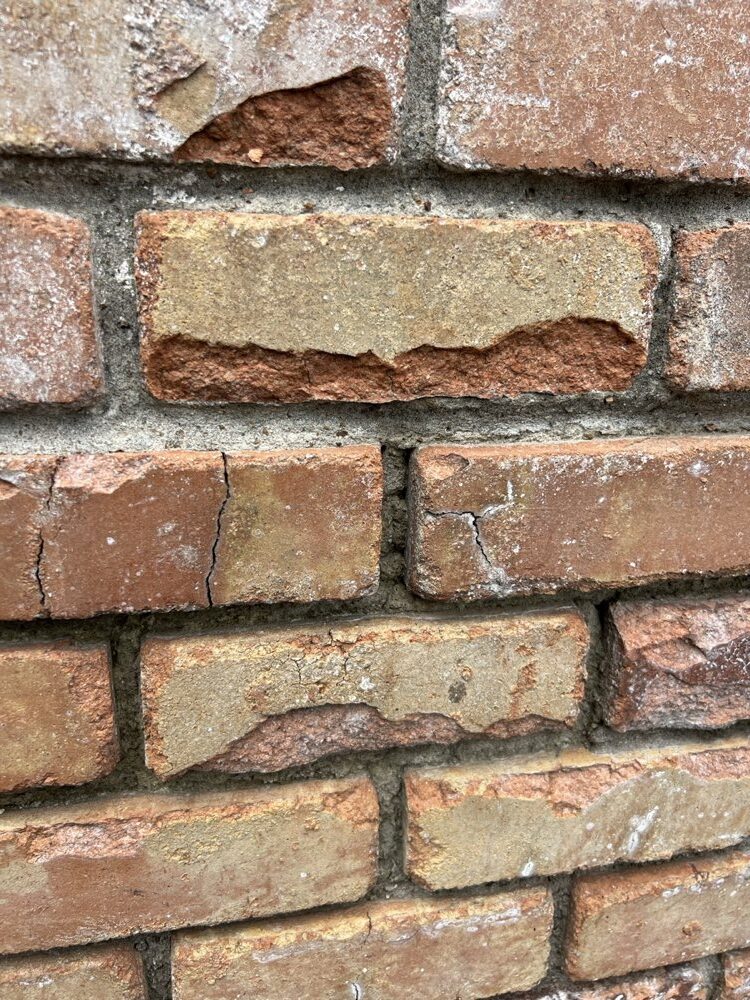
CAMERA INSPECTION
We look before we quote, every time
PHOTOS OF EVERY FINDING
No photo, no claim
MASONRY AND VENTING ONLY
Gas lines go to a gas fitter and we say so
SAME-DAY REPORT
In your inbox before we finish the day
Water is showing up in the firebox, or a rust streak is running down your brick, and somebody said the crown is cracked. Or was it the cap? Homeowners mix the two up constantly, and so do plenty of roofers.
Part of that is not carelessness. The residential building code calls the concrete a cap: its chimney termination language asks for a concrete, metal or stone cap with a drip edge and a caulked bond break around the flue liners. The metal lid people point at is filed a paragraph later under another name, spark arrestor.
Driveway version: the crown is what you have never looked at, the cap is what you see from the street. They fail on different clocks, and only one gets worse on its own.
YOU SEE WHAT WE SEE
You cannot see your own chimney. That is the whole problem with this trade, and it is why people feel talked into things.
Every visit ends with photographs of what we found, walked through with you before anything is quoted. If the pictures show nothing wrong, that is the report you get.
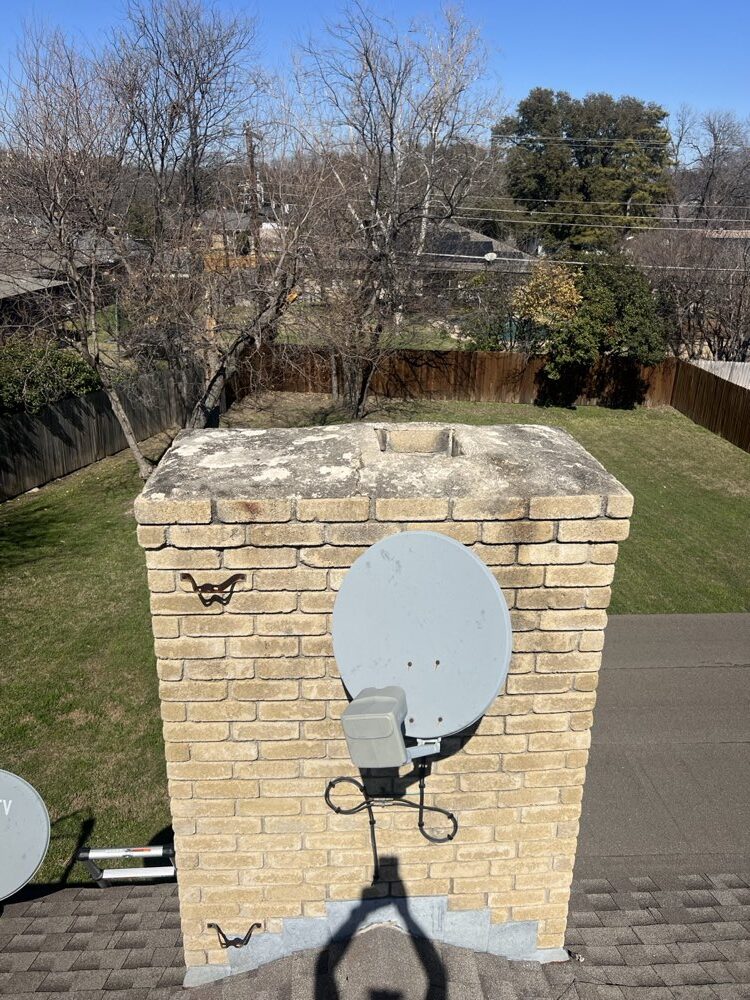
- Camera up the flue, not a guess from the hearth
- Every finding photographed before it is quoted
- The same spots photographed again after the work
- Written report in your inbox the same day
The Cap: The Metal Lid Over the Flue
A small metal roof on legs above the flue opening, mesh filling the four sides, so smoke leaves through the gap and everything else stays out. Usually galvanized steel, stainless, or copper.
How it holds on matters as much as what it is made of. A single-flue cap clamps to the clay tile above the concrete, so it is only as secure as that tile. A full-width cap spans the whole top, anchors into the brick, and keeps rain off the concrete.
- Keeps rain, leaves and animals out of the flue, the smoke shelf and the damper
- The mesh doubles as an ember screen on the evenings a fire is burning
The Crown: The Concrete Top of the Chimney
The crown is concrete cast over the entire top of the stack, from the flue tile out to the outer edges of the brick. Rain landing on it is meant to travel outward, leave the edge, and fall clear of the wall.
Nobody thinks about the volume. Airport climate normals put Dallas-Fort Worth at 37.01 inches of rain a year across roughly 79 days with measurable precipitation. Call a single-flue chimney top three feet by two and a half: that surface takes on the order of 170 gallons a year, steered off an area the size of a card table by shape alone.
Not Sure Which One Yours Has?
One photo from the roof settles it.
Crown Geometry: The Numbers a Good One Hits
A crown is geometry before it is concrete. ASTM C1283, the published practice for installing clay flue lining, sets out the shape, and the residential code points at it by name.
The detail nobody has heard of is the drip slot, a groove cut into the underside of the overhang. Water leaving a flat underside does not simply drop. It clings and travels back inward until it reaches brick, which is how a crown with a proper overhang still stains a wall.
The detail that fails most often is the bond break. The concrete is deliberately not attached to the flue tile. That joint stays open and gets closed with a resilient noncombustible sealant, never mortar. The liner takes the heat and grows, the crown sits in outside air and does not. Lock them together and the part that moves cracks the part that cannot.
- Thickness: two inches minimum, in real concrete rather than leftover mortar
- Overhang: two inches past the brick face, every side
- Drip slot: a groove underneath, an inch and a half back from the wall
- Slope: at least ten degrees of fall from tile to edge
- Bond break: an open, sealant-filled joint where concrete meets flue tile
- Tile height: clay lining no more than four inches proud of the concrete
Why a Skim-Coat Crown Fails, in Order
A large share of the crowns here are not crowns. They are a mortar wash: leftover mortar from the day the chimney went up, troweled across the top and feathered to nothing at the brick edge. It looks finished from the yard, and it fails in a fixed sequence.
One, shrinkage. Mortar is meant to be a thin joint between two bricks, not a slab bridging two feet of open air. Curing alone it splits, cracking outward from the tile where the material is thinnest.
Two, no bond break. The wash was troweled hard against the tile, so every fire expands the liner against that mortar and works those cracks wider from inside.
Three, no edge. A feathered wash dies flush with the brick face, so runoff never leaves the wall. It sheets down the front, which is where the long dark streaking comes from on chimneys that have never leaked indoors.
Four, delamination. Water now sits between wash and brick, and a thin coat has little grip, so it lifts in plates that turn up in the gutter and get read as roof debris.
That stage changes the repair: a flexible coating needs something solid underneath, and a lifted wash has only a void.
Cap Mesh: What the Numbers on a Spec Sheet Mean
The mesh does three jobs that pull against each other: catching embers, excluding animals, and staying out of the way of the smoke. Where a spark arrestor is fitted, the code gives numbers instead of adjectives. Open area at least four times the net free area of the flue outlet, so the mesh is never the tightest point. Openings small enough that a half-inch sphere will not pass, and large enough that a three-eighths-inch sphere will. Material matching the heat and corrosion resistance of 19-gauge galvanized steel or 24-gauge stainless.
That window is tighter than what gets sold. Three-quarter-inch mesh, common on lids sold on animal exclusion, passes a half-inch sphere without touching the sides, so it is an animal screen and not an ember screen. Go the other way into insect screening and you buy a different failure: fine mesh over a wood-burning flue loads with creosote, and a loaded screen strangles the draft. The symptom is smoke leaning into a room on a fireplace that used to pull fine.
What You Can Settle From the Ground
Stand where the chimney top shows against open sky rather than the roof behind it, zoom your phone all the way in, and take three frames: straight on and one from each side. Read them sitting down.
Three things stay hidden however good the photos are: fine surface cracking, invisible edge-on from sixty feet and exactly the stage where a coating still works; whether the joint at the flue tile is open or was packed solid; and whether a drip groove was ever cut underneath. Those are what a chimney inspection is for.
- A shadow line under the concrete edge means a real overhang. Concrete dying flush with the brick means a wash, and the streaking below it is the proof
- Tile standing much more than a hand's width proud means a clamp-on cap is working on a long lever every time the wind gets up
- A blank side where mesh should be, or a corner torn open by a squirrel, means the flue is either choked or no longer closed
- Rust streaks that begin at the cap date the problem to the metal, because the stain starts where the corrosion is
- White chalky staining on upper brick is mineral left as water moved through masonry and dried. It proves water got in without saying where
The Crown Is the Expensive One to Ignore
A missing cap sends water down one opening, on a known path: flue, smoke shelf, damper, firebox. Real damage, but self-announcing. You find water in the firebox after a storm, or a damper that will not swing, and you go looking.
A failed crown has no single path. It puts water into the top of the structure itself, across the whole footprint, into brick and joints and the space around the liner. None of that shows in any room of your house, so by the time something reaches a ceiling the problem is measured in years. If both need doing, the crown goes first, because a full-width cap sits on that concrete.
When This Is Not a Crown or Cap Problem
A ceiling stain beside the chimney with a dry firebox usually points at the flashing where the chimney meets the shingles, not at something two feet higher. A crown throws water outward. Flashing handles what the roof delivers sideways into the wall.
A chimney wrapped in siding with a flat metal top has no crown at all. It has a chase cover, a sheet-metal pan that fails by rusting through at the low spot, not by cracking.
Staining below a sound crown and sound flashing means the wall itself is drinking, which is a repointing and water-repellent question. The gas side of a fireplace, valves, burners and lines, is not ours.
Waiting is sometimes right. A crown holding its shape, overhang intact, joint at the tile open, showing only fine surface lines, is a watch item: photograph it from the same spot each spring and compare. What does not wait is a crown with pieces gone, a flue joint packed solid, torn mesh, or any open path into the chimney.
How We Handle Each One
If the lid is finished, chimney cap replacement is usually a same-visit fix, in stainless, sized off a measurement taken on the roof. If the concrete is the problem, chimney crown repair splits on the question this page keeps returning to: is there still a solid slab to bond to. If yes, it gets cleaned, filled and coated. If no, the failed material comes off and a new one is formed with the overhang, groove, fall and bond break the original never had.
WHAT HAPPENS WHEN YOU CALL
You call or send the form
We ask what you are seeing or hearing. A person, not a queue.
We arrive and cover everything
Tarps down and the vacuum ready before a tool comes out.
Camera, brushes, eyes on all of it
Firebox, damper, flue and the top of the chimney, photographed.
Photo report the same day
You see what we saw and decide what happens next.
COMMON QUESTIONS
Every masonry chimney should. The concrete is built with the structure, the metal lid is added afterwards, which is why so many chimneys are missing the second and almost none the first. A prefab metal chimney has neither. It gets a chase cover.
No, and filling it is a common well-meant mistake. That gap is a bond break and it is deliberate. The tile heats up when you burn and expands, the concrete around it does not, and the gap lets them move independently. Packed solid, the expanding tile cracks the crown instead.
Where a spark arrestor is fitted, the requirement is an opening a half-inch sphere will not pass but a three-eighths-inch sphere will, with open area at least four times the flue outlet. Three-quarter-inch mesh keeps animals out but passes a half-inch sphere easily, so it is not an ember screen. Much finer clogs with creosote and costs you draft.
You can settle whether the concrete overhangs the brick or dies flush, whether pieces are gone from the edges, and whether the brick below is streaked or chalky. You cannot see fine cracking, whether the joint at the tile is open or mortared solid, or whether a drip groove was ever cut.
Nothing falls over tomorrow. The reason to move anyway is that this is the one part up there whose repair category changes while you wait. Cracking in concrete that still holds its shape is a clean and a coating. Once it has lifted off the brick there is nothing to bond to.
It comes down to the metal and the fasteners rather than the years. Galvanized is mild steel under a zinc coat, and once that coat is scratched, rust starts and runs down your brick. Stainless and copper outlast whatever they are bolted to, and a lid held by two screws into clay tile tends to leave in a storm regardless.
Please do not. Tar hides everything under it, hardens through a couple of Texas summers, splits, then holds water against the concrete inside the split. You end up with the original crack still working plus a layer that has to come off first.
REQUEST A CALL BACK
A person calls you back about your chimney, not a dispatcher.
Not Sure Which One You Are Looking At?
Send a photo from the driveway, zoomed all the way in. We can usually tell you whether you have a crown, a wash, or a lid on its last winter.