
Fireplace and Firebox Repair in Dallas-Fort Worth
Cracked firebrick, open mortar joints, worn refractory panels. How to tell a surface line from a moving wall, and what the repair involves.
CAMERA INSPECTION
We look before we quote, every time
PHOTOS OF EVERY FINDING
No photo, no claim
MASONRY AND VENTING ONLY
Gas lines go to a gas fitter and we say so
SAME-DAY REPORT
In your inbox before we finish the day
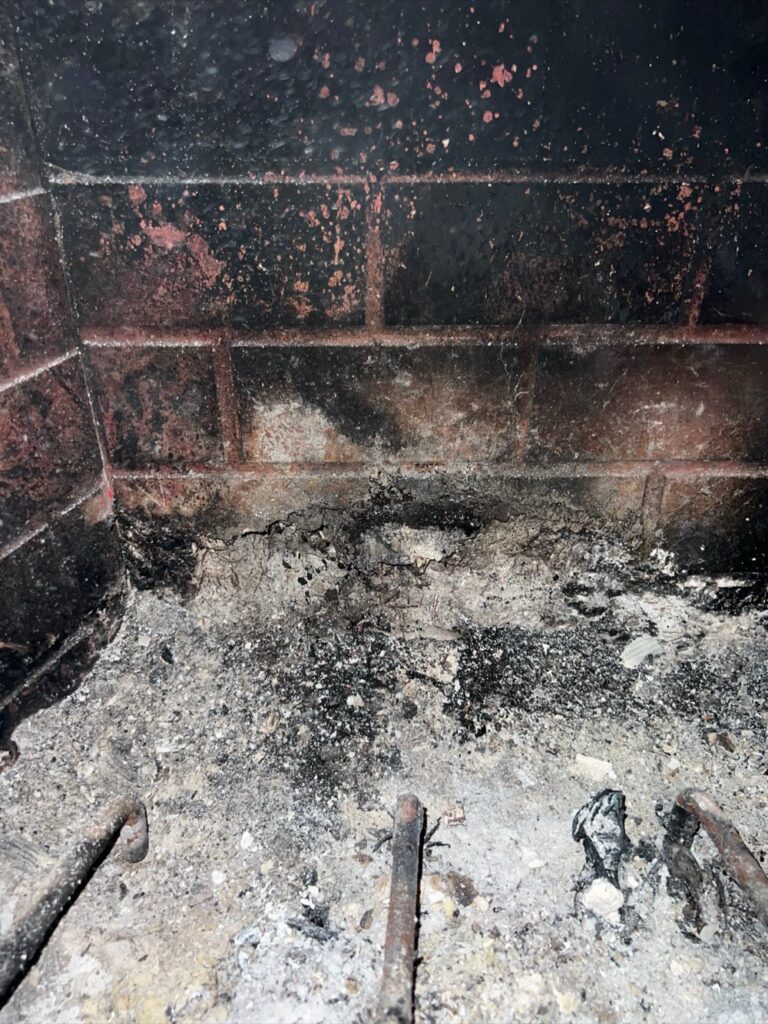
Firebox repair starts with one question: is the damage cosmetic or structural? Open the screen and look at the walls of your fireplace. That box of brick is the firebox, and it takes the direct hit from every fire you burn. In North Texas homes we see the same two problems over and over: cracked firebrick and mortar joints that crumble into sandy powder on the fireplace floor.
It looks cosmetic. It usually is not. The firebrick and the mortar between them are all that stands between a live fire and the wood framing inside your wall. A gap the width of a credit card gives heat a direct path to lumber never meant to feel it.
A firebox is also a place where you can be told almost anything, because whoever is talking holds the only flashlight. This page hands it back: how the box is built, how it fails, what you can check yourself, and what the repair involves.
YOU SEE WHAT WE SEE
You cannot see your own chimney. That is the whole problem with this trade, and it is why people feel talked into things.
Every visit ends with photographs of what we found, walked through with you before anything is quoted. If the pictures show nothing wrong, that is the report you get.
- Camera up the flue, not a guess from the hearth
- Every finding photographed before it is quoted
- The same spots photographed again after the work
- Written report in your inbox the same day
What Is Actually Behind Those Bricks
A masonry firebox is not one wall but a stack of layers, each with a separate job.
The face you see is firebrick, a dense clay brick made to sit against flame without breaking down. Residential building code calls for that lining to be at least two inches thick, laid in medium-duty refractory mortar, with joints no wider than a quarter inch. Behind it sits ordinary solid masonry, and lining plus backup together are meant to give eight inches of wall front to back.
Then comes the layer nobody mentions: air. Code holds wood beams, joists and studs back two inches from the front face and sides of a masonry fireplace, four inches from the back, and that space is supposed to stay empty. Not packed with insulation, not filled in during a remodel.
So the margin is brick, mortar, masonry, air. The firebrick is the wear surface and does the least structural work of the four, which is why a cracked brick face and a shifted wall are different findings even when both photograph as one dark line.
Heat, Water, and Soil: Where the Cracks Come From
Light a fire and the firebrick face climbs to several hundred degrees in minutes while the masonry a few inches behind barely moves. The hot face wants to expand, the cool backup will not let it, and something has to absorb the difference. Refractory mortar is the softer material by design, so the joint takes the strain instead of the brick splitting.
The trouble is repetition. A short burn season here means fewer cycles a year than a house up north racks up, but the cycles are not gentler, and a firebox built in one of this region’s booms has been through several hundred. Mortar that absorbs that strain enough times stops springing back and turns to sand.
Two other things wreck fireboxes, and neither is your fires. Water is first. If rain is getting down the flue, firebrick drinks it while the fireplace is cold, and the next fire turns that trapped moisture to steam inside the brick. Steam leaving a brick takes the face with it. Brick flaking in thin layers, with chalky white streaking nearby, is reporting a leak higher up rather than anything about how you burn.
Movement is second. A masonry fireplace stands on its own footing, at least a foot of concrete or solid masonry extending past the fireplace on every side, separate from the slab under the rest of the house. On the clay here, two foundations under one roof are under no obligation to move together, and the firebox is where that disagreement shows up as a straight line through brick. Our roughly twenty-nine freezing nights a year punish the outside of a chimney. The firebox lives indoors, and what reaches it is heat, water, and soil.
Gaps In The Firebox Joints?
Where the fire lives is the last place to leave a gap.
Cosmetic or Structural: Reading Your Own Firebox
Wait until the fireplace has been cold for a day, take a bright flashlight, and hold it almost flat against the wall instead of aiming straight in. Raking light throws a shadow into anything open, which is how a hairline separates itself from a joint you could lose a coin in. Give the back corners the most time: they flex more than the rest of the box and are hardest to see.
- Fine cracks that stop where the brick stops: surface crazing, cosmetic. Rules out movement, since a shifting wall does not end politely at the edge of a brick.
- A line crossing several bricks and continuing through the joints: the wall has moved. Structural until proven otherwise, and the issue is the footing, not the fires.
- A joint that takes a fingernail or a card edge: the mortar is gone, not merely tired. This is the finding that ends your burn season early.
- Grey sandy powder on the floor after every fire: refractory mortar giving up. Rules in repointing, rules out a cleaning.
- A gap where the back wall meets a side wall: the two walls are no longer one box.
- Faces peeling in layers with chalky streaks nearby: water, not heat. Replace the brick without fixing the water and the new brick goes the same way.
- Scorch marks or hot spots outside the opening: heat is reaching somewhere it should not. Stop burning and get a chimney inspection.
- Soot spreading up the wall above the opening, brick inside sound: a draft problem, not a firebox one.
GET A LOOK BEFORE IT SPREADS.
If your flashlight found a line crossing several bricks, a joint that takes a card edge, or grey powder after every fire, tell us what you saw.
Masonry Repair, and What Makes One Job Bigger
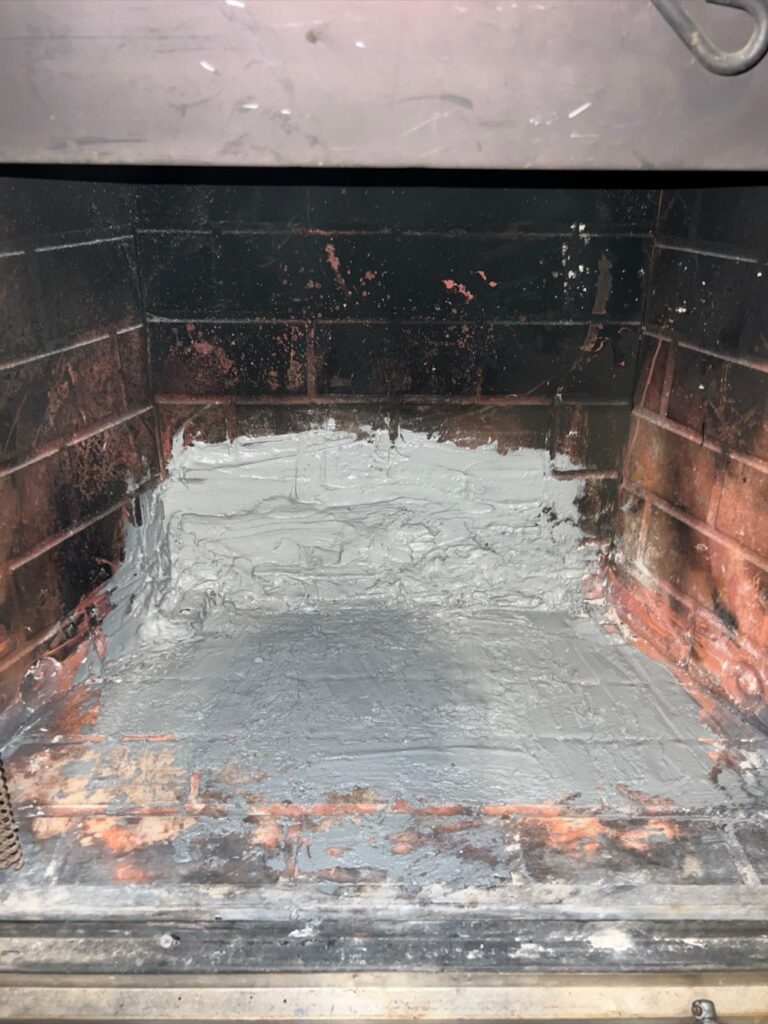
The work runs in a fixed order. The fireplace comes out cold and empty, ash vacuumed off so the real surface is visible. The brick gets sounded, tapped along the face, because a brick that rings is still keyed to the wall behind it and one that thuds has already let go. Failed joints are raked out to depth rather than scraped, since fresh mortar over crumbling mortar fails on the same schedule the old joint did. Cracked bricks come out one at a time and sound brick stays. Refractory mortar goes in packed rather than smeared, and each joint is tooled to shed instead of catch.
What makes one job bigger is rarely the number of cracks. It is these four.
Depth. Damage confined to the brick face is a repair. Damage that has opened a path through the lining to the masonry behind means the wall gets opened.
Which wall. The back runs hottest and has only four inches of air between it and framing. Side wall work is lighter.
The throat. The damper frame sits in the throat with chimney masonry bearing directly on it, so pulling that frame is a different order of work from swapping a firebrick. Where a damper has failed too, fitting a new one at the top of the flue is often cleaner than opening the throat, and the damper itself is quoted separately.
Where the damage stops. If cracking carries on above the damper, this is no longer a firebox job. The smoke chamber above it is repaired differently and checked with a camera, not a flashlight.
One last thing homeowners are rarely told: refractory mortar has to dry before it meets heat. Some products call for a week or more of air drying, then a small first fire held low before any normal burn. Skip that and water still in the joint turns to steam and cracks the repair you just paid for.
Prefab Fireboxes: When the Panel Is the Firebox
Many homes here have a factory-built fireplace: a metal unit lined with grey panels molded to look like stacked brick. Those panels are the firebox. There is no firebrick and no joint to repoint, and the panels are bracketed in as a replaceable wear part.
The useful thing about panels is that the replacement threshold is measurable rather than a matter of opinion. The trade works from about a sixteenth of an inch of crack width, and the field test is whether the edge of a nickel starts into the crack. A panel worn roughly a quarter inch down from its face is finished as well, even with no crack in it, and so is one shedding chunks. Anything shallower is the crazing a panel is expected to develop. Panels are one part of a factory-built system, and the rest of it ages on its own timetable.
When a Firebox Is Not Your Problem
A fair amount of what gets called firebox damage belongs somewhere else. Smoke pushing into the room while the brick looks sound is a draft question. Orange or sandy grit on the hearth is usually clay flue tile coming apart above you. Rust flakes and grey dust point at a factory-built unit taking water from the top. Cracking that runs out through the outer brick of the stack is fireplace repair on the structure, not liner work inside the box. Gas piping, valves and burners belong to a gas fitter; our work is masonry and venting.
Waiting is sometimes the honest answer too. Fine crazing on the face, no open joints, no line through the mortar, and it is July with no fires planned until the weather turns. Book that ahead of the first cold snap rather than tonight. What does not wait is an open joint, a gap at a corner, or heat on the wrong side of the brick.
We Photograph the Corners Where Cracks Hide
A homeowner cannot easily verify what happened inside a firebox, and that blind spot is where a quote drifts from honest to invented. We are new in Dallas-Fort Worth and we know it, so the answer is documentation.
- Every crack and open joint close up, plus the back corners lit from the side, before anything is quoted
- The raked-out joints before new mortar goes in, and the same angles after
- The full set is yours to keep, including for a second opinion elsewhere
WHAT HAPPENS WHEN YOU CALL
You call or send the form
We ask what you are seeing or hearing. A person, not a queue.
We arrive and cover everything
Tarps down and the vacuum ready before a tool comes out.
Camera, brushes, eyes on all of it
Firebox, damper, flue and the top of the chimney, photographed.
Photo report the same day
You see what we saw and decide what happens next.
COMMON QUESTIONS
No. Standard mortar and caulk break down quickly next to open flame, and a failed patch can hide a gap still open behind it. Firebox joints need refractory mortar made for direct fire contact, a different product rather than a stronger version of the same one.
Hairline surface cracks are usually fine to burn on while you schedule a look. Open joints, deep cracks, or missing mortar are not, because heat moving through those gaps reaches framing you cannot see. If a card edge slides into a crack, stop burning until it is repaired.
Yes, and it matters more. Heat damage tends to stay inside one brick and stop at its edge. A line carrying on through the joints and across a run of bricks means the wall itself has shifted, which points at the fireplace footing and the soil under it rather than at your fires.
A molded panel, usually grey with a brick pattern, lining a factory-built fireplace. The panels take the heat so the metal shell and the framing never touch flame. They are a wear item, like brake pads, made to be swapped when they crack or wear thin.
Usually not, and there is good reason to leave it alone. The damper frame sits in the throat with chimney masonry bearing down on it, so removing it is heavier work than the brick around it. Where a damper has genuinely failed, fitting a new one at the top of the flue is often cleaner than opening the throat.
Panel replacement is one visit once the right panels are in hand. Refractory mortar work is usually one visit too, but the mortar needs time to cure before your first fire, and we leave you that exact wait in writing.
Yes, once before your first burn. Fireboxes crack from house movement and moisture, not only from fires, and North Texas clay keeps both in play. A short visit with a flashlight and a camera tells you whether it is ready.
REQUEST A CALL BACK
A person calls you back about your chimney, not a dispatcher.
Show Us Your Firebox
Text over a shot of the cracked brick, or book a visit anywhere in Dallas-Fort Worth. You reach the technician directly, and you keep the pictures either way.